Greetings from Q Magnets!
Most people imagine medical breakthroughs happening in sophisticated laboratories.
Scientists in white coats.
Years of research.
A paper published in a prestigious journal.
Occasionally that’s exactly how it happens.
But many advances begin much more quietly.
With a conversation.
An observation.
Or simply one person asking...
“I wonder what would happen if…”
That question has probably changed medicine more than almost any other.
Earlier this year I wrote about one of my favourite expressions: Strong Opinions, Loosely Held.
It’s a reminder that conviction and curiosity can coexist. We should have the confidence to form opinions, but the humility to change them when better evidence or experience comes along.
To me, that’s one of the defining characteristics of a good clinician.
Not someone who thinks they know everything.
Someone who never stops asking questions.
One story that has stayed with me for many years is how Dr Robert Holcomb first became interested in using magnetic fields for pain.
Dr Holcomb was already a medical doctor with a PhD in pharmacology and training in microbiology. He wasn’t just focused on pain management. He was investigating the use of magnetic fields in water treatment and was intrigued by some of the effects he was observing.
Then came a simple question.
“I wonder if magnetic fields could influence pain?”
Rather than dismiss the thought because it sounded unconventional, he decided to test it.
Drawing on his understanding of magnetic field gradients, he created what became the first quadrupolar magnetic arrangement and applied it to a patient suffering from lower back pain—a police officer.
To his surprise, the patient reported that his pain had completely disappeared while the magnet was in place.
Whether that moment represented the beginning of an entirely new field or simply the start of a much longer journey, Dr Holcomb recognised something important.
There was enough evidence to keep asking questions.
Sometimes that’s how innovation begins.
Not with certainty.
With curiosity.
Over the past twenty-five years, I’ve found myself asking exactly the same questions.
After hearing from thousands of people who have used Q Magnets, and after hundreds of conversations with physiotherapists, chiropractors, acupuncturists, doctors and other health professionals, there are still times when I catch myself wondering...
“Is this really happening?”
Not because I doubt people’s honesty.
Quite the opposite.
Some of the feedback is so remarkable that it deserves to be questioned.
And every time I begin to question myself,, another credible practitioner contacts me with another carefully observed clinical experience.
Not grand claims.
Not marketing hype.
Just thoughtful observations from people whose job is to help patients every day.
Those conversations have shaped my thinking far more than any advertisement ever could.
This weekend I’ll be attending the AACMA Conference, where acupuncturists from across Australia will gather to share ideas, challenge assumptions and discuss what they’re seeing in clinical practice.
I’m looking forward to the presentations.
But if history is any guide, some of the most valuable learning won’t happen in the lecture theatre.
It will happen over coffee.
In the exhibition hall.
Or during a casual conversation where someone quietly says...
“Have you ever tried this?”
Medicine has always advanced that way.
One observation.
One conversation.
One clinician willing to ask a better question.
Recently, another physiotherapist shared an observation that challenged some of my own assumptions.
He admitted he wasn’t getting consistent results with Q Magnets. Some patients improved dramatically, while others seemed to gain little benefit.
Rather than dismiss the technology, he began asking why.
Was it the diagnosis?
The placement?
The type of pain?
Or something else entirely?
That conversation has already prompted some fascinating discussions about Adjunct Placements and how they may influence outcomes in more complex cases.
We’re continuing to explore those ideas together, and once we’ve gathered a little more clinical experience, I’ll share the full story in a future MagnaBlog.
I think you’ll find it just as interesting as I do.
One of the lessons I’ve learned over the years is that medicine doesn’t move forward because someone insists they’re right.
It moves forward because someone remains curious enough to keep asking questions.
Sometimes the biggest breakthroughs don’t begin with a breakthrough at all.
They begin with two simple words.
“I wonder…”
Until next time, stay curious and stay well,
James Hermans
and the Q Magnets Team
Weekly Reframe
“The important thing is not to stop questioning. Curiosity has its own reason for existing.” — Albert Einstein
Perhaps the greatest innovations in medicine don’t come from people who think they have all the answers.
They come from those who never lose the courage to ask the next question.
Featured Article
Why Pain Becomes Chronic And Why Early Treatment Matters

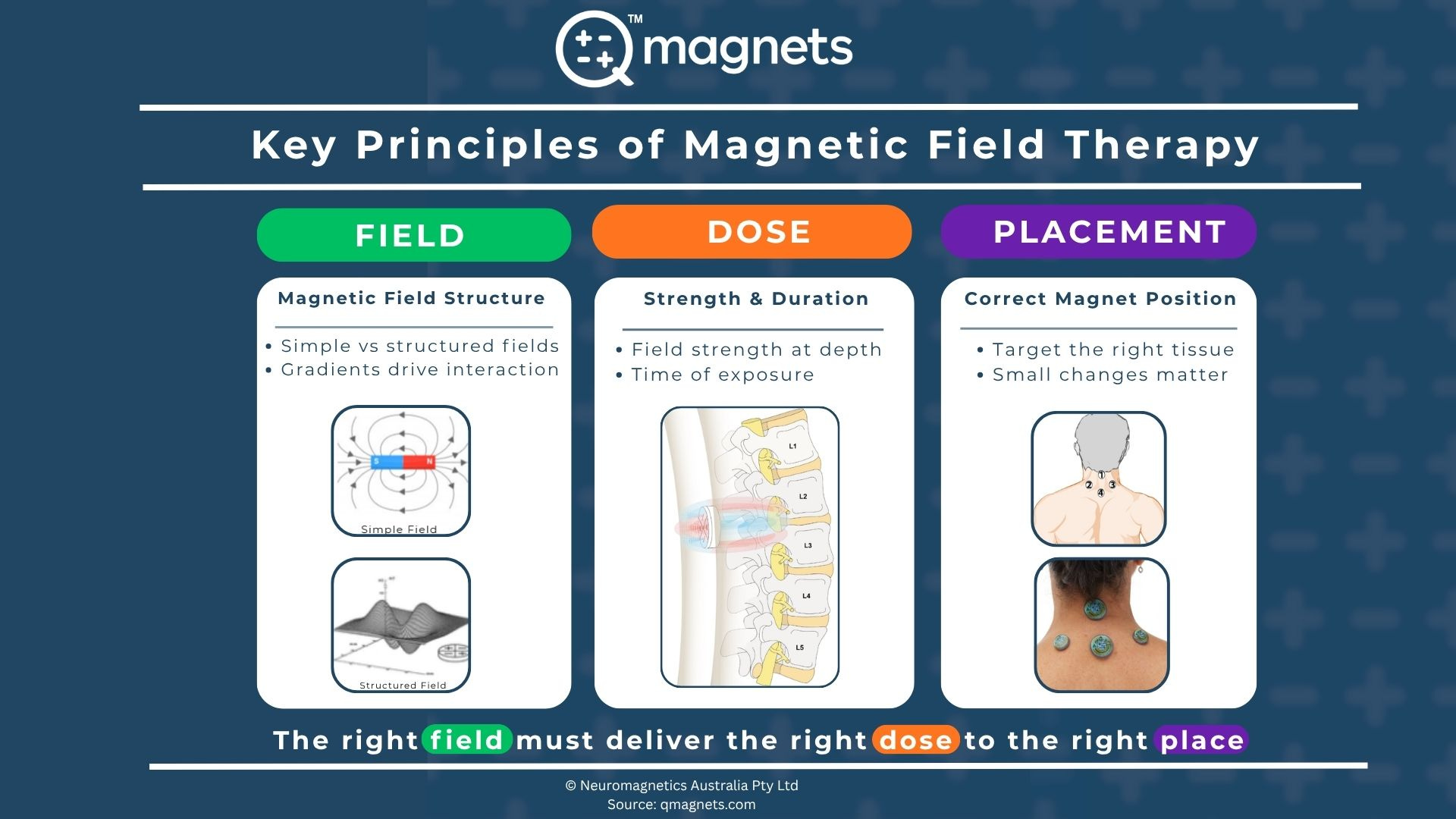
Field, Dose and Placement in Magnetic Field Therapy
Magnetic Therapy