Hope you had a pleasant Easter last week.
Later this month, I’ll be in Denver for the American Academy of Medical Acupuncture Symposium.
If there’s one thing I’ve learned from these events, it’s this:
The real divide in medicine isn’t between “believers” and “sceptics”.
It’s between those who are closed… and those who are open enough to explore.
At a recent medical acupuncture conference, something unexpected happened.
A doctor stopped at our stand. She had never come across static magnetic therapy before. No pre-formed position. No rehearsed scepticism. Just curiosity.
We spoke briefly. Mechanisms. Clinical observations. Field gradients. Placement.
And then she said something that stayed with me:
“A doctor’s position should be strong opinions, loosely held.”
What Does That Actually Mean?
It sounds simple. It isn’t.
It goes to the core of how medicine either evolves… or gets stuck.
Strong opinions → you need a working model
Loosely held → you must be willing to update it
Without strong opinions, you drift.
Without flexibility, you calcify.
Good clinicians operate in that narrow space between conviction and humility.
The Problem With “Settled” Thinking
In a previous MagnaBlog 👉 Why Is Magnetic Therapy Still Dismissed we explored why certain ideas are dismissed prematurely.
Not because they’ve been thoroughly disproven…
…but because they sit outside the current model.
History is full of examples:
When Being Right Looked Wrong
Dr. Ignaz Semmelweis was ridiculed for suggesting doctors wash their hands
Dr. Barry Marshall drank bacteria to prove ulcers weren’t caused by stress
Both challenged prevailing assumptions.
Both were dismissed.
Both were eventually proven correct.
Modern Medicine Still Faces the Same Trap
We like to think those days are behind us. They’re not. They’ve just evolved.
Today, the resistance doesn’t always look like open hostility. It often shows up as:
“There’s no evidence”
“That’s not how biology works”
“It’s been debunked”
But when you look closely, what’s often missing is not evidence…
…it’s a framework that can accommodate the evidence.
Where Magnetic Therapy Sits
Most therapy devices operate by delivering energy into tissue.
Static magnetic fields are different, they establish a persistent field environment, within which biological processes occur.
Because the body itself is an electrical system, many of these processes are sensitive to physical fields, particularly ion movement, membrane behaviour, and vascular regulation, which operate close to functional thresholds.
Within this environment, subtle shifts can occur:
ion movement can be influenced
membrane dynamics can change
signalling thresholds may shift
On their own, these effects are small.
But biology doesn’t always respond in a linear way.
When systems are operating near thresholds, as they often are in pain and injury even small influences can alter outcomes.
Why This Creates Friction
If you approach magnetic therapy expecting:
a dose-response curve like a drug
a universal outcome
a single mechanism
…it will look inconsistent.
But if you approach it as:
…it starts to make more sense.
The Outcome That Matters


“Qmagnets are non-invasive easy to use and I believe I’d be in a wheelchair without them.” — Jan, 86
Daily movement felt manageable again
“The constant pain and aches just saps all your energy, so I can still garden drive and keep reasonably active”
“Walking and gardening are still part of my life”
Felt more mobile and independent
Less pain and fatigue
Easy, non-invasive support
Still Walking. Still Gardening
Less daily discomfort
Able to keep walking and gardening
Felt more independent
Support she could rely on
Energy to continue what she loves
Full Testimony
Back pain previous surgery, perhaps a lot of arthritis I had used the previous quadrupole magnets 30+ years ago so I knew that they worked. I now have several of the Q magnets plus the sleep Matt I use the magnets sometimes three on my back and occasionally on my knee. When position correctly the relief is almost instant without them, I would not be able to function.. walking Gardening would really be impossible.
Non-invasive easy to use and I believe I’d be in a wheelchair without them. The constant pain and aches just saps all your energy.
So I can still garden drive and keep reasonably active. — Jan, 86. From Sydney
Strong Opinions, Loosely Held. Applied
The doctor at the conference didn’t accept or reject magnetic therapy on the spot.
She did something far more useful:
She left the door open.
Because progress in medicine rarely comes from:
blind acceptance
rigid dismissal
It comes from structured curiosity.
A More Useful Question
Instead of asking:
“Does magnetic therapy work?”
A better question might be:
“Under what conditions might a magnetic field influence biological systems?”
That’s a very different mindset.
And it’s one that leads somewhere.
Final Thought
The most dangerous position in medicine isn’t skepticism.
It’s certainty.
Because certainty closes the loop.
And once the loop is closed… nothing new gets in.
Until next time, stay curious and stay well,
James Hermans
and the Q Magnets Team
Featured Articles
Are the Dinosaurs of Medicine the Innovators or the Sceptics?
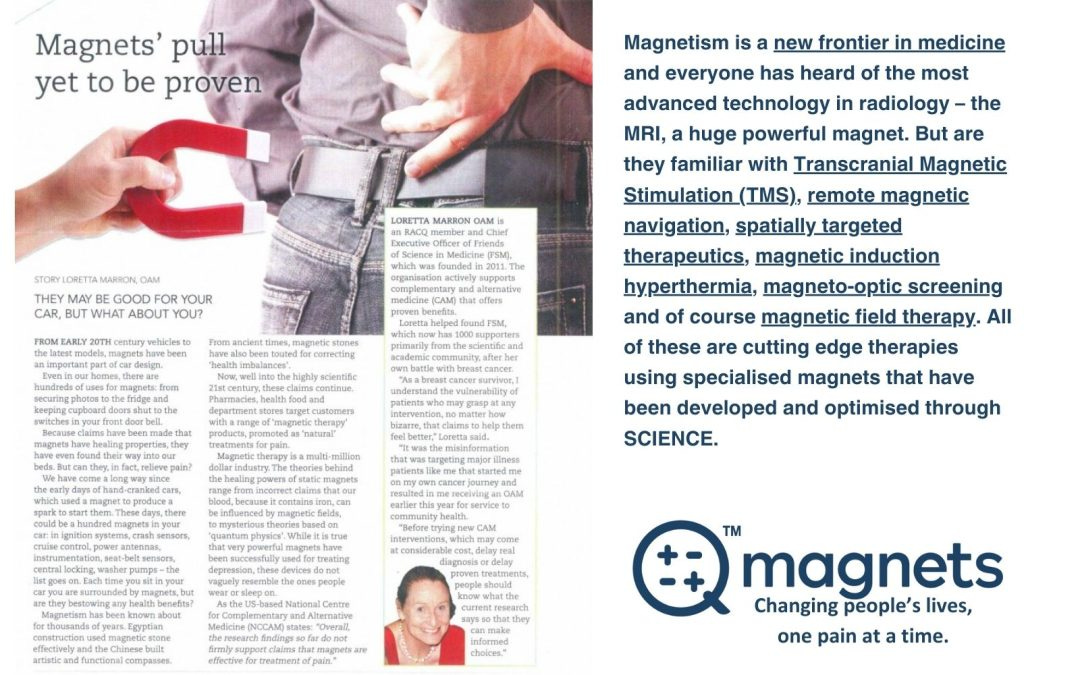
Response to RACQ magazine “The Road Ahead” article on magnetic therapy.
Why Pain Becomes Chronic And Why Early Treatment Matters