Greetings from Q Magnets.
One of the most interesting observations we’ve made over more than 20 years of working with Q Magnets is this:
Occasionally, someone will tell us,
“The magnet worked brilliantly at first... then it seemed to stop working.”
It’s a perfectly reasonable conclusion.
After all, people using other therapies sometimes experience exactly that.
For example, users of TENS machines may notice that the familiar tingling sensation becomes less obvious with continued use. The medical term for this is accommodation, where the nervous system becomes less responsive to a constant stimulus.
So it’s understandable that someone using Q Magnets might wonder whether the same thing has happened.
But before concluding that your body has “got used to” the magnet, we’d encourage you to ask a much simpler question.
Has anything changed?
Sometimes the Magnet Hasn’t Changed... Its Position Has
This is something we see most often with lower back pain.
Unlike a shoulder, elbow or knee, you can’t easily see the magnets on your own back.
They may have been removed after showering.
The adhesive might have loosened.
A partner may have replaced the magnet after cleaning the skin.
Or the magnet simply rotated or moved a few millimetres without anyone noticing.
Most people would never think that such a small change could matter.
Yet over the years we’ve seen enough examples to know that it sometimes does.
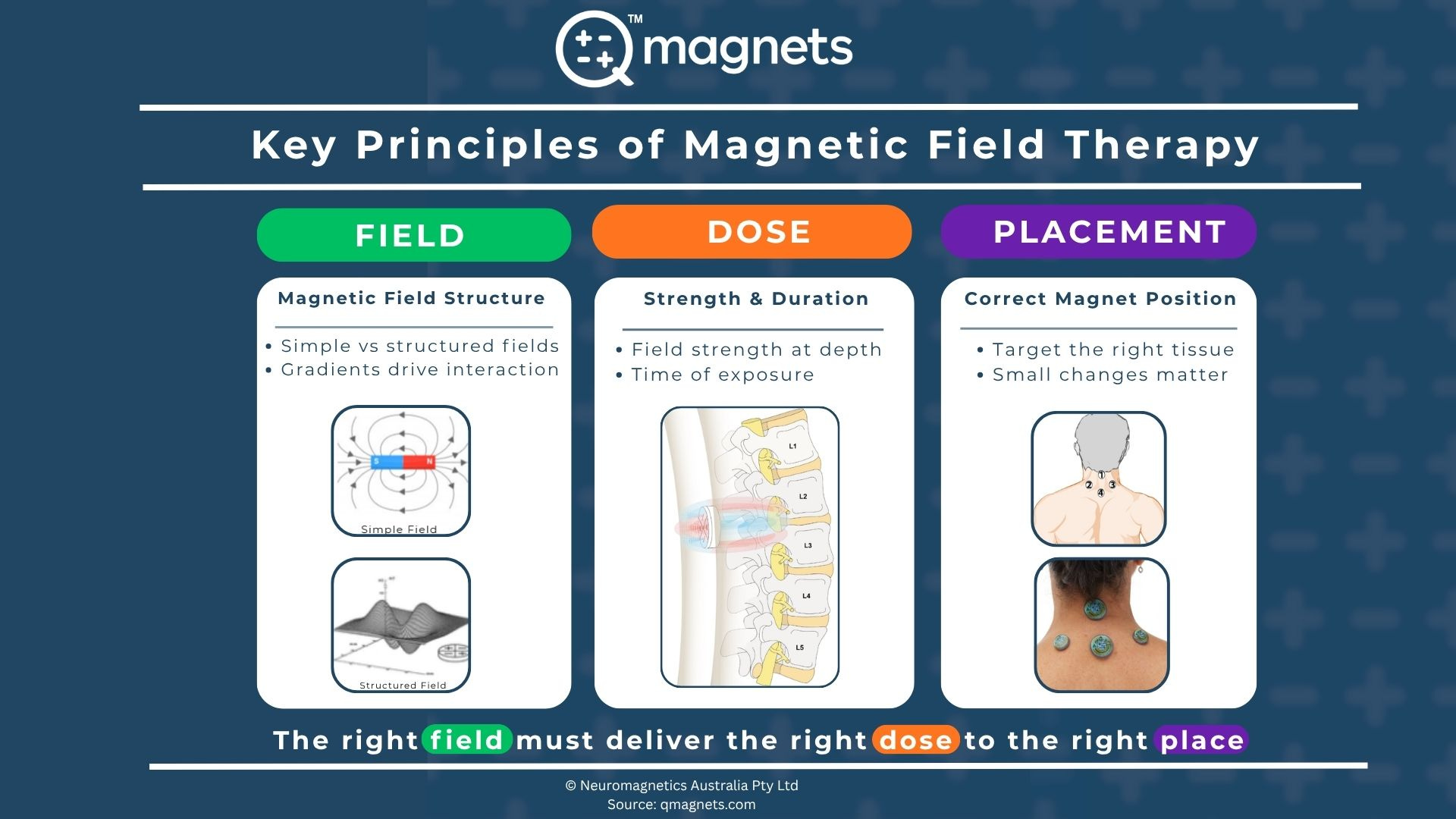
This is one of the reasons we place so much emphasis on Field | Dose | Placement (FDP).
Peter’s Story
One of our favourite examples comes from a physiotherapy patient.
After years of persistent lower back pain, Peter finally began experiencing something he hadn’t felt for a very long time.
Pain-free moments.
He could sit longer.
Driving became easier.
Perhaps most importantly, he began to feel hopeful again.
Then everything changed.
His pain gradually returned.
He was understandably disappointed and assumed the improvement had simply been temporary.
When he returned to his physiotherapist, however, something unexpected was discovered.
His wife had removed the magnet to clean the skin and replace the tape.
Without either of them realising it, the magnet had been replaced the wrong way around.
Instead of the active surface facing the body, the yellow label side (with the steel flux plate) was against the skin, substantially reducing the magnetic field reaching the intended tissues.
The placement orientation was corrected.
Very quickly, his symptoms began to settle again.
What makes this observation particularly interesting is that Peter never knew the magnet had been replaced incorrectly.
As far as he was concerned, nothing had changed.
His expectations hadn’t changed.
His treatment hadn’t changed.
Only the placement had changed.
That doesn’t prove how static magnetic fields work, nor does it eliminate every possible explanation.
But it is a strong clinical observation that is difficult to explain by expectation alone. If the response had been driven purely by placebo, you might not expect symptoms to worsen when the patient was completely unaware that anything had changed, and then improve again once the placement was corrected.
You can read Peter’s full case study here:
https://lifestyle.physio/pain/magnetic-therapy/402.html
Peter Stanton Has Seen the Same Thing
Sports physiotherapist Peter Stanton tells remarkably similar stories from his years working with elite athletes.
Professional athletes train hard.
They sweat.
They shower.
Tape loosens.
Magnets move.
Occasionally an athlete would return disappointed, convinced the magnet had “stopped working”.
Peter’s first response wasn’t to change the treatment.
He checked the placement.
Quite often, the magnet had simply shifted slightly from the intended location.
Once it was repositioned correctly, many athletes reported that the benefits returned.
Again, these athletes had no reason to believe that moving the magnet a few millimetres would make any difference.
Yet repeated clinical experience suggested that it sometimes did.
Like Peter’s (the patient) experience, these observations don’t prove a mechanism.
But together they form a consistent pattern that suggests there may be much more occurring than expectation alone.
One athlete understood the importance of accurate placement enough, that she solved the problem permanently.
An international triathlete whose symptoms responded best when the magnet was positioned over a very specific point around her L4/L5 spine decided to have a small turtle tattoo placed exactly where the magnet belonged.
From then on, whether it was her physiotherapist, coach, partner or support crew applying the magnet, everyone knew precisely where to place it.
Sometimes the simplest stories are the most memorable.
If you’d like to hear Peter describe these clinical observations himself, you can watch his practitioner education video here…
Why We Teach Field | Dose | Placement
One of the biggest misconceptions about magnetic therapy is that placement doesn’t really matter - that as long as the magnet is somewhere near the painful area, the result should be much the same.
In reality, placing a magnet where it hurts is often an excellent place to start. In fact, many of the published clinical cases involving multipolar medical magnets describe the magnets being placed directly over the patient’s area of greatest pain or tenderness.
Experienced practitioners will often use palpation to identify the most tender point, allowing them to refine the placement even further.
However, pain isn’t always felt exactly where the underlying problem originates. Referred pain, altered movement patterns and central sensitisation can all influence where symptoms are experienced. In those situations, the most effective placement may not always be the most painful spot.
That’s why we teach Field | Dose | Placement as a clinical framework. It doesn’t replace good clinical reasoning, it helps guide it. Sometimes the most painful point is exactly where the magnet belongs. Sometimes a small adjustment, even just a few millimetres, can make all the difference.
Before Assuming Your Magnet Has Stopped Working...
If your Q Magnet doesn’t seem to be providing the same benefit it did initially, ask yourself:
Has the tape loosened?
Has the magnet rotated?
Has it slipped even a few millimetres?
Has someone removed and replaced it after showering?
Is the correct side still facing the skin?
Has the location of your pain changed as your condition has improved?
Sometimes, a careful review of placement is all that’s needed.
We’d Love to Hear Your Story
Have you ever discovered that a Q Magnet had shifted without you realising?
Did repositioning it seem to make a difference?
Or have you developed your own way of ensuring it always goes back in exactly the right place?
We’d love to hear your experience.
Every real-world story helps us better understand how people use Q Magnets in everyday life, and helps us continue improving the educational resources we provide for both patients and practitioners.
The next time you think your Q Magnet has stopped working, don’t immediately assume your body has become used to it.
First, ask a simpler question.
Has anything changed?
Sometimes the answer isn’t the magnet at all.
Sometimes it’s Field. Dose. Placement.
Until next time, stay curious and stay well,
James Hermans
and the Q Magnets Team
Q Magnets Weekly Reframe
Helping you think differently about pain, recovery and the science of precision multipolar medical magnets.
Don’t ask...
“Have my Q Magnets stopped working?”
Ask instead...
“Has anything changed?”
Before assuming your body has become accustomed to the magnets, check the simplest possibilities first:
✔ Has the magnet rotated?
✔ Has it moved a few millimetres?
✔ Has someone reapplied it after showering?
✔ Is it still over the intended treatment area?
Sometimes the answer isn’t the magnet at all.
Sometimes it’s Field. Dose. Placement.
Featured Article
Why Pain Becomes Chronic And Why Early Treatment Matters

Field, Dose and Placement in Magnetic Field Therapy
Magnetic Therapy