Greetings from Q Magnets!
We tend to think of pain as a warning light.
Injure a joint, irritate a nerve or strain a muscle and the nervous system sends a message:
Something is wrong here.
Fix the injury and eventually the warning should disappear.
Except sometimes it doesn’t.
Pain can continue long after tissues should have healed. Light touch can become uncomfortable. Pain can spread. Movements that once felt normal can begin provoking disproportionate symptoms.
One reason is that persistent pain signalling can actually change the nervous system processing those signals.
And a new 2026 paper takes that idea considerably further.
Pain isn’t always just reporting damage
One of the most important changes in modern pain science has been the recognition of sensitization.
Following an injury or persistent irritation, sensory nerves can become more excitable.
Changes can occur in the nerve-cell membrane, including the behaviour and expression of ion channels that regulate electrical signalling.
The threshold for activating the nerve may fall.
The nerve may fire more easily.
Persistent or even spontaneous firing can occur.
This is known as peripheral sensitization.
The important part is what can happen next.
If heightened sensory input keeps arriving at the spinal cord, neurons within the central nervous system can themselves become increasingly responsive.
Signals get amplified.
A painful stimulus may hurt more than expected.
A normally harmless stimulus may begin to hurt.
Pain may spread outside the original injured area.
This is central sensitization.
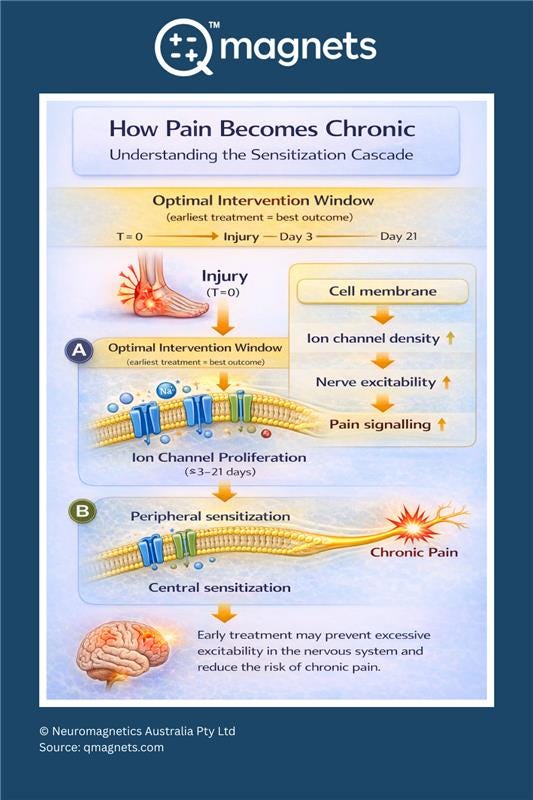
So persistent pain is not necessarily a passive message being sent through an unchanged nervous system.
The system carrying the message can adapt.
The nervous system can learn pain
“Learning” is not meant here in a psychological sense.
It is neuroplasticity.
Repeated neural activity can produce physiological changes in neurons and synapses.
That matters because it changes how we think about timing.
If sustained nociceptive signalling can contribute to sensitization, then reducing unnecessary persistent input earlier may be preferable to allowing the nervous system to remain in a highly activated state for months.
That doesn’t mean every painful injury becomes chronic.
It doesn’t.
Nor does it mean suppressing every pain signal is desirable. Acute pain has an important protective function.
But it does give us a reason to take persistent, disproportionate or escalating pain signalling seriously.
A new hypothesis goes even further
A paper published in Frontiers in Pain Research in June 2026 by Muhammad Khatib, Dror Robinson and Mustafa Yassin proposes a much broader hypothesis about chronic primary pain.
The authors focus on thalamocortical dysrhythmia — abnormal patterns of electrical activity involving communication between the thalamus and cerebral cortex.
Studies using EEG and MEG have previously identified altered brain rhythms in some chronic pain populations.
Khatib and colleagues ask whether those changes may sometimes sit much further upstream in chronic pain than generally assumed.
Their proposed hierarchy runs roughly like this:
abnormal organisation of neural electromagnetic activity
→ altered thalamocortical rhythms
→ cellular and mitochondrial changes
→ neuroinflammation
→ central sensitization
→ longer-term neuroplastic and epigenetic changes.
That is an ambitious proposal.
And it is important to say what it isn’t.
It is not an established explanation for chronic pain.
The authors describe it as a hypothesis, acknowledge that much of the supporting evidence is indirect or correlational, and propose experiments that could potentially falsify it.
They also acknowledge that chronic pain is heterogeneous and that no single mechanism is likely to explain every patient.
But there is an important idea underneath the more speculative aspects of the paper.
Chronic pain increasingly appears to involve the behaviour of networks, not just damaged tissues.
That is a significant shift.
From individual nerves to neural networks
At Q Magnets, one area we have followed closely is research into sensory-neuron excitability.
Laboratory studies by McLean and colleagues exposed cultured sensory neurons to steep static magnetic field gradients produced by multipolar magnetic arrays.
In one study, capsaicin was used to provoke sustained action-potential firing.
Exposure to the static magnetic field gradient reversibly suppressed that sustained firing, with neuronal activity returning after the field was removed.
That doesn’t tell us that static magnets “switch nerves off.”
Quite the opposite.
The interesting feature was reversibility.
It suggests that under particular experimental conditions, static magnetic field gradients may influence how excitable a sensory neuron is.
The precise biological mechanism is still uncertain, although changes involving membrane behaviour and sodium and calcium ion movement "have been proposed." ... seem like the most likely candidate.
Could reducing peripheral input matter centrally?
This leads to an interesting question.
If persistent peripheral nociceptive input can contribute to central sensitization, and if particular static magnetic field gradients can influence sensory-neuron excitability under experimental conditions, could reducing abnormal peripheral firing earlier in the process help reduce one of the inputs driving sensitization?
It is a plausible hypothesis.
It is not yet a demonstrated clinical effect of Q Magnets.
But the question itself is scientifically reasonable:
Can modulating one source of persistent sensory input alter the trajectory of a nervous system becoming progressively sensitized?
That is quite different from simply asking:
“Do magnets work for pain?”
One practical advantage of local treatment
One practical advantage of static magnetic therapy is that it can be applied locally, directly over the anatomical area of interest.
That is very different from systemic treatments such as medications, which circulate throughout the body and can produce effects well beyond the painful region being treated.
A local approach is also relatively simple.
Once a sensitized peripheral nerve, painful tissue or relevant anatomical target has been identified, an appropriately sized Q Magnet can be positioned so that the therapeutic field reaches that area.
In principle, that makes the treatment strategy straightforward:
identify the target → select the appropriate field and device size → place it over the target → maintain exposure
This does not mean that every pain problem is purely local, or that local treatment will address established central sensitization on its own.
But where ongoing peripheral nociceptive input is contributing to the problem, the ability to apply treatment directly over that source is an important practical advantage.
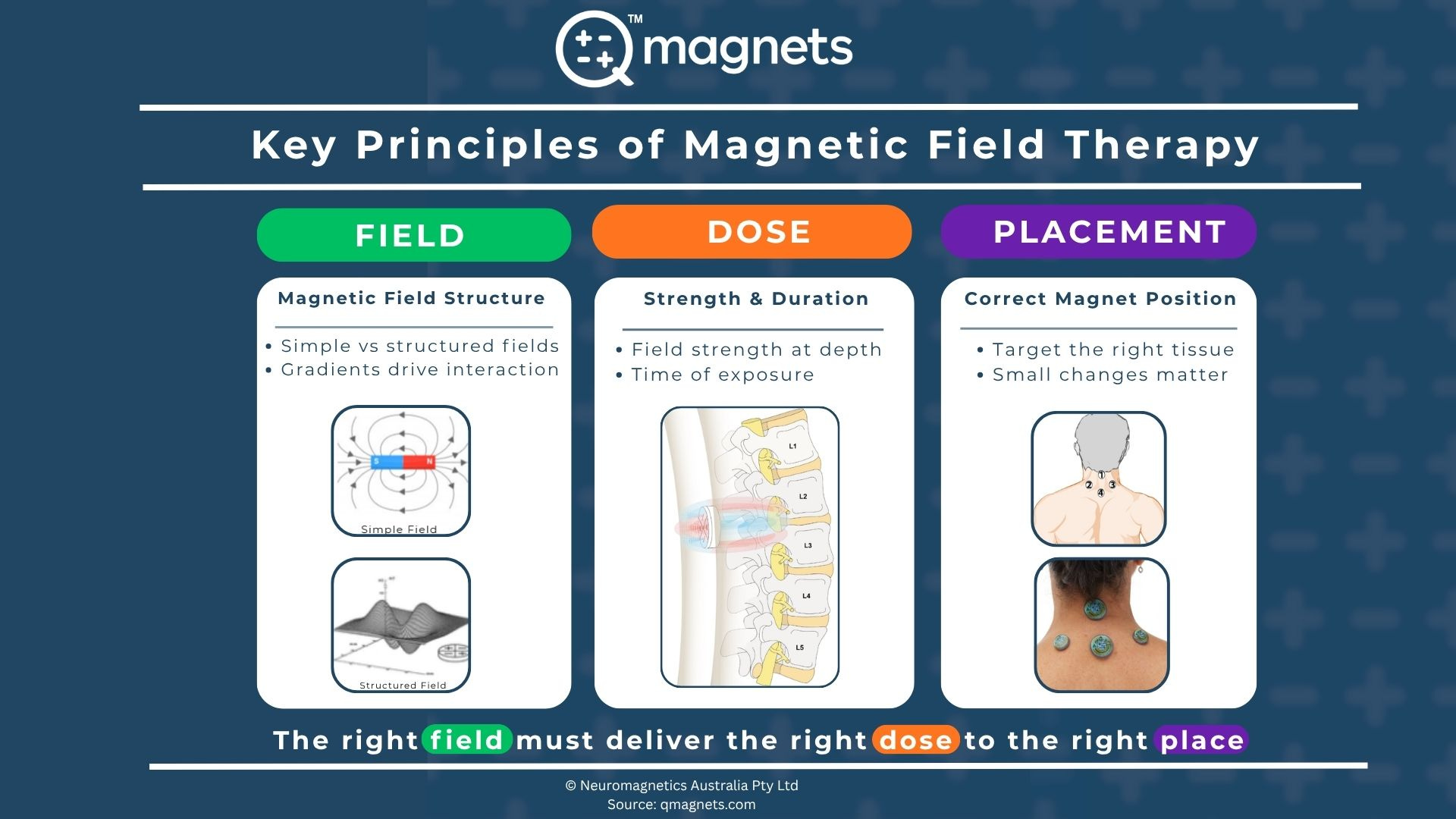
This is where Field | Dose | Placement matters
If biological interaction depends on the field reaching a relevant neural target, then the word “magnet” alone tells us very little.
The relevant questions become:
Field — What magnetic field geometry and gradient is being produced?
Dose — How much tissue is exposed, at what depth, and for how long?
Placement — Is the device positioned over a relevant anatomical target?
This is why Q Magnets use multipolar configurations designed to create localized static magnetic field gradients rather than treating every magnet as biologically interchangeable.
It is also why correct placement is so important.
The bigger lesson may be timing
The Khatib paper is unlikely to settle the mechanism of chronic pain.
That isn’t its value.
Its value is that it adds to a much larger change in how researchers think about persistent pain.
Pain may begin with damaged tissue.
But over time, the nervous system itself can change.
Peripheral nerves can become more excitable.
Spinal pathways can become sensitized.
Brain networks can reorganize.
And some researchers are now asking whether even the organisation of large-scale neural electrical activity may become part of the chronic pain state.
The practical lesson is fairly simple:
Pain that keeps firing is not necessarily standing still.
When appropriate, addressing the injury, restoring movement, reducing unnecessary nociceptive input and preventing prolonged sensitization may be easier earlier in the process than after persistent pain has become deeply established.
Q Magnets may have a role as one adjunct within that bigger rehabilitation picture, particularly where sensitized sensory nerves and persistent nociceptive signalling are involved.
But there is still a great deal to learn about exactly where static field therapy fits within the biology of pain chronification.
And that is a far more interesting scientific question than whether magnets simply “work” or “don’t work.”
Further reading
Central Sensitization: When the Nervous System Amplifies Pain
https://qmagnets.com/central-sensitization/
Why Pain Becomes Chronic and Why Early Treatment Matters
https://qmagnets.com/why-pain-becomes-chronic-and-why-early-treatment-matters/
Scientific Evidence for Magnetic Field Therapy
https://qmagnets.com/scientific-evidence-for-magnetic-field-therapy/
Research discussed:
Khatib M, Robinson D, Yassin M. A bioelectromagnetic hypothesis of chronic primary pain: from thalamocortical dysrhythmia to the consciousness-brain interface. Frontiers in Pain Research. 2026;7:1790293.
Until next time, stay curious and stay well,
James Hermans
and the Q Magnets Team
Weekly Reframe
A stitch in time saves nine.
With persistent pain, addressing the signal early may matter before the nervous system starts stitching the pattern in more deeply.
Featured Article
Central Sensitization: When the Nervous System Amplifies Pain

Field, Dose and Placement in Magnetic Field Therapy
Magnetic Therapy