Greetings from Q Magnets!
Every now and again, I come across something that reminds me just how extraordinary magnetism really is.
We tend to think of magnets as familiar objects: something on the refrigerator, a compass needle, an electric motor - or, in my case, the static magnetic fields I have spent decades studying through Q Magnets.
But take a much bigger view.
Electromagnetism is one of the four fundamental forces of nature, alongside gravity and the strong and weak nuclear forces.
That puts magnetism in rather distinguished company.
And right now, some of the most ambitious problems in science, medicine and energy are being tackled with magnetic fields.
Perhaps the most spectacular example is nuclear fusion.
Trying to Build a Sun on Earth
The Sun has been operating a fusion reactor for approximately 4.6 billion years.
Deep within it, enormous gravitational pressure and temperatures of around 15 million °C create conditions where hydrogen nuclei can fuse, ultimately releasing extraordinary amounts of energy.
There is one rather obvious problem if we want to reproduce fusion here on Earth.
We don’t have the gravity of the Sun.
So scientists have developed other ways of creating the conditions necessary for fusion.
One of the most important is magnetic confinement.
Rather than physically touching a plasma, which would destroy any ordinary container, powerful magnetic fields can be used to confine, shape and control the electrically charged particles.
And the conditions are extreme.
Experimental deuterium–tritium fusion machines such as ITER are designed for plasma temperatures above 150 million °C.
Think about that for a moment.
On one side of the machine you can have superconducting magnets cooled to only a few degrees above absolute zero.
A short distance away is plasma hotter than the centre of the Sun.
ITER’s superconducting magnet system is designed to produce fields approaching 12-13 tesla in parts of the machine, while its superconductors operate around 4 Kelvin (4 K). That’s approximately −269 °C.
It is difficult to imagine a more spectacular demonstration of what magnetic-field engineering can accomplish.
And the Magnets Are Getting Better
This is one reason fusion has become particularly interesting again.
The physics is not new.
What is changing is the technology surrounding it.
High-temperature superconducting, or HTS, magnets can generate extremely high magnetic fields and potentially allow some fusion machines to become substantially smaller.
Commonwealth Fusion Systems, which grew from work at MIT, demonstrated a large-bore 20-tesla HTS magnet in 2021 and is now building its SPARC fusion experiment around this technology.
Europe is pushing another approach.
Proxima Fusion, a spin-out from Germany’s Max Planck Institute for Plasma Physics, is developing advanced stellarators - machines whose extraordinarily complex magnetic coils are designed to confine plasma continuously.
In February 2026, Proxima, energy company RWE, Bavaria and the Max Planck Institute announced a roadmap towards a demonstration machine called Alpha and ultimately a proposed commercial stellarator power plant called Stellaris. Proxima says Alpha is planned for the early 2030s.
And just last month, in July 2026, Proxima announced another €411 million capital raise.
This isn’t a science-fiction concept sitting forgotten in a university basement.
Serious scientists, engineers, governments and investors are putting serious money behind it.
Whether commercial fusion arrives in five years, fifteen years or considerably longer remains an open question.
But something important is happening.
Magnet technology is helping push the boundary of what fusion machines can do.
An Australian Perspective
This naturally makes me think about what we are doing here in Australia.
Snowy 2.0 is one obvious example. Snowy 2.0 is principally energy storage. It uses electricity when it is abundant to pump water uphill, then releases that water through turbines when electricity is required.
When Prime Minister Malcolm Turnbull announced the project in 2017, the early public estimate was around $2 billion. Following further work, the 2018 investment estimate became approximately $6.1 billion. In 2023 it was reset to $12 billion.
By March 2026, $11.1 billion had already been spent, and some estimate the costs could blow out to well over $20 billion. The figures are eye-watering and to think, what that type of investment in nuclear fusion research would have accomplished?
How much of our national energy strategy should be devoted to building today’s infrastructure, and how much should we be investing in technologies that could fundamentally change tomorrow’s infrastructure?
Meanwhile the geniuses running our government are spending many billions more, building solar and wind farms with generous taxpayer subsidies criss-crossing our vast country and spending billions more connecting them to the grid with enormous transmission wires. Whereas, to develop nuclear fusion reactors and replace the existing coal-generation sites that already have transmission access makes perfect sense.
A country with Australia’s scientific capability should at least be deeply involved in that conversation. But I never hear it discussed at the national level!
There is another intriguing possibility.
Large thermal power-station sites already have valuable assets: grid connections, transmission corridors, industrial land, access roads and a skilled energy workforce. Studies of converting former coal sites to nuclear generation have highlighted precisely these advantages.
If fusion ultimately becomes commercial, locating future firm generation near existing energy infrastructure may be one of the questions worth exploring.
That doesn’t mean you can simply “clunk a fusion reactor” into an old coal station.
But existing infrastructure could become a valuable part of the equation.
Fusion Is Remarkable - but It Isn’t Magic
What fusion offers is the potential for abundant low-carbon firm energy without the same self-sustaining chain reaction used in conventional nuclear fission reactors (what most of us understand as nuclear reactors).
That’s an extraordinary prize.
It is not yet a solved engineering problem.
And that distinction matters.
Magnetism Is Already Transforming Medicine
Fusion may be the spectacular example, but look at medicine.
MRI is now so commonplace that we barely stop to think about what the initials mean:
A powerful magnetic field aligns hydrogen protons within our tissues. Radiofrequency energy disturbs that alignment, magnetic-field gradients encode spatial information, and computers reconstruct the resulting signals into remarkably detailed images.
No X-rays are required.
A technology that once seemed extraordinary is now routine medicine.
Then consider transcranial magnetic stimulation (TMS).
TMS uses rapidly changing magnetic fields outside the skull to induce small electrical currents within selected regions of the brain. It is already used clinically for several neurological and psychiatric applications, including treatment-resistant depression and OCD.
The Body Produces Magnetic Fields Too
There is another fascinating connection.
Magnetic fields aren’t foreign to human physiology. The electrical currents generated by the heart, brain, nerves and muscles also produce extraordinarily small magnetic fields that can now be measured with sensitive instruments.
The magnetic field of the heart can be recorded with magnetocardiography, while the magnetic activity associated with the brain can be measured with magnetoencephalography.
That does not prove that externally applied static magnetic fields have therapeutic effects.
But it does demonstrate why bioelectromagnetism is a legitimate and fascinating field of science. Biology, electricity and magnetism are not completely separate subjects.
The interesting question is what happens when particular externally generated fields interact with biological systems - and under what conditions.
And the frontier continues to move.
Researchers reported in 2026 on quantum-sensing MRI, investigating whether extremely small magnetic fields associated with neuronal firing might eventually be detected using MRI systems. This remains an emerging technology requiring independent validation, but it shows just how far magnetic sensing is being pushed.
Elsewhere, researchers are developing new magnetic materials for spintronics, where the magnetic properties and spin of electrons can be used for next-generation memory, sensing and computing technologies. A major Nature Physics review published only last month examined the emerging field of altermagnetic spintronics.
So when someone treats magnetism as an old or simplistic technology, I find that rather amusing.
Some of the most sophisticated laboratories on Earth are doing exactly the opposite.
The Real Lesson Is Field Engineering
There is another connection between these technologies that I think is particularly important.
The extraordinary advances are not simply coming from making magnets stronger.
They are coming from becoming better at engineering magnetic fields.
In fusion, scientists carefully shape magnetic fields to confine plasma.
In MRI, magnetic-field gradients allow the scanner to determine where signals originate within the body.
In TMS, the characteristics of the magnetic pulse and where it is applied determine which neural structures are influenced.
And this is particularly relevant to our work with Q Magnets.
Q Magnets are not simply “strong magnets”. They are precision multipolar medical magnets designed to create particular field geometries and steep localised magnetic-field gradients.
Unlike MRI, TMS or fusion systems, Q Magnets do not require an external power source. They are passive medical devices that create persistent localised static magnetic-field environments.
That doesn’t mean these technologies work by the same mechanism. They clearly don’t.
It illustrates something more fundamental:
When discussing magnetic technology, the characteristics of the field matter.
Different Fields. Different Effects.
An MRI magnet is not a TMS coil.
A fusion confinement magnet is not an MRI scanner.
A weak refrigerator magnet is not a precision multipolar static medical magnet.
The relevant questions are always more specific.
· What kind of field?
· How strong is it?
· Is it static or changing?
· What is its geometry?
· How rapidly does it change across space?
· How long is the exposure?
· And what exactly is being exposed to it?
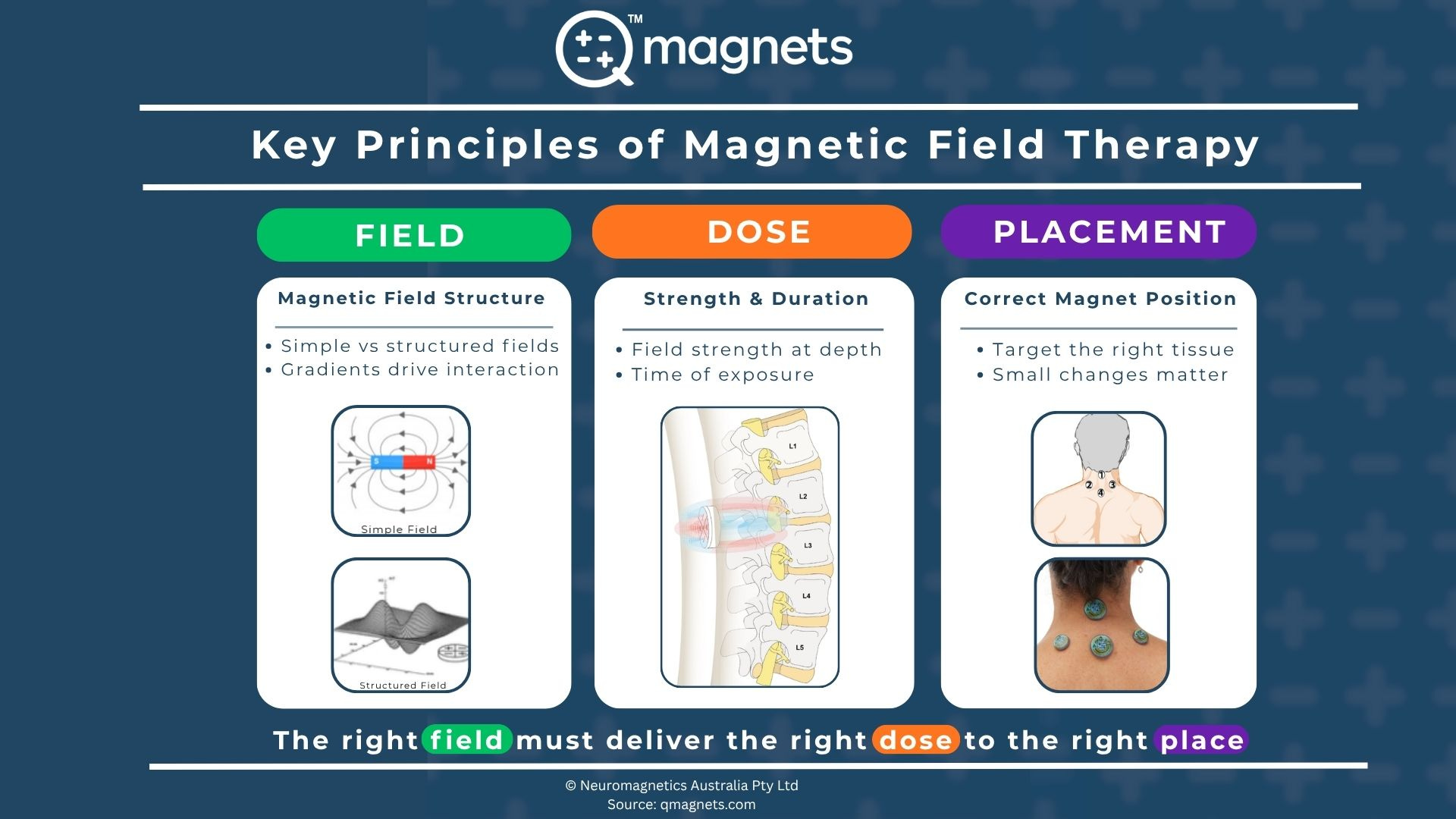
That is why in our own field I keep returning to the same three variables:
Field. Dose. Placement.
Different magnetic-field configurations produce very different physical environments.
That doesn’t prove that every claimed biological use of magnets works.
Quite the opposite.
It tells us why the word “magnet” alone is scientifically inadequate.
The Bigger Lesson
I don’t know when commercially viable fusion electricity will arrive.
Nobody does.
Some companies are talking about this decade. Other roadmaps extend well into the 2030s, and history tells us to maintain a healthy degree of scepticism about ambitious fusion timelines.
But I do know this.
Humanity is using magnetic fields to see inside the body.
We are using them to stimulate specific regions of the brain.
We are developing magnetic materials for the next generation of computing.
We are building superconducting magnets capable of producing fields tens of thousands of times stronger than Earth’s magnetic field.
And we are trying to use magnetic fields to hold plasma hotter than the Sun long enough to capture the energy released when atomic nuclei fuse.
For something invisible, magnetism has an extraordinary reach.
Perhaps the lesson isn’t that we should believe every claim made about magnets.
We shouldn’t.
The lesson is that we should probably stop underestimating what carefully engineered magnetic fields are capable of doing.
Want to dig deeper?
For the shorter introduction that prompted this week’s MagnaBlog, watch the overview of Europe’s emerging stellarator fusion technology:
For a much deeper exploration, Lex Fridman’s conversation with fusion engineer and Helion Energy CEO David Kirtley runs for nearly three hours and covers fusion physics, extreme plasma temperatures, reactor engineering and the challenge of turning fusion energy into electricity.
For readers interested in our own area of research, explore How Q Magnets Work and Magnetic Field Gradients for an introduction to why magnetic-field configuration, gradient, dose and anatomical placement matter.”
Until next time, stay curious and stay well,
James Hermans and the Q Magnets Team
Weekly Reframe
“It’s not the size that matters. It’s what you do with it.”
When it comes to magnetism, strength is only part of the story. Field geometry, gradients, dose and placement can completely change what a magnetic field does.
Featured Articles

Field, Dose and Placement in Magnetic Field Therapy
Magnetic Therapy