Greetings from Q Magnets!
A few weeks ago, I came across an article ranking prominently in Google for searches around “scientific published reviews for magnetic therapy”.
It is published by Stanford Magnets and titled:
Magnetic Therapy for Pain Relief: A Review of Research and Case Studies.
At first glance, it looks useful.
It discusses static magnets and electromagnetic therapies, lists numerous conditions, quotes scientific studies and finishes with 14 references.
And because I have spent decades working with therapeutic magnets, you might expect me to welcome an article presenting favourable research. But when I started checking the references, some did not appear to support what the article implied. Others were studies of completely different technologies. And some citations, as written, appear to be made up! They certainly don’t correspond to papers in the journals cited.
That matters.
But then there is another side to this story.
One of the papers most frequently used to argue that static magnets don’t relieve pain—the Pittler, Brown and Ernst systematic review published in CMAJ in 2007—raises a different problem.
Its references are real.
Its methodology is vastly more rigorous.
But when you examine the individual studies, very different magnetic devices, field configurations, treatment durations and anatomical applications are placed under the same broad heading of “static magnets.” And some trial summaries reduce considerably more complicated findings to a simple “no significant difference.”
So this week’s MagnaBlog isn’t going to argue that the positive side is right and the sceptics are wrong.
It’s about something more important:
Evidence bias can travel in both directions.
And if we’re serious about understanding static magnetic field therapy, we need to be willing to identify it whichever direction it travels.
First, What Do I Mean by “Bias”?
I am not suggesting deliberate dishonesty.
Scientific bias can be much more subtle.
It can enter when we:
select studies supporting what we already believe
classify unlike interventions as though they are equivalent
focus on one outcome while overlooking another
describe a statistically non-significant result as though nothing happened
count “positive studies” without considering their quality
cite studies of one technology as evidence for another
accept a reference because it looks scientific without checking the original paper
And that can happen whether you’re trying to prove that magnets work or prove that they don’t.
The Stanford Magnets article provides a useful example from one direction.
Pittler provides an interesting example from the other.
Problem One: Calling Everything “Magnetic Therapy”
To Stanford Magnets’ credit, its article initially makes an important distinction.
It explains that static magnetic field therapy uses permanent magnets, whereas PEMF involves time-varying electromagnetic fields generated by powered equipment.
Good.
They’re not the same intervention.
But once the article begins reviewing the evidence under the heading “Do Magnets Help with Pain?”, those distinctions start disappearing.
Among the favourable examples are:
PEMF combined with backward walking for low-back pain
PEMF for shoulder impingement
electromagnetic field treatment for dysmenorrhea
repetitive transcranial magnetic stimulation (rTMS) for fibromyalgia
magnetic bead acupressure combined with transcutaneous electrical stimulation after surgery
magnetic peripheral nerve stimulation for diabetic neuropathic pain
Those may all be interesting studies.
But they are not evidence for static permanent-magnet therapy.
PEMF, rTMS, magnetic peripheral nerve stimulation and a permanent magnet sitting on the skin involve fundamentally different exposure conditions.
You cannot demonstrate the effectiveness of one by citing the effectiveness of another simply because they all involve magnetic fields.
That would be a little like reviewing “light therapy” and treating sunlight, red-light photobiomodulation and surgical lasers as interchangeable interventions.
They all involve light.
But scientifically, that’s nowhere near enough information.
Then I Started Checking the References on the page
At first I was quite excited as there were a few papers, I had never heard of. But soon after, things became more concerning.
Reference 1 is Vallbona’s famous 1997 post-polio study.
That’s real.
Reference 3 is Alfano’s fibromyalgia study.
Also real.
But Reference 2 isn’t actually a research paper at all.
ANC.00006 Biomagnetic Therapy is a medical-policy document published by Anthem. In fact, its current position is that biomagnetic therapy remains “investigational and not medically necessary.”
Then there is this citation:
Lefebvre G, Morissette R, Courtemanche S. “Magnetic therapy for osteoarthritis pain: A meta-analysis of clinical trials.” Journal of Pain Research. 2011;4:89–101.
I have been unable to locate that paper.
More tellingly, the official Journal of Pain Research archive shows that pages 91–101 of Volume 4 were occupied by an entirely different paper:
Progesterone prevents development of neuropathic pain in a rat model: Timing and duration of treatment are critical.
So the Stanford citation, at least as written, cannot be correct.
Another reference attributes a 2016 Pain Medicine paper on “magnetic insoles” for low-back pain to Kwon, Kim and Choi on pages 923–930.
But the actual Volume 17, Issue 5 pagination shows one article ending on page 923 and the next occupying pages 924–930. The citation as presented doesn’t align with the journal issue.
The 2025 Kim citation is also problematic. Stanford lists it as Journal of Physical Therapy Science, Volume 37(2), pages 85–92. Yet the journal’s actual February 2025 issue has one article spanning pages 84–88 and another spanning 89–94.
Again, that doesn’t prove that every underlying idea is wrong.
But it does tell us something important.
A reference list is not evidence until somebody checks the references.
And this is precisely where confirmation bias can favour magnetic therapy.
We see an article saying magnets help pain.
We agree.
There are 14 scientific-looking references underneath it.
We share it.
But if some of those studies are actually PEMF or rTMS studies, and several citations cannot be traced as written, we have inadvertently made the evidence base look stronger than it really is.
That’s something we try to avoid.
Now Let’s Apply Exactly the Same Standard to Pittler
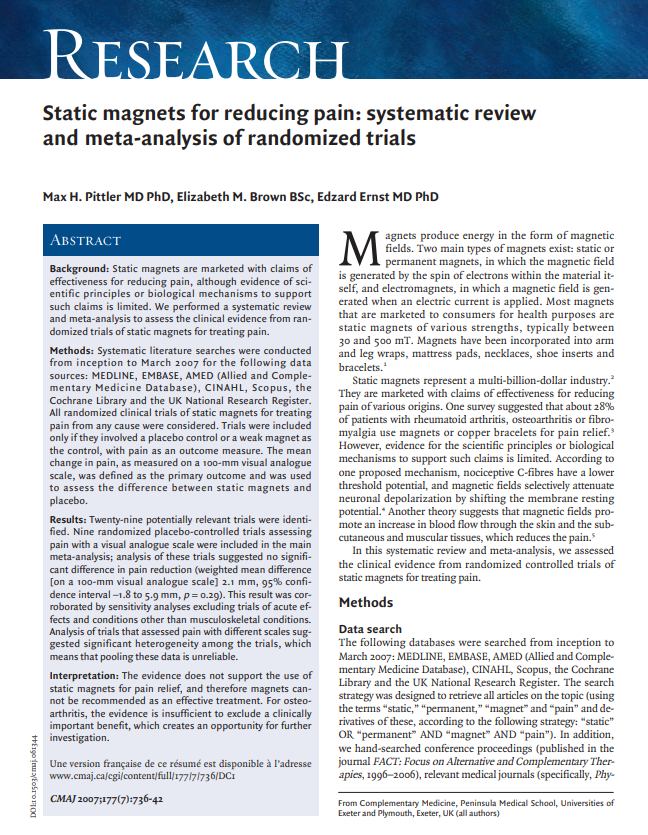
In 2007, Max Pittler, Elizabeth Brown and Edzard Ernst published their systematic review:
Static magnets for reducing pain: systematic review and meta-analysis of randomized trials.
Their primary meta-analysis included nine randomized controlled trials using a 100 mm visual analogue pain scale.
The overall difference between magnet and placebo groups was not statistically significant.
That result is real.
And the review was far more rigorous than the commercial article I’ve just criticised.
But look at what sits underneath the label “static magnets.”
Pittler’s review included:
magnetic bracelets
magnetic necklaces
mattress pads
shoe insoles
flexible magnets
magnetic sleeves
magnets taped directly over painful locations
quadripolar MagnaBloc arrays
Field strengths ranged from approximately 4 to 395 mT.
Exposure periods ranged from less than an hour to several months.
Conditions included osteoarthritis, diabetic neuropathy, fibromyalgia, chronic low-back pain, post-polio pain, foot pain, repetitive strain injury and experimentally induced muscle soreness.
Pittler itself acknowledged substantial clinical heterogeneity arising from different conditions, treatment durations and magnet strengths.
So once again:
Are we actually studying one intervention?
Or have we created one by giving a heterogeneous collection of devices the same name?
The Segal Knee Study Shows How Nuance Disappears
Segal and colleagues studied 64 people with rheumatoid arthritis and persistent knee pain.
The active treatment used quadripolar MagnaBloc devices producing approximately 190 mT fields with steep field gradients.
Importantly, the control wasn’t nonmagnetic.
It was another magnetic device producing a weaker, differently configured field of up to 72 mT.
Pain declined by:
40.4% with the quadripolar device
25.9% with the magnetic control
The difference between groups for the main pain comparison was not statistically significant: p=.23.
So if someone says:
“Segal did not demonstrate a statistically significant between-group difference in its primary pain comparison.”
That’s fair.
But there was more to the study.
The active group reported a 33% decrease in global assessment of disease activity compared with 2% in the control group.
And:
68% of the active-treatment group reported feeling better or much better
compared with 27% of the control group
Those differences were statistically significant.
Pittler’s table reduces Segal to:
“No significant differences.”
That isn’t necessarily false.
It refers to the pain outcome chosen for the review.
(Interestingly Laakso summarises the exact same study with – “Significantly less pain in treatment group compared to control group; Greater reduction in global assessment of disease activity”.)
But it demonstrates how outcome selection can change the impression left by a study.
“Primary pain endpoint not significantly different” and “no significant differences” do not communicate quite the same thing.
Weintraub Is Even More Interesting
Michael Weintraub and colleagues conducted a much larger study involving people with symptomatic diabetic peripheral neuropathy.
Participants continuously wore multipolar 450 G magnetic insoles or nonmagnetic sham insoles for four months.
Pittler’s table summarizes the study:
“No significant difference at 4 mo.”
Now read the original results.
During months three and four, statistically significant differences favouring the magnetic group were reported for:
burning
numbness and tingling
exercise-induced foot pain
Among people with severe baseline symptoms, numbness and tingling fell by 32% in the magnet group versus 14% with sham, while foot pain declined 41% versus 21%.
Again, that doesn’t mean we should declare Weintraub definitive proof.
There was substantial attrition.
Placebo responses were important.
And these were relatively weak flexible magnets targeting superficial tissues in the foot.
But “no significant difference at four months” clearly doesn’t tell the entire story of the trial.
Brown Shows the Same Problem
Pittler summarizes Brown’s chronic pelvic pain trial as:
“No significant differences.”
The original study is more nuanced.
Thirty-two women completed two weeks and only 19 completed four weeks, so this was a small pilot study.
After four weeks, however, the active-magnet group had statistically better Pain Disability Index and Clinical Global Impression outcomes.
But there was an important problem:
participants receiving active magnets were significantly more likely to correctly identify their treatment.
So blinding had been compromised.
What’s the correct conclusion?
Not:
“Magnets worked.”
And not:
“Nothing happened.”
A fairer interpretation is:
some clinically relevant outcomes favoured the active treatment, but the small sample and compromised blinding substantially limit confidence in the result.
That’s less exciting.
It’s also better science.
And Some Negative Studies Really Were Negative
Collacott’s chronic low-back pain trial is a good example.
Twenty people with longstanding low-back pain used a flexible bipolar magnet producing about 30 mT.
The overall VAS changes were almost identical:
sham: –0.44
magnet: –0.49
p=.90
That’s a negative study.
We shouldn’t try to make it positive.
But we are still entitled to ask what intervention was tested.
It was a relatively weak flexible bipolar magnet used over a condition where important pain-generating structures may lie considerably deeper beneath the skin.
The result therefore tells us something specific:
that device, at that exposure, used in that way, did not outperform placebo in that population.
It does not logically establish that every static magnetic field configuration must fail for low-back pain.
That is where Field | Dose | Placement becomes important.
But Here’s Where We Need to Challenge Our Own Side Too
In 2021, Fan and colleagues published a much more favourable review of static magnetic fields.
Their headline figure is attractive:
64% of the human studies they reviewed showed positive analgesic effects.
They also reported positive findings in all six mouse studies they included and concluded that static magnetic fields showed considerable promise when appropriate parameters were used.
As someone who believes the parameters matter, I naturally find that interpretation interesting.
But I would make exactly the same caution here.
“64% of studies were positive” is not the same as “the treatment is 64% proven.”
A small pilot study and a large randomized controlled trial are not equally weighted because each receives one tick in the “positive” column.
Nor does counting positive and negative studies automatically account for:
study quality
sample size
magnitude of effect
risk of bias
publication bias
quality of blinding
differences between outcomes
differences in field characteristics
And six positive animal studies remain six studies.
A 100% success rate sounds impressive, but with a small literature base it should generate interest, not certainty.
Fan does something very useful by paying considerably more attention to field strength, exposure time and pain type than many earlier reviews.
But we shouldn’t turn a favourable review into dogma simply because we prefer its conclusion.
That would be the same mistake in the opposite direction.
Perhaps Laakso Offers a Better Model


One reason I keep returning to Liisa Laakso and colleagues’ 2009 review is that it tried to deal with an issue that much of the literature overlooks.
They explicitly separated studies involving quadripolar magnetic arrays from conventional static magnets because their magnetic field characteristics were substantially different.
That makes sense.
But they didn’t then become advocates.
They also pointed out:
small study populations
inadequate controls in some studies
potential problems with blinding
confounding variables
investigator affiliations and financial interests
the lack of independent replication
In other words:
they recognised that magnetic fields can differ substantially while still demanding better evidence from the more promising configurations.
That is much closer to where I think this field needs to go.
Field | Dose | Placement Is Not an Excuse for Negative Results
This distinction is important.
Field | Dose | Placement should never become a convenient way of saying:
“Whenever a trial is negative, they must have used the wrong magnets.”
That would make the hypothesis impossible to falsify.
Instead, FDP gives us variables that should be defined before the trial begins.
Field
What field configuration was used?
Was it unipolar, bipolar, quadripolar, multipolar or another geometry?
What was the actual spatial field distribution?
Dose
What field reached the intended tissue, not merely the magnet surface?
How long was the exposure?
Was the target superficial or deep?
Placement
Where was the magnet positioned?
What tissue or neural structure was the researcher attempting to expose?
How accurately and consistently was that placement maintained?
Context
What condition was being treated?
Was the pain acute, inflammatory, neuropathic, musculoskeletal or sensitization-related?
Only after defining those variables can we meaningfully ask whether the intervention worked.
The Biggest Problem May Be the Question Itself
For decades, magnetic therapy research has often revolved around one deceptively simple question:
“Do magnets work?”
The Stanford Magnets article can make the answer appear more positive by borrowing evidence from PEMF, rTMS and other technologies and combining them under “magnetic therapy”, while also quoting made up studies.
A sceptical systematic review can move in the opposite direction by aggregating bracelets, mattresses, flexible magnets, insoles and engineered magnetic arrays into the category “static magnets.”
Both approaches lose information.
And once information disappears at the classification stage, even excellent statistics can’t put it back.
A better question is:
“Which magnetic field, at what dose, placed where, for which target, under what clinical circumstances?”
That question will produce positive results sometimes.
It will produce negative results sometimes.
And hopefully it will eventually tell us why.
My Standard Is Simple
I have an obvious interest in this subject.
I’ve worked with therapeutic magnets for decades.
So I probably have more reason than most people to be aware of my own confirmation bias.
That’s why I think we should apply a simple rule:
If we criticise sceptics for selectively interpreting evidence, we must be equally prepared to criticise favourable articles when they overstate it.
Don’t accept a reference because it supports your position.
Find the paper.
Don’t accept a systematic-review table because it opposes your position.
Find the paper.
Check what device was actually used.
Check the field.
Check the dose.
Check the placement.
Check the comparator.
Check the endpoint.
Check what the authors actually concluded.
The objective shouldn’t be to accumulate evidence for magnetic therapy or against magnetic therapy.
It should be to understand the evidence accurately enough to discover where static magnetic fields may, or may not, have a useful biological and clinical effect.
That’s a slower process than arguing from headlines.
But it’s how a credible field develops.
And perhaps the literature has been telling us something for years:
Stop asking whether “magnets” work as though all magnetic interventions are the same.
Start asking what was actually tested.
Until next time, stay curious and stay well,
James Hermans and the Q Magnets Team
Further Reading
Pittler MH, Brown EM, Ernst E. Static magnets for reducing pain: systematic review and meta-analysis of randomized trials. CMAJ. 2007;177(7):736–742.
Laakso L, Lutter F, Young C. Static magnets—what are they and what do they do? Rev Bras Fisioter. 2009;13(1):10–23.
Fan Y, Ji X, Zhang L, Zhang X. The analgesic effects of static magnetic fields. Bioelectromagnetics. 2021;42:115–127.
Segal NA, Toda Y, Huston J, et al. Two configurations of static magnetic fields for treating rheumatoid arthritis of the knee: a double-blind clinical trial. Arch Phys Med Rehabil. 2001;82:1453–1460.
Weintraub MI, Wolfe GI, Barohn RA, et al. Static magnetic field therapy for symptomatic diabetic neuropathy: a randomized, double-blind, placebo-controlled trial. Arch Phys Med Rehabil. 2003;84:736–746.
Brown CS, Ling FW, Wan JY, Pilla AA. Efficacy of static magnetic field therapy in chronic pelvic pain: a double-blind pilot study. Am J Obstet Gynecol. 2002;187:1581–1587.
Collacott EA, Zimmerman JT, White DW, Rindone JP. Bipolar permanent magnets for the treatment of chronic low back pain: a pilot study. JAMA. 2000;283:1322–1325.
Weekly Reframe
“The evidence is in the details.”
Research headlines can simplify. Conclusions can persuade. But the real evidence lies in what was actually tested, how it was tested, and what the results really showed.
Whether the findings support our beliefs or challenge them, the standard should be the same.
The evidence is in the details.
Featured Article
Why magnet design matters? Learning from Cow Magnets

Magnetic Field Gradients

Magnetic Therapy