

Greetings from Q Magnets!
Period pain is one of those health problems that is both extremely common and, for many women, simply accepted as something to put up with.
For plenty of women, medication works well. Anti-inflammatory drugs and other conventional treatments are established options, and if they provide good relief without unwanted effects, there is no reason to argue against them.
But not everyone wants to rely on medication every month.
Some women experience side effects. Some cannot use particular medicines. Others simply prefer to explore a non-pharmaceutical option where a reasonable one exists.
So this week we asked a narrower question:
What does the published research actually say about using static magnets for period pain?
The answer turned out to be more interesting than many people might expect.
Two Randomised Studies Specifically on Menstrual Pain
There are two published randomised pilot studies that directly investigated static magnetic fields for primary dysmenorrhoea period pain.
And both reported significantly better pain outcomes with the active magnetic treatment than with their control devices.
That does not mean the evidence is definitive.
Both studies were small and need replication.
But it does mean that saying there is simply “no evidence” for static magnets and menstrual pain isn’t an accurate description of the literature.
Read our comprehensive article where we pull apart the research and applications for menstrual pain.
Eccles: prolonged treatment over the pelvic region
In 2005, Dr Nyjon Eccles conducted a randomised, double-blind, placebo-controlled pilot study involving women with regular dysmenorrhoea.
The active device was a specially designed 2700-gauss neodymium static magnet.
It was positioned anterior to the pubis in other words, over the lower pelvic region and women began wearing it about two days before the expected start of menstruation, continuing through their period.
The active-magnet group experienced a significantly greater reduction in pain than the weak-magnet control group.
What caught our attention was not simply that the result was positive.
It was how the magnetic field was used.
The researchers selected a particular magnetic configuration, positioned it over an anatomically relevant region, and gave it a substantial exposure time.
In other words:
Field. Dose. Placement.
Mayrovitz: only 40 minutes but precisely over the pain
A second randomised study published by Harvey Mayrovitz and colleagues in 2021 took a very different approach.
This time researchers used a 0.4 Tesla concentric rare-earth neodymium magnet.
Instead of applying it to exactly the same anatomical position for every woman, each participant identified the abdominal location where her menstrual pain was greatest.
The device was placed directly over that location.
And it stayed there for just 40 minutes.
The results?
Average pain reduction was approximately 41.8% with the active magnet compared with 20.8% with the sham.
Eleven of the 19 women receiving active treatment achieved what the researchers defined as a meaningful reduction in pain, compared with three of 17 women receiving sham treatment.
Again, this was a small pilot study.
But it raises a fascinating practical question.
Why could a relatively short treatment exposure produce a measurable result?
One possibility worth investigating is placement.
The magnet wasn’t simply worn somewhere convenient.
It was positioned directly over the location each woman identified as being most painful.
Then There Is Chronic Pelvic Pain
There is another study worth adding to the picture.
Brown and colleagues investigated static magnets in women with chronic pelvic pain.
This wasn’t specifically a menstrual-pain study, so we need to keep that distinction clear.
But the placement method is particularly relevant.
Researchers palpated the abdomen, identified the two most sensitive trigger points, and positioned approximately 500-gauss concentric bipolar magnets directly over those sites.
The magnets were worn continuously.
Women completing four weeks of active treatment showed significant improvements in measures of pain-related disability and global clinical impression compared with placebo, although the study also had limitations including compromised blinding.
Three studies.
Different conditions.
Different magnets.
Different exposure times.
But there is an interesting common denominator:
The researchers paid attention to where the magnetic field was placed.
This Is Why “Do Magnets Work?” Is Probably the Wrong Question
Static magnetic therapy is often discussed as if every magnet were interchangeable.
They aren’t.
The Eccles study used one field configuration.
Mayrovitz used another.
Brown used another again.
Their treatment duration varied from 40 minutes to continuous wear over weeks.
Their placement strategies also differed.
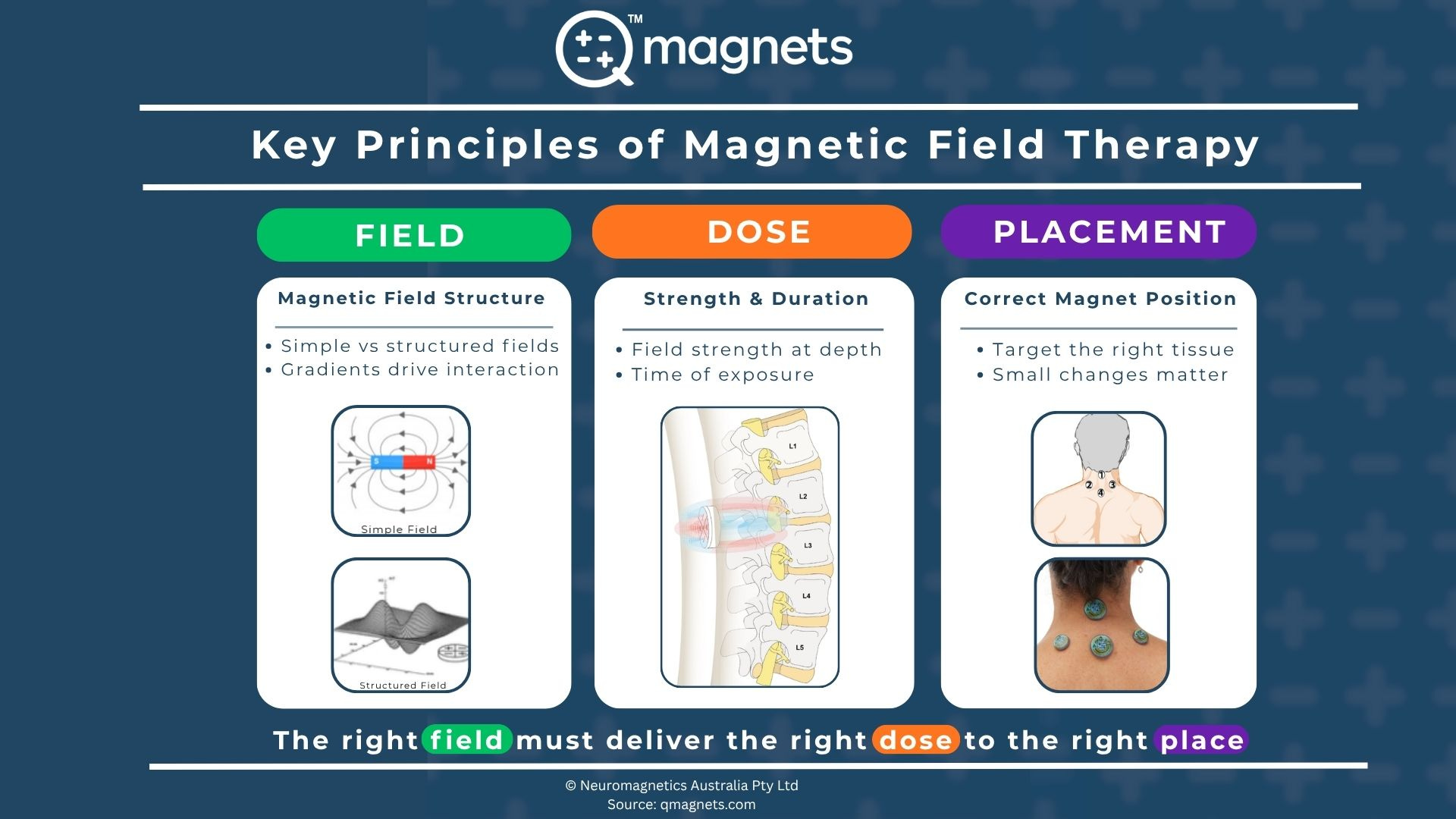
That is precisely why we keep coming back to our Field | Dose | Placement framework.
Field
What type of magnetic field is being produced?
A bipolar magnetic field is not the same as a concentric alternating-pole field, which is not the same as a quadrupolar or octapolar field.
Dose
How large is the device?
How deep is the target?
How strong and complex is the field?
How long is the exposure?
Forty minutes and several days of continuous wear are very different doses.
Placement
Where is the field actually being applied?
Over the lower pelvis?
At the precise location of greatest pain?
Over a tender abdominal trigger point?
These aren’t minor details.
They may be part of why studies using static magnets sometimes produce different results.
How Does This Compare With the Q Magnets Protocol?
This was the other reason we wanted to take a close look at these papers.
Our current Abdominal and Menstrual Pain Treatment Protocol begins with placement over the lower pelvic region immediately above the pubic bone, with additional magnets used to create greater pelvic coverage.
Placement can also be adjusted according to where discomfort is being experienced.
Our Adjunct Placement approach can then consider more focal areas of tenderness or selected acupuncture and trigger points when appropriate.
There are clear parallels with the published research.
anatomically relevant placement, sufficient exposure and deliberately selected magnetic field configurations.
We have put the complete analysis, including the limitations of the evidence and detailed comparison of the three studies, into a new research page:
Read: Static Magnets for Period Pain What the Research Actually Shows
Read: Abdominal and Menstrual Pain Treatment Guide with Magnetic Therapy
It is considerably more detailed than this MagnaBlog and is intended to become an ongoing research resource as new evidence emerges.
And That Gave Us an Idea…
One of the most interesting things about this research is that the investigators did not all use the same kind of magnet.
So for this MagnaBlog, we wanted to create an offer that lets Q Magnets users access a much broader range of the field configurations discussed in both the published research and our own application protocols.
Women’s Research Special Offer
Purchase the: Q Bonus Package Complex Lower Back Pain
The set already contains:
1 × OF50-3 Octapolar Q Magnet
2 × QF28-6 Quadrapolar Q Magnets
2 × QF28-3 Quadrapolar Q Magnets
6 × Q6-1.5 small Q Magnets
QFix adhesives
Q Bag
Information & Treatment Guide
Despite its name, this is much more than a lower-back-only collection.
It provides a selection of different Q Magnet sizes suitable for a range of appropriate joint, muscular and minor pain applications when selected and positioned according to the relevant protocol.
Click on the WOMENSRESEARCH offer
And the following magnets will be added at no additional cost:
BF28-3N
A neodymium bipolar Bio-North magnet with flux plate the Q Magnets field configuration most relevant for comparison with the directional/bipolar-style approach discussed in the Eccles research.
CF28-3
A neodymium alternating-polarity concentric magnet—the configuration particularly relevant to understanding the concentric rare-earth approach investigated by Mayrovitz.
CFBS120 Pack of 2
Flexible approximately 500-gauss magnets using alternating concentric field geometry, providing another useful comparison with the flexible concentric magnets investigated in the chronic pelvic pain research.

Why We Put This Package Together
This isn’t simply about giving away three extra products.
There is an educational point behind the offer.
With the Complex Lower Back Pain Set plus these bonus magnets, you have access to:
quadrupolar fields
octapolar fields
a bipolar field
neodymium concentric fields
flexible concentric fields
different magnet sizes and field depths
That creates an unusually broad collection for understanding one of the most important lessons emerging from static magnetic field research:
Not all magnets create the same field.
It also means the investment isn’t limited to menstrual discomfort.
The magnets in the Complex Lower Back Pain Set are reusable devices designed for repeated use over time. Depending on the condition, model and correct placement, they can also be used according to Q Magnets protocols for appropriate applications involving the lower back and other areas affected by minor aches, muscular soreness or stiffness.
And because the permanent magnets themselves are reusable, this isn’t a treatment that needs to be purchased again every month.
Q Magnets have a minimum stated shelf life of ten years when stored, handled and maintained according to the Instructions for Use, and may retain their magnetic properties beyond that period.
That long service life is one of the practical advantages of passive static-field technology.
The Bigger Point
None of this means every woman with period pain will respond to static magnets.
And it doesn’t mean a woman who is doing well with conventional pain medication needs to stop using it.
Our argument is much simpler.
If someone wants a non-pharmaceutical option for recurring menstrual pain, there is enough published research here to make static magnetic field therapy worthy of serious consideration rather than casual dismissal.
Two randomised dysmenorrhoea studies found significant differences in favour of active magnetic treatment.
A third study found encouraging results in chronic pelvic pain.
And perhaps most importantly, when we look closely at how the researchers achieved those results, we keep arriving back at the same practical variables:
Field. Dose. Placement.
That’s where the evidence starts getting interesting.
Explore the Research
Static Magnets for Period Pain: What the Research Actually Shows
Our new research page examines the Eccles, Mayrovitz and Brown studies in detail—including magnet design, placement, exposure time, outcomes and limitations.
MagnaBlog Women’s Research Offer
Purchase the Q Bonus Package Complex Lower Back Pain
to receive the BF28-3N, CF28-3 and CFBS120 pack at no additional cost.
The magnetic devices provided in the Women's Research Offer will replicate the devices used in the quoted studies. The published study outcomes should not be interpreted as a guarantee of individual results. Use Q Magnets according to the Instructions for Use and seek appropriate medical assessment for severe, persistent, unexplained or changing pelvic pain.
Until next time, stay curious and stay well,
James Hermans
and the Q Magnets Team
Weekly Reframe
“The proof is in the placement.”
When static magnets are studied for pain, the details matter. Different fields, different exposure times and, importantly, different placements can produce very different outcomes. The menstrual and pelvic pain studies are a useful reminder that the better question may not be simply “Do magnets work?” but “What field, what dose, and where?”
Featured Articles
Magnetic Therapy

Field, Dose and Placement in Magnetic Field Therapy
Magnetic Therapy