Greetings!
“How long should I wear them?”
It is one of the most common questions we receive about Q Magnets.
Customers ask it after their first purchase. Practitioners ask it when they begin using Q Magnets with patients. People living with long-term pain ask it because they want to know whether they should expect a change in minutes, hours, days, or weeks.
It sounds like a simple question.
But it is not really one question.
It is several questions hiding inside one:
How long before they begin to work?
How long should I keep wearing them once I feel better?
When should I remove them?
And if the pain returns, does that mean I am dependent on them?
To help answer those questions properly, we recently published a new practical guide:
The reason we wrote it is because the answer depends heavily on context.
A fresh injury is not the same as chronic pain.
A small finger joint is not the same as the lower back.
A bruise is not the same as nerve-related facial pain.
And immediate relief is not always the same thing as complete recovery.
That is why the new guide looks at four different case studies, each showing a different response pattern.
Case Pattern 1: Acute Injury with Immediate Relief
The first case is one of the simplest and most instructive examples we have.
A young football player injured his finger at training. The finger swelled quickly, bruising appeared by the next morning, and a doctor confirmed there was no fracture, just a badly bruised finger.
Two small magnets were placed on either side of the affected finger joint.
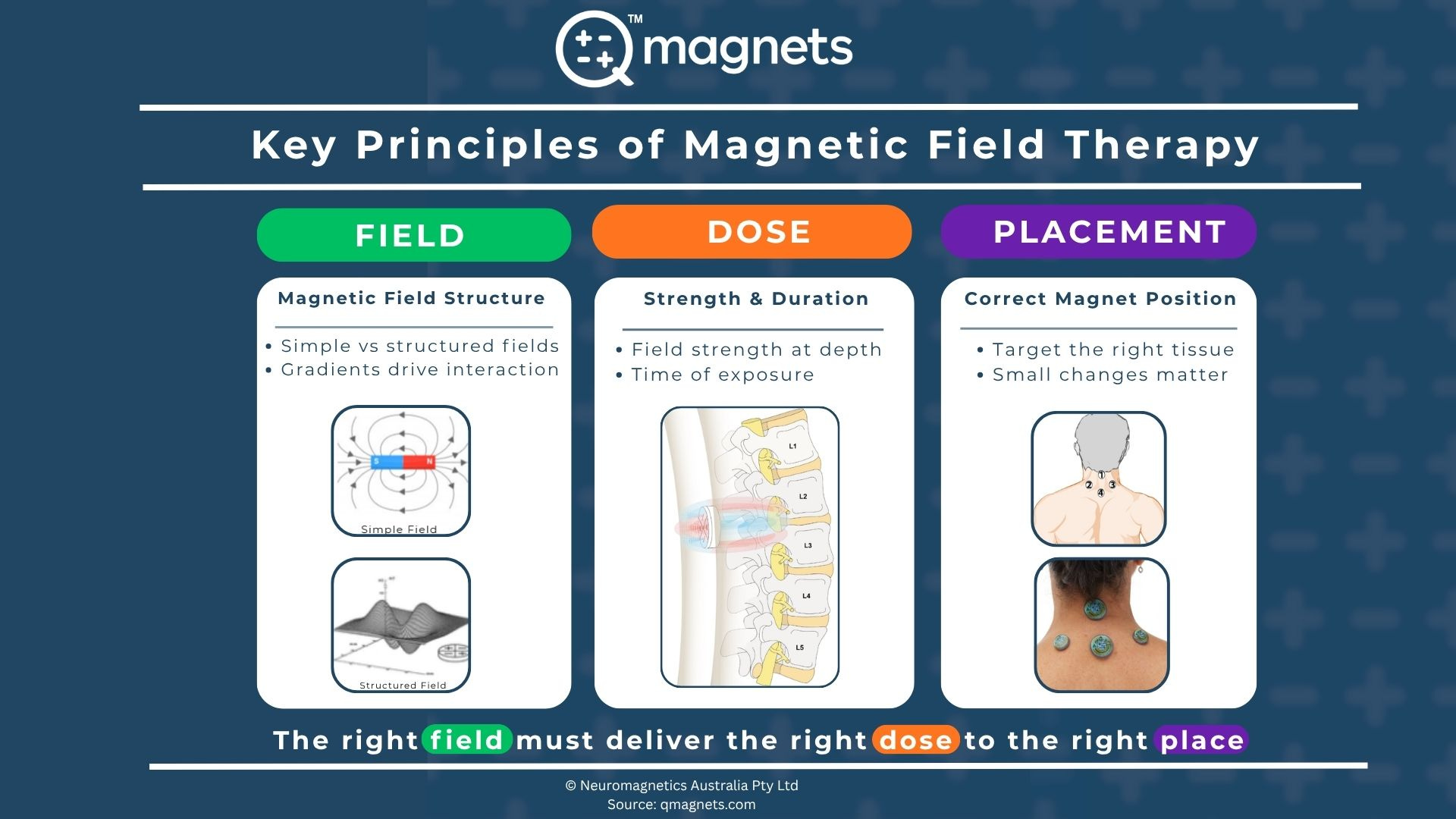
This was a clean example of Field | Dose | Placement.
The injury was small.
The target was superficial.
The placement was precise.
The dose did not need to be large.
By Saturday morning, the bruising and pain had reportedly settled, and he was able to play football that weekend.
This type of case teaches an important principle:
When the injury is recent, localised, and close to the surface, the response may be relatively quick, especially when the magnets are placed accurately.
In cases like this, the wearing strategy is usually straightforward:
Wear while symptoms are active.
Remove once the area feels settled and function has returned.
Reapply if symptoms return.
Case Pattern 2: Chronic Pain with Immediate Relief
The second case is very different.
John had lived with low back pain for 27 years after a lifting and twisting injury. His history included disc bulges at L3/4 and L5/S1, multiple specialists, many therapies, and daily pain medication.
When Q Magnets were placed over the relevant lumbar levels, he noticed an unusual sensation almost immediately.
But the most meaningful change became obvious the next morning.
For the first time in many years, he was able to get out of bed without the same pain. Two weeks later, he reported that his daytime pain had reduced substantially.
This case is important because it challenges an assumption many people make.
People often assume that if pain has been present for decades, any response must be slow.
That is not always what we observe.
Some long-term pain cases may respond quickly, especially when the pain pattern, placement, magnet size, and tissue depth are well matched.
But there is an equally important caution.
Fast pain relief does not always mean the underlying condition has fully resolved.
If someone has had pain for 10, 20, or 30 years, their body may also have developed protective movement patterns, muscle guarding, altered confidence, and sensitised responses.
So in chronic pain cases, the question is not simply:
“Did the pain reduce?”
The better question is:
“What should we do with this window of reduced pain?”
Sometimes the answer is to keep wearing the magnets while the body stabilises. Later, once symptoms are consistently improved, it may be useful to test short periods without them.
Case Pattern 3: Chronic Pain with Delayed Relief and Intermittent Use
The third case involves Beth, who had trigeminal neuralgia affecting all three branches of the trigeminal nerve on the left side of her face.
This was not a simple injury.
Beth had undergone several brain surgeries and was still experiencing severe burning pain.
Using a Field | Dose | Placement approach, she positioned one magnet over the trigeminal ganglion region and another over the occipital area.
Her response was not instant.
After three days of continuous use, she reported a significant reduction in pain intensity. She then continued using the magnets at night for around eight hours while sleeping.
Over time, this became an intermittent routine that fit into her life.
This case helps answer another common question:
“What if I do not feel something immediately?”
In more complex pain states, especially nerve-related pain, the response may build over time. A few minutes may not be enough to judge the application.
This does not mean people should wear magnets indefinitely without thought.
It means the first trial may need to be long enough to give the body a chance to respond.
In Beth’s case, the pattern was:
Consistent early use.
A delayed but meaningful response.
Then intermittent use that suited her daily routine.
That is a very different pattern from the bruised finger.
And that is exactly the point.
Case Pattern 4: Chronic Pain with Strong Relief and Continued Use
The fourth case is Fran’s story.
Fran had lived with chronic atypical trigeminal neuralgia for seven years. After applying Q Magnets, she experienced three weeks completely free from pain.
For someone who had lived with symptoms for years, that kind of relief was understandably difficult to let go of.
And this is where Fran’s case becomes especially important.
When someone finally feels better after years of pain, it is natural to avoid changing anything. If the magnets are helping, why remove them?
But this is where we need to think carefully.
In Fran’s case, the magnets were eventually changed. Smaller magnets were used, and one larger magnet was positioned incorrectly. Her pain returned immediately, and the original comfort could not be recreated despite further attempts.
This story is not a warning that everyone must remove magnets after a fixed period.
It is a lesson in timing, placement, and observation.
When symptoms are active, magnets may provide useful support.
But when symptoms have been absent for several days, that may be the best time to gently test whether the body can remain comfortable without continuous exposure.
If symptoms return, reapply.
If symptoms remain settled, continue without them.
This is not dependency.
It is learning how the body responds.
Pain Relief Is a Window
One of the most important ideas in the new guide is this:
Pain relief creates a window. What you do in that window matters.
When symptoms reduce, it may be easier to sleep, walk, move, rehabilitate, relax, or simply live with less guarding.
But pain relief and full recovery are not always the same thing.
A person may feel better before the tissue has fully recovered. A nerve pathway may settle before the broader pain pattern has fully changed. A chronic condition may improve while still needing ongoing management.
That is why the question “How long should I wear Q Magnets?” cannot be answered with a single number.
The better question is:
What is the context?
Is the problem acute or chronic?
Is the pain local or referred?
Is the target superficial or deep?
Is the response immediate or delayed?
Do symptoms remain settled when the magnets are removed?
Does discomfort return when support is taken away?
These questions are much more useful than asking for a universal wearing time.
A Simple Practical Rule
For most people, the starting point is simple:
Wear Q Magnets while symptoms are active.
Once symptoms have clearly reduced or settled, remove them for a short period and observe what happens.
If symptoms return, reapply.
If symptoms remain settled, continue without them and use again only as needed.
For acute injuries, this may happen quickly.
For chronic pain, the process may take longer.
For complex nerve-related symptoms, some people may need consistent use before testing removal.
The important thing is not to treat symptom return as failure.
And it is not evidence of dependency.
It may simply mean the underlying pain sensitivity, injury, joint irritation, nerve pathway, or recovery issue still needs support.
Read the Full Guide
We have now published a more detailed resource that brings these ideas together and includes all four case studies in more detail.
You can read it here:
It is designed for new users, existing customers, and practitioners who want a clearer framework for response timing, wearing duration, removal, and reapplication.
Because the real answer is not “wear them for X hours.”
The real answer is:
Understand the context.
Match Field | Dose | Placement.
Observe the response.
Remove when symptoms have settled.
Reapply if needed.
And seek professional advice for persistent, severe, worsening, or unexplained pain.
Until next time, stay curious and stay well,
James Hermans
and the Q Magnets Team
The Weekly Reframe
Marcus Aurelius reminded us that what stands in the way can become the way.
Symptom return after removing Q Magnets does not need to be seen as failure.
It may simply be feedback.
Wear while symptoms are active.
Remove when symptoms have settled.
Reapply if discomfort returns.
The goal is not constant use.
The goal is learning what your body is ready for next.
Featured Article
Why Pain Becomes Chronic And Why Early Treatment Matters

Field, Dose and Placement in Magnetic Field Therapy
Magnetic Therapy