Greetings from Q Magnets!
If you are dealing with persistent pain or trying to support recovery, you may have come across a surprisingly long list of options.
Q Magnets.
Red or near-infrared light therapy.
TENS.
PEMF.
Acupuncture.
They can sometimes be used for similar problems, which raises an obvious question:
Are they basically different ways of doing the same thing?
Not really.
In fact, one of the most interesting things about these therapies is just how different they are.
Same Goal, Very Different Inputs
Consider what is actually being applied to your body.
Q Magnets provide a static magnetic field. There are no batteries, electrical leads or light source. Once appropriately positioned, the magnetic field remains present for as long as the magnets are being worn.
Red and near-infrared light therapy, often called photobiomodulation or PBM, delivers light. Photons enter the tissue and can interact with biological molecules, triggering cellular responses.
TENS uses electrodes to deliver small electrical pulses through the skin, stimulating nerves and helping to modulate pain signalling.
PEMF also involves magnetic fields, but unlike a permanent magnet, those fields change with time. That changing magnetic field can induce electrical effects.
Acupuncture is different again. Needle insertion and manipulation provide mechanical and sensory stimulation that can activate peripheral nerves and influence how pain is processed through the nervous system.
So although all five may appear somewhere in pain management or rehabilitation, they are not interchangeable technologies.
Which One Is More Effective?
That sounds like the obvious next question.
But there isn’t a useful universal answer.
It depends on what you are trying to achieve.
A treatment being useful for short-term pain relief does not necessarily mean it is intended to do the same job as an intervention used to support tissue recovery or one designed for prolonged application.
The research also varies between therapies and between different conditions.
That means a better question is:
Which approach makes sense for this particular problem and treatment objective?
How a Treatment Is Used Matters Too
Something else is easily missed when therapies are compared online.
The name of the treatment doesn’t tell you the whole story.
Dose and application matter.
With light therapy, wavelength, intensity, treatment time and the amount of light reaching the target tissue all matter.
With TENS, electrical intensity, pulse settings and electrode placement matter.
With acupuncture, needle placement, depth, stimulation technique and treatment schedule can matter.
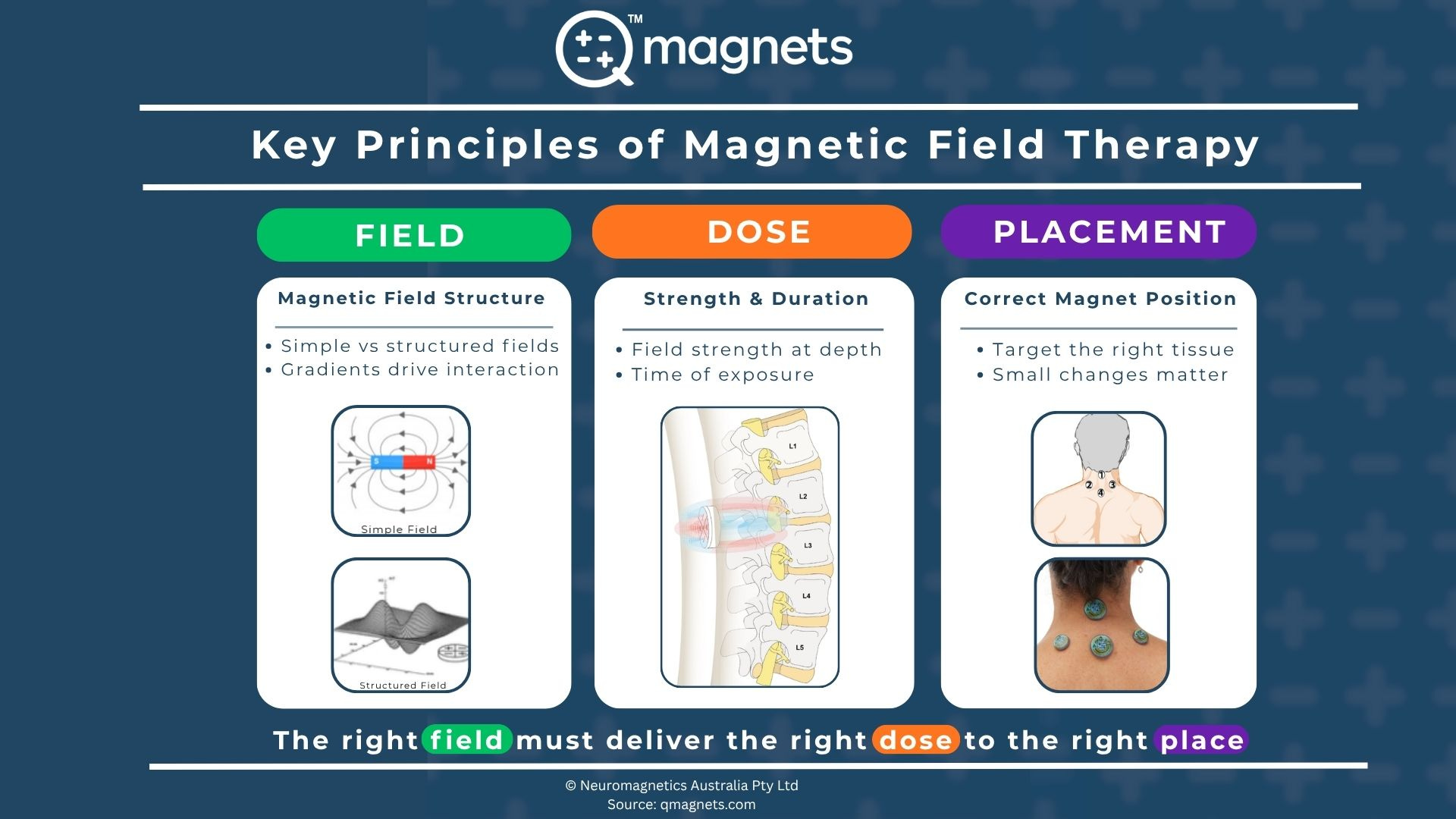
And with static magnetic fields, simply knowing the maximum gauss rating of a magnet does not completely describe the exposure.
The strength of the magnetic field, its spatial pattern, distance from the target tissue, duration of exposure and placement all need to be considered.
For Q Magnets, we describe this as:
Field | Dose | Placement
It is one reason we don’t think it is particularly useful to talk about all therapeutic magnets as though they were identical.
What About “Penetration”?
Another common question is:
Which treatment penetrates deepest?
Again, the comparison is not as straightforward as it sounds.
Light entering tissue is absorbed and scattered.
A static magnetic field behaves differently and extends through biological tissue, although its strength and spatial variation decrease with distance.
Electrical stimulation depends on electrode position, tissue properties and stimulation parameters.
An acupuncture needle can physically reach deeper structures, but needle depth alone doesn’t tell us what physiological response will occur.
So simply asking how “deep” something goes can be misleading.
The more useful question is:
Does an appropriate treatment exposure reach the intended target?
They Don’t Necessarily Have to Compete
This may be the most useful takeaway.
Different therapies don’t necessarily have to compete for the same job.
Someone might use one modality for short-term symptom management and another as part of a longer-duration treatment strategy.
A practitioner may also consider different approaches for different components of the same clinical problem.
What About Combining Q Magnets With Red or Near-Infrared Light?
This is where the differences between modalities become particularly interesting.
Photobiomodulation and Q Magnets provide fundamentally different physical exposures.
PBM delivers energy to tissue in the form of red or near-infrared photons. Q Magnets provide a persistent, spatially varying static magnetic-field environment while they remain appropriately positioned.
Because the two modalities provide different physical inputs and are proposed to interact with biology in different ways, there is a reasonable basis for exploring their combined use.
Experienced practitioners using Q Magnets alongside photobiomodulation have reported that the combination can appear to work particularly well in clinical practice, with some describing the effect as synergistic.
Still, understanding that the therapies work through different physical inputs helps explain why choosing one does not automatically make the others redundant.
Effectiveness Isn’t the Only Consideration
When deciding whether a treatment is appropriate, effectiveness matters, but so do practical considerations.
Questions worth asking include:
What am I actually trying to achieve?
What evidence exists for this treatment for my particular problem?
What are the risks, precautions and contraindications?
How easy is it to use correctly?
Does it require repeated appointments or specialised equipment?
Can it be used outside the clinic?
What does treatment cost over time?
Could another approach address a different part of the problem?
For some people, convenience and the ability to continue treatment at home may be important.
For others, direct practitioner involvement may be desirable.
There isn’t one answer that applies to everyone.
The Bigger Lesson
Magnets, red light, TENS, PEMF and acupuncture may sometimes appear beside each other in discussions about pain and recovery.
But underneath the surface, they are remarkably different.
The useful sequence is:
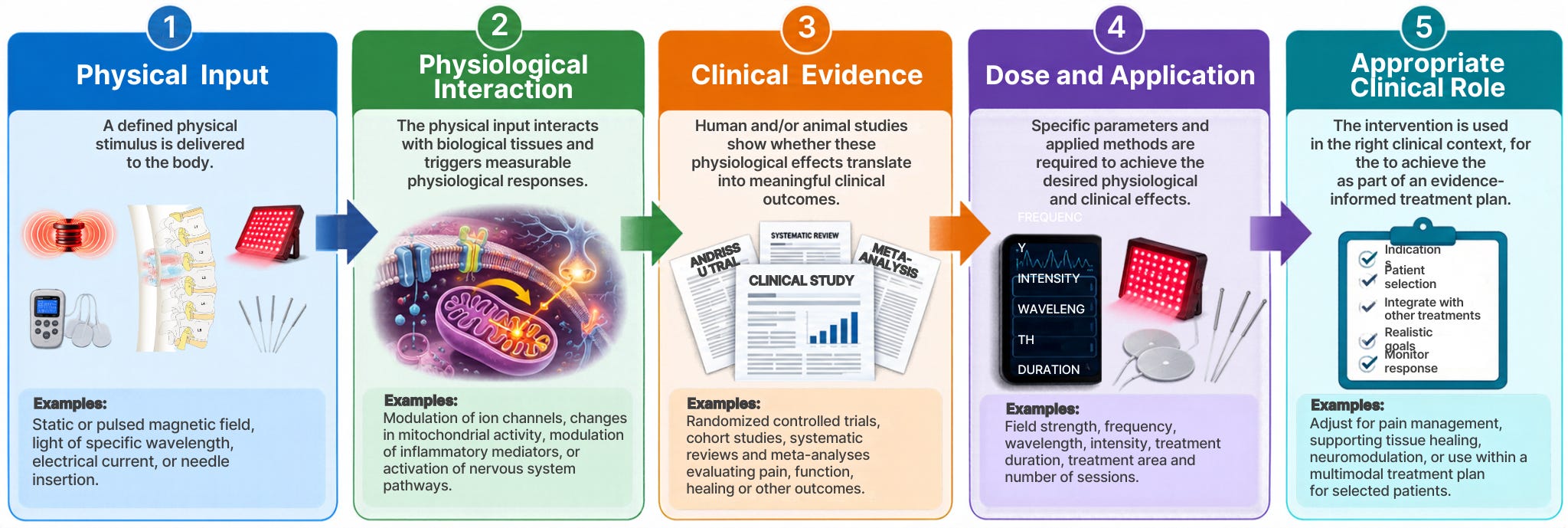
That’s a much better starting point than asking which technology is the “strongest.”
Want to Go Deeper Into the Physics?
We’ve published a detailed comparison looking at static magnetic fields, PEMF, photobiomodulation, TENS and acupuncture from the physics through to physiology, clinical evidence, dose and application.
It includes the actual physics—including magnetic field gradients, electromagnetic induction, photon energy and electrical stimulation—for readers who want to understand why these therapies are fundamentally different.
Read the full scientific article:

This article is educational and is not a substitute for individual medical advice. Treatment suitability, precautions and contraindications should be considered for the individual and the modality being used.
Until next time, stay curious and stay well,
James Hermans
and the Q Magnets Team
Weekly Reframe
Horses for courses. Magnets for fields, light for photons.
Featured Article
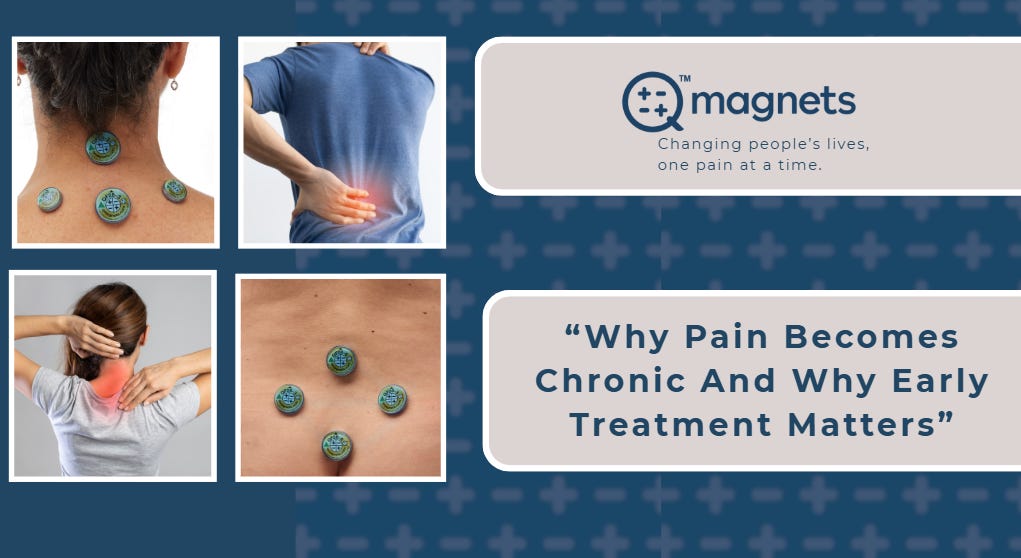
Why Pain Becomes Chronic And Why Early Treatment Matters
Field, Dose and Placement in Magnetic Field Therapy
Magnetic Therapy