Greetings!
When most people hear the words magnetic therapy, they usually picture something simple: a magnet, placed on a painful area, either “working” or “not working.”
But that is not how the better research reads.
And it is certainly not how we think about it at Q Magnets.
A good example surfaced in an older article published in American Family Physician. The article summarised a Harvard-affiliated pilot study by Wolsko and colleagues looking at static magnets for osteoarthritis of the knee.
The headline was straightforward enough: Magnet therapy appeared to produce short-term pain relief in knee osteoarthritis.
But the most interesting part of the study was not the headline.
It was the device.
The active sleeve used in the study was not just a generic magnet strapped to the knee. The researchers had gone to considerable effort to design a high-strength magnetic knee sleeve that exposed the knee to both high field intensity and high field gradients.
In other words, the study was not really testing “a magnet” in the everyday sense.
It was testing a deliberately engineered magnetic field environment.
That distinction matters.
The Problem With Asking, “Do Magnets Work?”
The usual public conversation around magnets is far too blunt.
People ask:
“Do magnets work for knee pain?”
But that question skips over the variables that may matter most.
· What kind of magnet?
· What field configuration?
· How strong is the field at the target tissue?
· How quickly does the field change across space?
· Where is the magnet placed?
· How long is it worn?
· Is the painful structure superficial or deep?
· Is the pain mainly local tissue irritation, sensitized nerve behaviour, or part of a broader pain pattern?
These are not minor details.
They may be the whole conversation.
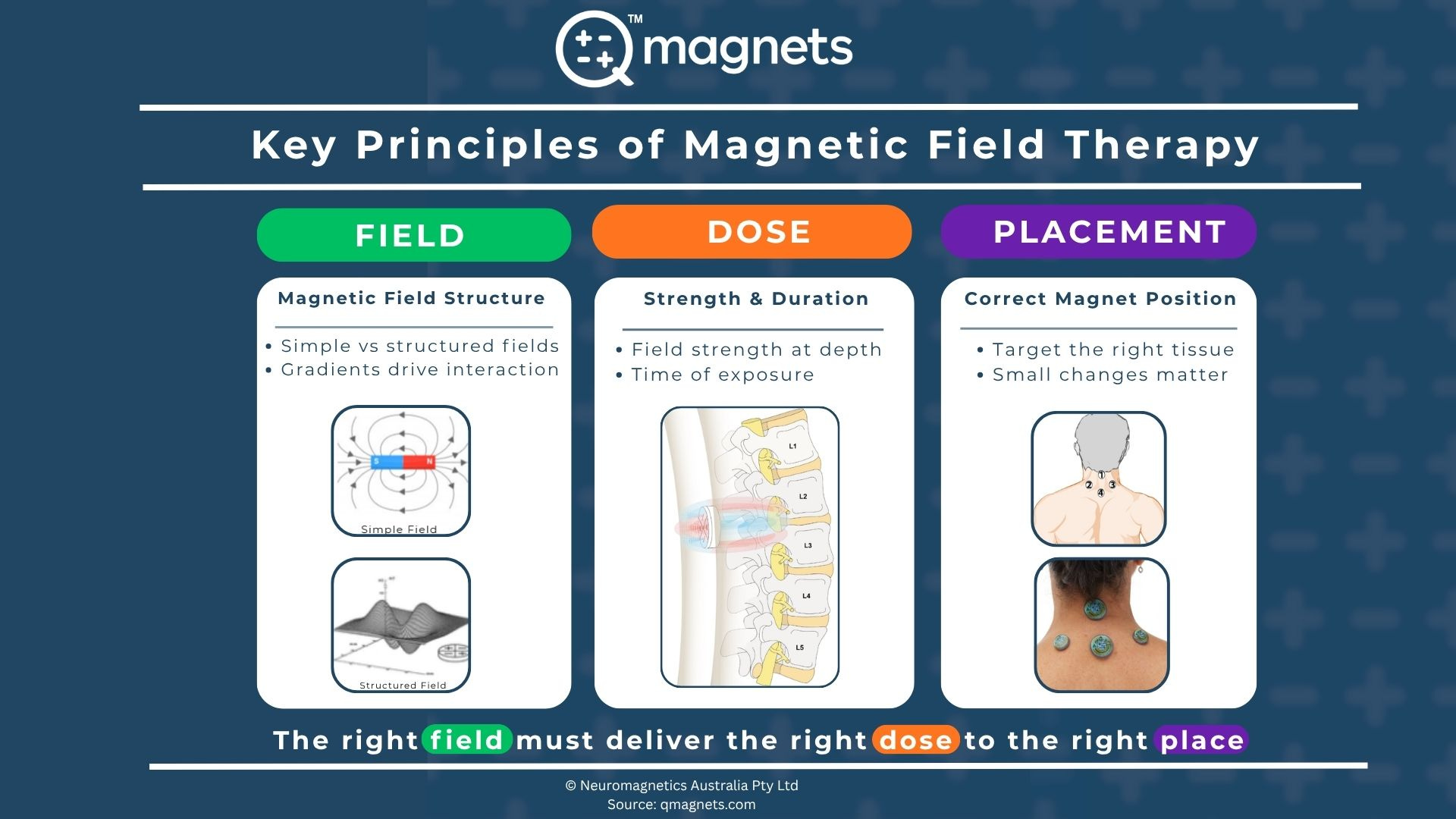
This is why Q Magnets uses the Field | Dose | Placement framework. It moves the question away from generic magnetic therapy and toward something more useful:
Under what conditions might a static magnetic field environment influence pain, recovery, or nervous system behaviour?
What the Wolsko Knee Study Helps Us See
The Harvard Medical School/Wolsko knee study is often summarised as a simple magnetic therapy trial. But when you look more closely, several details stand out.
The researchers were concerned about proper blinding. That is important because static magnet trials are notoriously difficult to blind. If a participant can test whether the device sticks to metal, the placebo becomes obvious.
This is what researchers call unblinding.
So the researchers created a clever sham sleeve that still appeared magnetic from the outside, but directed little meaningful field toward the knee joint.
That is good trial design, and it is similar in principle to the approach used by Segal and colleagues in their study of multipolar static magnets for rheumatoid arthritis of the knee.
But the most interesting detail is how Wolsko and colleagues described the active sleeve.
They did not only describe it in terms of magnetic strength. They also described the gradient.
The active knee sleeve exposed a large adult knee to magnetic field intensities ranging from about 40 to 850 Gauss, with magnetic gradients reported as high as 100 G/mm. The authors noted that these gradients were in the same general order of magnitude as in-vitro gradients associated with suppression of sustained action potential firing in earlier laboratory work by Cavopol.
That is the part most people miss.
Even the American Family Physician POEM summary does not mention field gradients. Most clinicians reading it would likely walk away thinking the study was simply about “high-strength magnets.”
But strength alone is not the whole story.
A field gradient refers to how quickly the magnetic field changes from one point in space to another.
In plain language, it is not just “how strong is the field?”
It is also:
“How much does the field vary across the tissue?”
That spatial variation is especially relevant when discussing multipolar magnets, because alternating polarity designs can create more complex field environments than a simple north-south magnet.
Why Multipolar Magnets Are Different
Most people have heard of magnets.
Very few have heard of multipolar magnets.
When I speak with members of the public or health professionals, I often ask who has heard of multipolar magnets. Almost no one puts their hand up.
That tells us something.
People are not necessarily rejecting the idea of magnetic therapy. In many cases, they have never been introduced to the important design questions.
A simple bipolar magnet has a north and south pole. A multipolar magnet uses multiple poles arranged in a specific configuration. Q Magnets use engineered multipolar designs such as quadrupolar, hexapolar, octapolar, and alternating polarity concentric ring configurations.
These designs are not just aesthetic.
They are intended to create localized field gradients and more complex magnetic field geometry. That may be one reason why lumping all “magnets” together is scientifically unhelpful.
A weak flexible magnetic sheet, a fridge magnet, a simple bipolar disc, and a precision multipolar medical magnet should not automatically be treated as equivalent.
They are different field environments.
What the Laboratory Research Suggests
The field-gradient discussion becomes especially interesting when we look at the earlier Vanderbilt/McLean/Cavopol work.
In cultured sensory neurons, researchers observed that static magnetic fields generated by arrays of permanent magnets could influence sustained action potential firing. Importantly, the effect appeared to depend strongly on spatial variation in the field.
This does not mean we can simply jump from a laboratory dish to a human knee and claim the same thing is happening.
We should not do that.
But it does provide a plausible reason to take field geometry seriously.
If certain biological interactions depend more on spatial field variation than on raw field strength alone, then the old question “How many gauss is it?” becomes too simplistic.
A better question is:
What field is being created at the relevant tissue, and is the placement appropriate for the pain pattern?
What Knee Pain Testimonials Can Teach Us
Customer testimonials are not the same as controlled clinical trials.
But they are still valuable when they are used correctly.
The most useful testimonials do not simply say, “My knee felt better.” They help us understand the real-world pattern:
· Where was the discomfort?
· Where were the magnets placed?
· How long were they worn?
· Was the change immediate, gradual, or inconsistent?
· Did walking, stairs, sleep, or confidence with movement improve?
· Was the result sustained, or did the magnets need to be reapplied?
This is where published studies and customer experience can complement each other.
Studies help us ask whether an effect can be detected under controlled conditions.
Testimonials help us understand how people actually use magnets in daily life.
We have received many authentic knee pain testimonials over the years. One example involving knee osteoarthritis and Q Magnets was also published in Medical Acupuncture, and several other knee pain stories are collected on the Q Magnets website.
These stories are not proof that every knee pain case will respond the same way.
But they do remind us that application details matter.
For knee pain, practical context is especially important. Knees are not simple structures. Pain may arise from the joint line, patellofemoral region, soft tissue irritation, tendon attachment areas, referred patterns, or sensitized nerves around the knee. A single placement may not suit every case.
That is why Field | Dose | Placement is not a marketing slogan.
It is a practical framework.
For readers who want the practical knee pain guide, the Primary Page is here:
Magnetic Therapy for Knee Pain Using Q Magnets
You can also read several knee pain experiences here:
Using Magnetic Field Therapy to Put Knee Replacement Surgery on the Backburner

Even one published in a medical journal…
https://journals.sagepub.com/doi/full/10.1089/acu.2022.29203.rcn?cf-mal-redirected=true&
Why the Wolsko Study Still Matters
The Wolsko study did not provide a sweeping answer.
The short-term results were encouraging. The authors concluded that, despite the small sample size, magnets showed statistically significant benefit compared with placebo after four hours under rigorously controlled conditions.
But at six weeks, the difference between active and sham groups was not statistically significant.
Some people may read that and say, “So magnets do not work.”
Others may say, “They clearly work.”
Both interpretations are too simplistic.
The more useful interpretation is this:
The study suggests that static magnetic field therapy for knee osteoarthritis deserves careful investigation, especially when field characteristics, gradients, dose, placement, and placebo design are properly described.
It also reminds us that pain is not one thing. Knee osteoarthritis pain can involve local tissue changes, inflammation, mechanical load, sensitized nerve endings, and central pain processing.
A magnetic device is not a replacement for strength work, weight management, mobility, medical assessment, or appropriate professional care.
But it may be a useful non-pharmaceutical support tool for some people, particularly when the application is thoughtful.
The Practical Takeaway
The next time someone asks, “Do magnets work for knee pain?” the best answer may be:
“It depends what kind of magnet, what kind of field, what dose, and where it is placed.”
That is not a dodge.
It is a more scientific answer.
A multipolar medical magnet is not just a stronger version of a fridge magnet. It is an engineered field-based recovery tool designed to create a localized static magnetic field environment.
For some people with knee pain, the right application may help reduce discomfort enough to move more confidently, sleep more comfortably, or participate more easily in rehabilitation.
For others, especially where the pain is complex, severe, structural, or referred from elsewhere, magnets may be only one small part of the picture.
The important step is to stop treating all magnets as the same.
· Field geometry matters.
· Dose matters.
· Placement matters.
· Context matters.
And when we understand those variables, the conversation becomes much more useful.
References
Cavopol, A. V., A. W. Wamil, et al. (1995). “Measurement and analysis of static magnetic fields that block action potentials in cultured neurons.” Bioelectromagnetics 16(3): 197-206. PMID 7677796; doi:10.1002/bem.2250160308
Segal, N. A., Y. Toda, et al. (2001). “Two configurations of static magnetic fields for treating rheumatoid arthritis of the knee: a double-blind clinical trial.” Arch Phys Med Rehabil 82(10): 1453-1460. PMID 11588753; doi:10.1053/apmr.2001.24309
Wolsko PM, et al. (2004). “Double-blind placebo-controlled trial of static magnets for the treatment of osteoarthritis of the knee: results of a pilot study.” Altern Ther Health Med. Mar-Apr;10(2):36-43. PMID: 15055092”
Until next time, stay curious and stay well,
James Hermans
and the Q Magnets Team
The Weekly Reframe
Not all magnets are the same.
And not all knee pain is the same.
The better question is not simply whether magnetic therapy works.
The better question is whether the right field is being applied, at the right dose, in the right place, for the right pain pattern.
Featured Article
Why Pain Becomes Chronic And Why Early Treatment Matters

Field, Dose and Placement in Magnetic Field Therapy
Magnetic Therapy