Greetings from Q Magnets!
Most discussions about therapeutic magnets eventually come back to pain.
Back pain. Knee pain. Arthritis. Injury. Sensitised nerves.
That does makes sense. Pain relief is where much of the interest in static magnetic fields has historically been concentrated, and it is also where Q Magnets are intended to be used.
But researchers haven’t always limited themselves to pain.
Over the years, static magnetic fields have been investigated in animals and humans in connection with inflammation, swelling, wound repair, blood glucose regulation, vascular responses and other physiological processes.
A recently published mouse study adds another unusual application to that list.
Researchers placed a small magnetic collar around the necks of mice with experimentally induced autoimmune thyroiditis, a model intended to resemble aspects of Hashimoto’s thyroiditis.
They weren’t simply measuring pain behaviour.
They measured thyroid hormones, thyroid antibodies, inflammatory markers, gene expression and changes within thyroid tissue itself.
That did get our attention.
Not because it provides evidence for treating Hashimoto’s disease with magnets. It doesn’t.
But it does raise a bigger question:
What biological processes might respond to appropriately applied static magnetic fields and under what conditions?
A Very Unusual Magnetic Experiment
The researchers divided the mice into four groups:
healthy controls;
untreated mice with experimental autoimmune thyroiditis;
mice receiving a nutraceutical combination; and
mice receiving the same nutraceutical combination plus local static magnet exposure.
The supplement contained vitamin C, vitamin D3, selenium, zinc and Nigella sativa extract.
For the magnetic intervention, the researchers constructed a soft collar containing small neodymium magnets positioned over the anterior neck, above the thyroid gland.
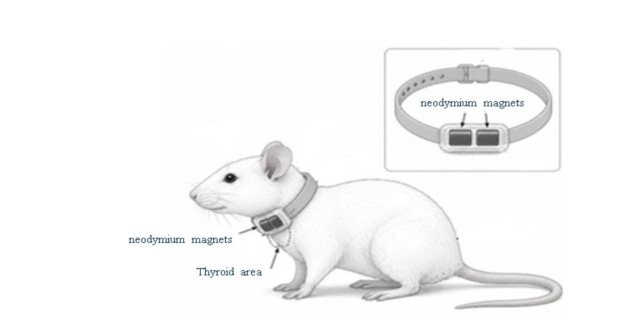
And this is one reason the accompanying photograph is so interesting.
It isn’t an abstract laboratory apparatus.
It is essentially a wearable local static-field intervention.
The researchers reported that the supplement group showed improvements in several biochemical measures compared with untreated animals. They also reported further differences in the group receiving both the supplement and magnetic exposure, including measures related to thyroid hormones, antibodies, inflammation and thyroid tissue structure.
Interesting?
Certainly.
Proof that static magnets treat Hashimoto’s disease?
Absolutely not.
This was a very small animal experiment, with only four mice per group. There was no magnet-only group and no proper sham-magnet collar group. There are also inconsistencies within the paper regarding the magnetic field strength and exposure duration reported in different sections.
So we need to keep the findings firmly where they belong:
Preliminary, hypothesis-generating animal research.
But sometimes an imperfect experiment can still prompt a very good question.
Static Magnetic Fields Have Been Taken Beyond Pain Before
This isn’t the first time researchers have used permanent static magnets to investigate something other than ordinary pain relief.
Readers who have followed MagnaBlog may remember the work of Hungarian researcher János László and colleagues.
In one of their mouse experiments, they investigated analgesia and found that the biological response depended substantially on the distribution and arrangement of the permanent magnets being used. In other words, merely saying that an animal was “exposed to magnets” wasn’t enough. How those magnets were configured mattered and what mattered most was the alternating magnetic pole matrix and a strong magnetic field gradient.
That fits closely with an idea we discuss regularly:
Field matters.
But László’s group didn’t stop at pain.
In another experiment, diabetic mice received 30 minutes of whole-body exposure each day to a highly inhomogeneous (think non-uniform/gradient) static magnetic field. The researchers reported a significant reduction in blood glucose in one diabetic group. Again, this was an animal experiment—not a clinical treatment recommendation—but it demonstrates that researchers have asked questions about static fields that extend considerably beyond analgesia.
Other researchers have done the same.
What About Inflammation and Swelling?
One particularly interesting experiment came from biomedical engineers at the University of Virginia.
Researchers deliberately produced localised inflammation and swelling in rat paws and then exposed the paws to static magnetic fields.
They tested different field strengths.
What happened was especially interesting.
Static fields of 10 mT and 70 mT reduced experimentally induced oedema, while a much stronger 400 mT field did not. Timing mattered too: applying the field at some stages of the inflammatory response produced an effect, whereas applying it at other stages did not. The clearest pattern was that earlier application produced the greater effect.
That finding deserves attention for another reason.
It challenges the simple assumption:
If some magnetic field is useful, more magnetic field must be better.
That is not necessarily how biological systems behave.
It looks like there are windows in which particular exposure conditions interact with a biological process, while considerably stronger exposure does not produce the same result.
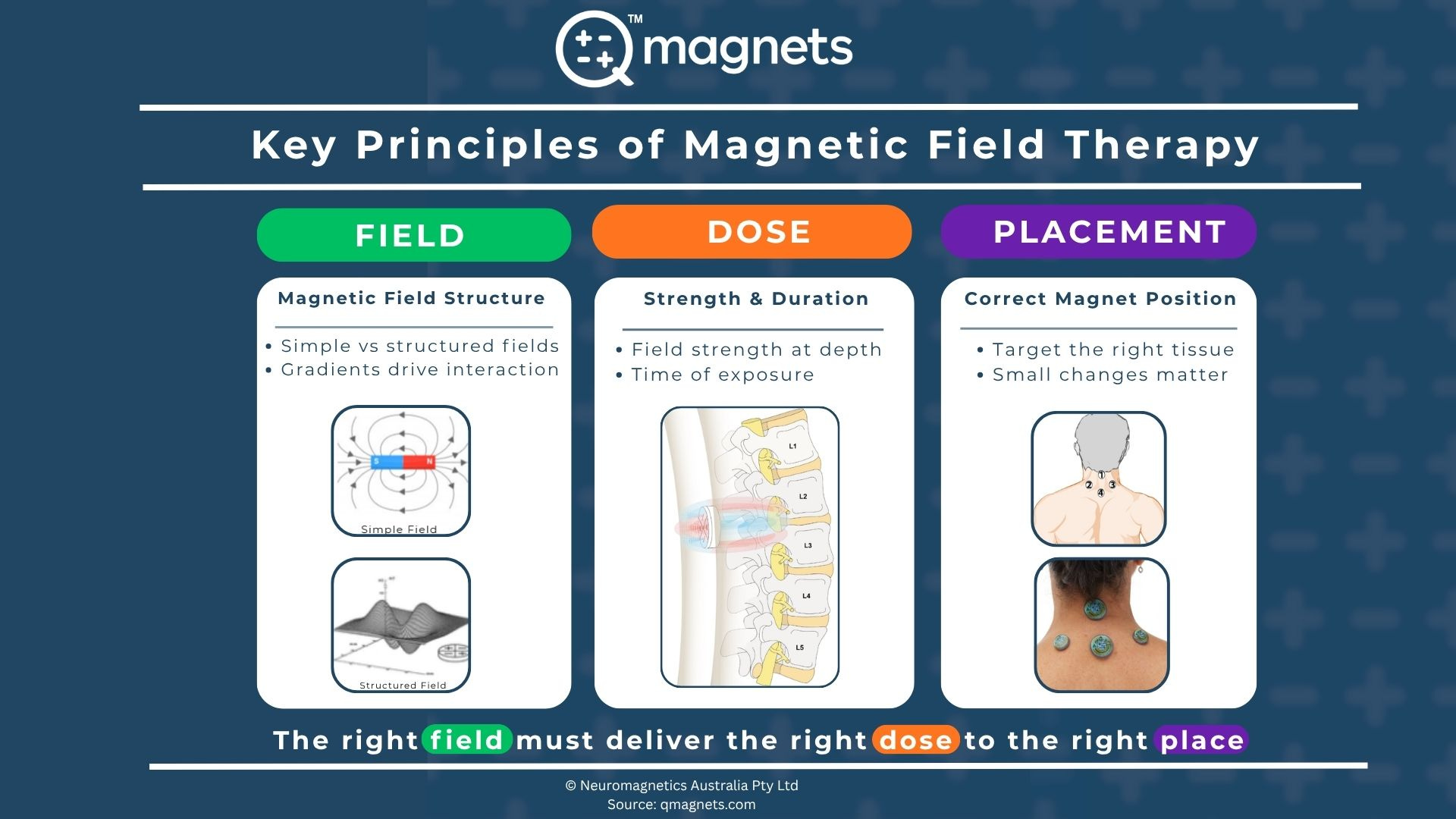
That takes us straight back to Field | Dose | Placement | Context.
Wound Healing Has Also Been Investigated
Static magnets have also been studied in experimental wound healing.
A recent systematic review identified eight rodent studies in which static magnetic fields were applied to skin wounds.
The overall results were mixed.
The pooled analysis did not find a statistically significant improvement for some measures of wound area. However, differences were reported in gross healing time and tensile strength in some comparisons.
Again, that does not establish magnets as a wound-healing treatment.
But it shows something important about the history of this field:
Researchers have repeatedly investigated static magnetic exposure as a biological variable, not merely as a way to alter pain perception.
Human Research Is Broader Than Many People Realise
There has also been considerable human research involving permanent static magnets.
A critical review published in 2009 identified 56 human studies, involving 39 different physiological or pathological conditions.
These included areas as varied as osteoarthritis, peripheral neuropathy, vascular disease, wound and ulcer healing, muscle soreness, blood flow, heart rate and blood pressure.
But there was a major problem.
The researchers found that 61% of the studies did not describe the magnetic exposure sufficiently well for another researcher to reproduce it.
Important details were often missing:
magnet dimensions;
actual measured field strength;
distance between the magnet and target tissue;
characteristics of the field being applied.
And that may tell us something about why the magnetic-therapy literature has remained so difficult to interpret.
Perhaps the question has too often been:
Do magnets work?
when the better question is:
What field was applied, at what dose, to what tissue, in what location, and under what biological conditions?
Field | Dose | Placement | Context
This is why we keep returning to the same framework.
Field
What type of magnetic field was actually applied?
A uniform field and a highly inhomogeneous field are not the same exposure.
A simple single-pole arrangement and an engineered multipolar field are not the same exposure.
The spatial gradient can matter just as much as the number printed in gauss or millitesla.
Dose
How strong was the field at the tissue?
How far was the tissue from the magnet?
How long was the exposure?
Was it applied once, for minutes, for hours, or repeatedly for weeks?
The University of Virginia oedema experiment is a good reminder that simply increasing magnetic field strength does not necessarily increase a biological response.
Placement
Where was the field applied relative to the tissue being investigated?
This is especially interesting in the new thyroid study.
The researchers weren’t exposing the entire mouse indiscriminately.
They deliberately positioned the magnets over the thyroid region.
Context
And perhaps the variable that receives the least attention:
What biological process was occurring at the time?
Acute inflammation?
Chronic sensitisation?
Tissue injury?
Metabolic dysfunction?
Autoimmune activity?
Recovery?
The same static field might conceivably interact differently with tissues in very different physiological states.
We don’t yet know.
That’s precisely why these experiments are interesting.
This Isn’t About Acupuncture Magnets
There is an important distinction worth making.
Acupuncturists have used small magnets on acupuncture points for many years, sometimes instead of needles or as a way of providing prolonged stimulation after treatment.
That is interesting in its own right.
But conceptually it is a different question.
If a magnet is being used primarily to stimulate an acupuncture point according to an acupuncture framework, it becomes difficult to determine whether an observed effect relates to the properties of the static magnetic field itself, stimulation of the selected point, or some combination of the two.
The same caution applies to other systems involving magnets, including approaches such as the Biomagnetic Pair method developed by Dr Isaac Goiz.
Those systems raise their own questions and deserve separate discussion.
For this article, we’re interested in something narrower:
What happens when researchers treat a local static magnetic field itself as the experimental intervention?
And That Brings Us Back to the Mouse With the Collar
The photograph from the new thyroid study looks almost deceptively simple.
A mouse.
A small collar.
Two permanent magnets.
Yet the researchers were attempting to influence—or at least investigate—a complicated inflammatory and autoimmune process occurring inside an organ beneath those magnets.
The study is nowhere near strong enough to tell us whether the reported effects are clinically meaningful.
It certainly doesn’t tell us that people with Hashimoto’s disease should start placing magnets over their thyroid.
But perhaps its real value is different.
It reminds us how little of the potential biological landscape of static magnetic fields has been systematically mapped.
Pain may only be one place researchers have looked.
Have You Seen Something We Should Know About?
This brings us to our readers.
Among MagnaBlog subscribers are clinicians, acupuncturists, therapists, researchers and people who have been experimenting with static magnets for many years.
Some of you have probably used magnets in ways that extend beyond straightforward musculoskeletal pain.
We’re curious.
Have you ever observed an unexpected effect from static magnetic-field exposure that appeared to extend beyond pain relief?
Perhaps something involving:
swelling;
recovery following an injury;
an inflammatory response;
tissue healing;
some other physiological change you weren’t expecting.
We’re particularly interested in observations that appeared to be repeatable.
If you have something worth sharing, don’t just tell us that “the magnets helped.”
Tell us:
Field — What magnet or magnetic configuration did you use?
Dose — How long was it applied, and how frequently?
Placement — Exactly where did you put it?
Context — What was happening physiologically or clinically at the time?
Observation — What changed?
And perhaps most importantly:
Did the same thing happen again when you repeated the application?
Please don’t experiment with magnets to treat serious medical conditions or use them in place of appropriate medical care simply because of something discussed in this newsletter.
We’re asking about observations that have already occurred.
Anecdotes are not clinical evidence.
But careful observations can generate questions.
And good questions are often where research begins.
Perhaps We Have Been Asking the Wrong Question
For decades, debate around magnetic therapy has often been reduced to two opposing positions.
Magnets work.
Or:
Magnets don’t work.
Biology is rarely that simple.
The research discussed here suggests a much more interesting question:
Under what Field, Dose, Placement and Context might a static magnetic field produce a measurable biological effect?
We don’t yet have that map.
But studies ranging from László’s experiments with field configuration, to inflammatory oedema, wound healing, metabolic models and now autoimmune thyroiditis suggest that researchers have been quietly exploring different parts of it for decades.
Some findings will undoubtedly fail to replicate.
Some mechanisms proposed today will probably turn out to be wrong.
Some apparent effects may disappear under better experimental controls.
That is how science progresses.
But if static magnetic fields can interact measurably with biology under certain conditions, the important task isn’t to believe in magnets.
It is to discover the conditions.
Field. Dose. Placement. Context.
And perhaps some of our readers have observations that could point towards questions researchers haven’t thought to ask yet.
Until next time, stay curious and stay well,
James Hermans
and the Q Magnets Team
Research discussed
László J, et al. Optimization of static magnetic field parameters improves analgesic effect in mice. Bioelectromagnetics. 2007;28:615–627. PMID: 17654477
László JF, et al. Daily exposure to inhomogeneous static magnetic field significantly reduces blood glucose level in diabetic mice. International Journal of Radiation Biology. 2011;87:36–45. PMID: 20961270
Morris CE, Skalak TC. Acute exposure to a moderate strength static magnetic field reduces edema formation in rats. American Journal of Physiology – Heart and Circulatory Physiology. 2008. PMID: 17982018
Lewandoski LT, et al. Static magnetic field on wound healing in rodents: a systematic review and meta-analysis. Electromagnetic Biology and Medicine. 2025. PMID: 39760456
Colbert AP, et al. Static magnetic field therapy: a critical review of treatment parameters. Evidence-Based Complementary and Alternative Medicine. 2009. PMID: 18955243
Yaramiri A, et al. A novel non-invasive combination of nutraceuticals and magnet therapy for Hashimoto’s thyroiditis: preclinical evidence. 2026. REF
Weekly Reframe
You’ve heard the saying, “Timing is everything.”
This research suggests static magnetic fields may be no exception: when the field is applied could matter just as much as how strong it is.
Featured Article
Why Pain Becomes Chronic And Why Early Treatment Matters
Field, Dose and Placement in Magnetic Field Therapy
Magnetic Therapy