Greetings from Q Magnets!
This week, 20 rather unusual Q Magnet devices were sitting on a steel tray in our workshop.
They looked like Q Magnets.
They were made to serve as Q Magnets in a research setting.
But they were placebos.
Beside them was a stack of active Q Magnets.
The difference was immediately visible.
The active devices pulled strongly towards one another and interacted with the steel plate beneath them. The placebo devices did not show the same obvious magnetic behaviour.
It made such a simple demonstration that I recorded a short video.
The same clip is also available on YouTube Short.
But the interesting part is not really the video.
It is the research problem behind it.
How do you make a placebo for a magnet?
With a drug trial, researchers can often manufacture two tablets that look virtually identical.
One contains the active ingredient.
The other does not.
With static magnets, things become more complicated because the treatment has a physical property that can potentially be tested.
Bring a magnet near a piece of steel and you may quickly discover whether it is magnetic.
Put two strong magnets together and the answer becomes even more obvious.
That creates a problem for researchers.
If participants are meant to be blinded to whether they received the active or control intervention, what happens if they discover which device they have?
We were writing about this problem as far back as 2012 in our article on the challenges of designing placebo static magnets for double-blind clinical trials.
It remains an important issue today.
A placebo is not necessarily as simple as using a weaker magnet
One apparent solution is to use a weak magnet as the control.
The participant still feels that they have been given something magnetic, so perhaps they are less likely to know which group they belong to.
But that introduces another question:
Is a weak magnetic field really a placebo, or is it simply a lower dose of the intervention?
Researchers Colin Greaves and Tim Harlow explored exactly this problem in 2008. They compared 50 mT magnetic bracelets with stronger 180 mT bracelets. Participants were not significantly different in their beliefs about whether they had received the active device, but those testing the stronger magnets expected greater pain relief. The researchers concluded that weak magnets created problems as placebo controls when participants were able to test the devices.
That distinction matters.
If the intervention being investigated is a magnetic field, a control that still exposes the participant to a biologically relevant magnetic field may no longer be an inert placebo.
It may be a dose-comparison study.
Our older Magnetic Placebo Device page discusses one approach we developed to this problem, using a device engineered to resemble the active device, while substantially changing the field presented towards the body. Even there, we acknowledged the underlying methodological question, rather than pretending it had disappeared.
This is why the details of magnet studies matter
Magnetic therapy research is often reduced to a very simple headline:
“Researchers tested magnets.”
But what exactly did they test?
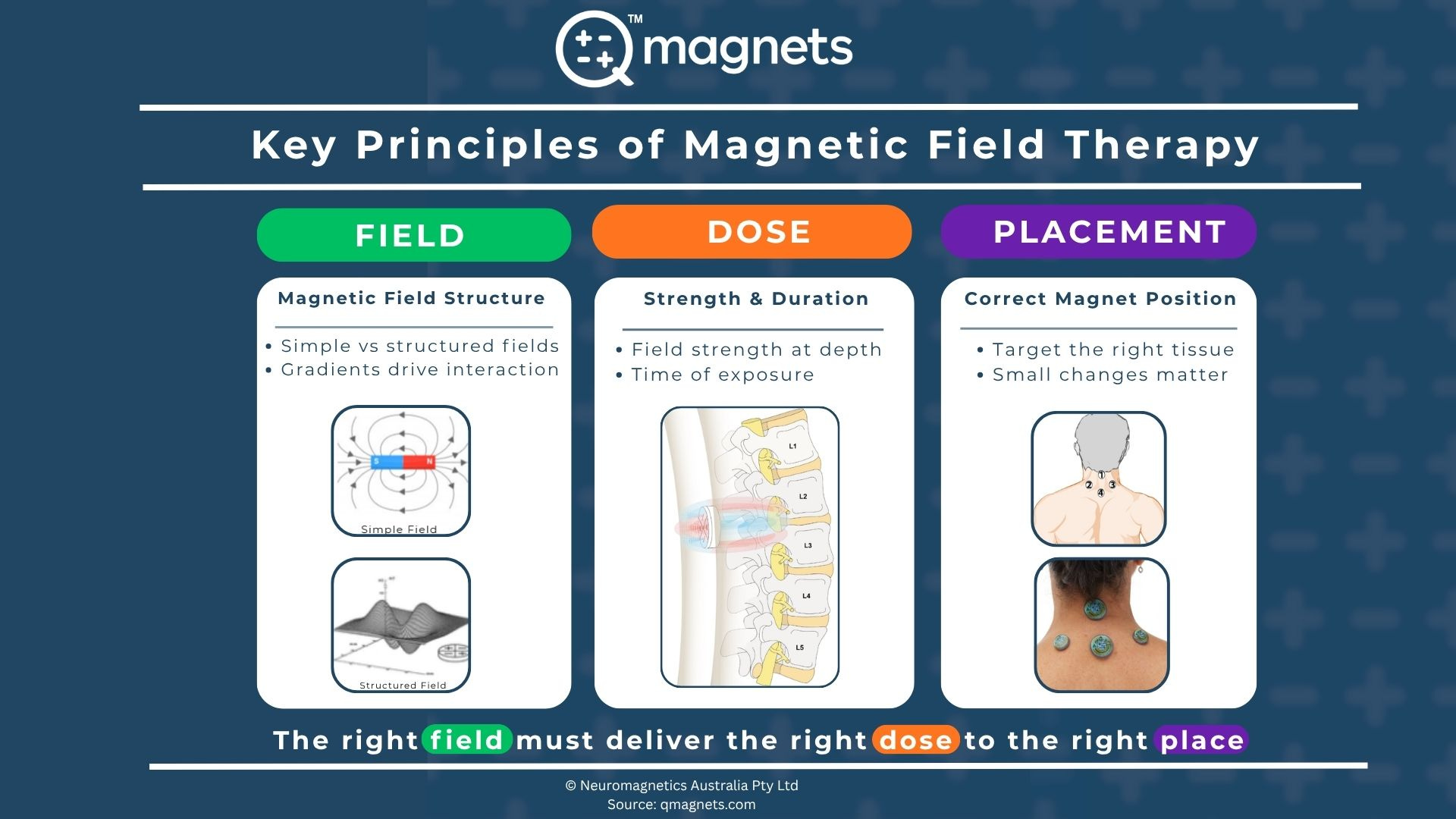
That question becomes much more useful when we think in terms of our familiar framework:
Field | Dose | Placement | Context
The Field needs to be defined. Was it homogeneous or strongly inhomogeneous? Bipolar or multipolar? What field strength and gradient actually reached the target region?
The Dose matters. How strong was the exposure at the tissue, and how long was the device worn?
The Placement matters. Was the device applied over the relevant anatomical region or simply somewhere convenient?
And Context matters. What condition was being investigated, what outcome was being measured, and what was the control device actually doing?
This is why we’ve increasingly moved away from asking the blunt question, “Do magnets work?”
A better research question is:
Under what field, dose, placement and experimental conditions might a static magnetic field influence a measurable biological or clinical outcome?
We explored that distinction more deeply in our MagnaBlog on Field, Dose and Placement.
Placebo design is part of the experiment
When most people read the results of a clinical trial, they naturally look at the outcome.
Did the active group improve more than the control group?
But before interpreting that result, there are several other questions worth asking:
What magnetic field did the active device actually produce?
What field, if any, did the placebo produce?
Could participants distinguish the active device from the placebo?
Were field, dose, placement and exposure time appropriate for the question being investigated?
These aren’t minor technicalities.
They help determine what the trial actually tested.
We recently touched on the same problem when looking at knee-pain research, where the design of the magnetic intervention and the researchers’ attempts to maintain blinding were an important part of understanding the study rather than an inconvenient footnote. Read that MagnaBlog here.
Why do we make placebo devices?
From time to time, researchers approach us because they want to investigate static magnetic fields under controlled conditions.
Where appropriate, we can manufacture placebo devices alongside the active Q Magnet devices required for the study.
We don’t determine what the trial will find.
Nor should we.
The purpose of controlled research is to give the experiment the opportunity to answer the question.
Sometimes that means making the active device.
Sometimes it means putting just as much thought into the placebo.
And occasionally it leaves you with 20 rather convincing placebo devices sitting beside a stack of very magnetic Q Magnets on a steel tray.
Which, as it turns out, makes the research problem rather easy to see.
Until next time, stay curious and stay well,
James Hermans
and the Q Magnets Team
References
Greaves CJ, Harlow TN. Exploration of the validity of weak magnets as a suitable placebo in trials of magnetic therapy. Complementary Therapies in Medicine. 2008;16(3):177–180.
https://pubmed.ncbi.nlm.nih.gov/18534331/?utm_source=chatgpt.com
Weekly Reframe
“The devil is in the detail.”
In magnetic-field research, sometimes the most important detail isn’t the active magnet.
It’s the placebo.
Featured Articles
The challenges of designing a placebo static magnet for double blind clinical trials.

Field, Dose and Placement in Magnetic Field Therapy
Magnetic Placebo Device