In early 2000, Quadrapolar magnets were used at Vanderbilt Medical University and the consumer devices were being sold through a MLM company as Magna Bloc.
Dianne Hermans, a physiotherapist with a keen interest in treating complex and chronic pain understood the power of Quadrapolar magnets and how to use them better than anyone, except maybe the neurologist who pioneered much of the early research.
So Dianne was in demand in Australia to conduct numerous in-services and training sessions for health professionals and rehabilitation groups.
One such group, was Chamelian Consultants, in Launceston Tasmania.
There something remarkable unfolded.
They documented what happened next.
They logged cases.
They estimated insurer savings.
And in March 2001, their Managing Director, Glenn Bromfield, summarised the results.
The original case summary can be viewed here:
Chameleon Consultants Rehabilitation Case Series (March 2001)
Read the full article here: Chameleon’s experience with : Neuromagnetic Therapy
This was 26 years ago.
Before Q Magnets existed as a brand.
Before “biohacking.”
Before social media testimonials.
Just rehabilitation clinicians applying a new tool and observing outcomes.
Case 1: Bill - Chronic Degenerative Back Pain
Bill was in his 60s. A former shearer. Immobilised by lower back pain for two years following degenerative changes and disc bulging.
He had physiotherapy. Stretching. Exercise programs. Some functional gains, but no meaningful return to work. Sleep was disrupted. Driving was difficult.
After Quadrapolar placement training, magnets were applied over his lower back.
The reported effect was dramatic.
Within 20 minutes, his pain began to fade
Over the following months:
He returned to supervisory duties.
He drove longer distances.
He ceased pain and anti-inflammatory medication.
His quality of life improved significantly.
Estimated savings:
Approximately $300 per week in reduced wage compensation.
Approximately $40 per week in medication.
Roughly $17,000 annually
The cost of the devices was described as insignificant compared to the savings.
Case 2: Emma - Severe Period Pain
Emma, mid-20s, was experiencing severe menstrual pain. Endometriosis was suspected. Exploratory surgery was being considered.
After training, the therapist trialled different magnet placements during a symptomatic episode.
The effect was not immediate. Placement was refined.
Eventually, a configuration was found that allowed her to largely control symptoms when they occurred
Surgical intervention was avoided.
Estimated savings
Estimated savings were at least $1,000
More importantly: escalation was avoided.
Case 3: Robert - Post-Surgical Shoulder Pain
Robert, 46, had undergone shoulder tendon repair 18 months prior.
Despite conventional rehabilitation, he experienced persistent winter pain and was reluctant to increase medication.
After one trained session with six quadrapolar magnets strategically placed:
His pain and aching were significantly relieved
The insurer initially hesitated to fund the devices.
Estimated savings
They later recognised that ongoing medication would exceed the one-off device cost.
Estimated annual saving: $1,200
Case 4: Jason - Lumbar Disc Bulge with Radicular Pain
Jason was 32. Sole income earner. Four children. MRI-confirmed posterior disc bulge with severe referred leg pain.
Conventional therapy plateaued. He returned only to restricted duties. Medication use was substantial.
Then magnets were introduced alongside therapist training.
He progressed beyond the plateau. Returned to full-time general sales duties. Surgery may have been avoided
Estimated savings
Estimated savings:
$30,000 in redeployment and medication.
Potential $20,000 surgical avoidance.
What This Wasn’t
This was not a cure claim.
Bill still had degenerative changes.
Jason still had to manage behaviour and workload.
Robert still required strategic placement.
But something shifted.
Pain became manageable.
Function improved.
Medication reliance reduced.
Escalation slowed.
And importantly, therapist skill improved outcomes over time
That observation alone is profound.
Even in 2001 they were recognising that placement mattered.
What This Means Today
We now describe this framework as:
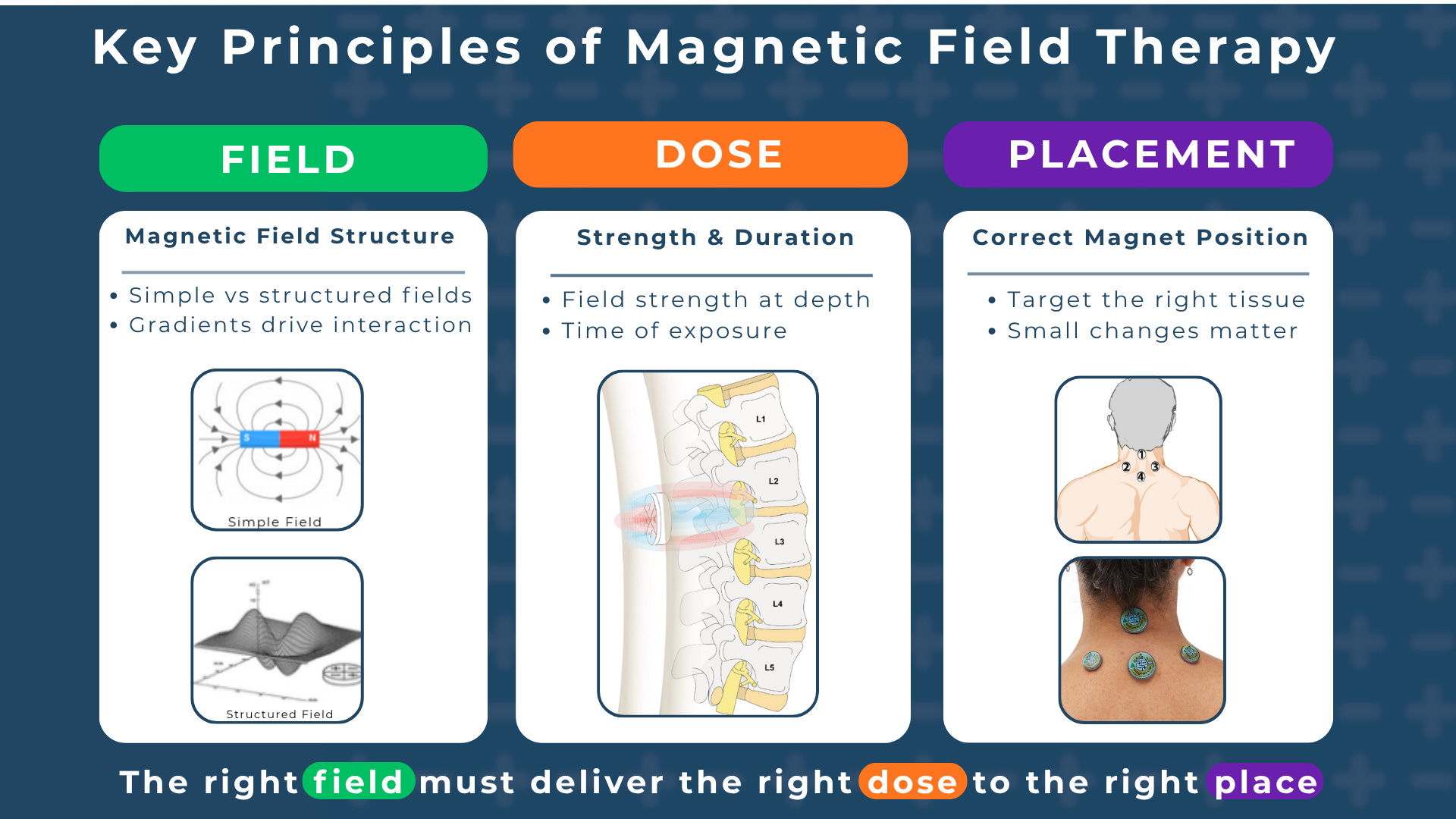
The field gradient matters.
The size of the device matters.
Where you put it matters.
What Chameleon Consultants documented in 2001 was not hype.
It was early health-economics.
Return to work metrics.
Reduced insurer burden.
Reduced medication costs.
Surgery avoided.
Twenty-six years ago.
Before Q Magnets existed as a company.
Before Magnetic Fields were gaining credibility in modern medicine
Before social media.
Just clinicians applying physics to human biology.
A Quiet Lesson from 2001
Healthcare costs have not decreased.
Surgical rates have not decreased.
Medication reliance has not decreased.
But the principles remain.
Non-invasive.
Low risk.
Placement dependent.
Adjunctive.
The document from March 2001 concluded that Neuromagnetic Therapy was a legitimate pain controlling and healing-promoting therapy without side effects.
What has changed since then?
Not the Quadrapolar field, but there have been many enhancements:
The introduction of many different Q Magnet sizes, you can better target different anatomical structures such as the finger, elbow, shoulder and lower back.
Producing alternating poles within the one magnetic body, hence allowing for a more compact device with steeper field gradients.
The introduction of Hexapolar, Octapolar and Concentrics, thus further optimising placement
And our understanding of how to apply it properly.
And that continues to evolve.
Even today, acupuncturists are developing new ways to combine Q magnets with ancient acupuncture principles to enhance outcomes and provide for an improved patient experience. More on this to come in the coming months.
If you are a practitioner, insurer, or rehabilitation professional interested in understanding how magnetic field gradients can integrate into modern rehabilitation frameworks, please reach out. At the time, Dianne’s physiotherapy practice regularly treated third-party-funded patients, including motor accident and WorkCover clients. In principle, insurers did not fund magnets for these cases. Yet in a number of instances, the clinical progress and projected cost savings were significant enough that quadrapolar magnets were approved and paid for.
Some lessons are old.
Some data is forgotten.
But good physics does not expire.
Until next time, stay curious and stay well,
James Hermans and the Q Magnets Team
PS: Two weeks ago, I mentioned about a MagnaBlog subscriber offer.
If you’d like to take advantage of this, use the discount coupon MB20 to apply a 20% discount to items in your shopping cart.
The MB20 Offer will last until next week’s MagnaBlog.
Featured Articles
Why magnet design matters? Learning from Cow Magnets

Field, Dose and Placement in Magnetic Field Therapy
Effects of Static Magnetic Fields on Nerve Conduction: What the Science Really Shows