Greetings,
Gauss is one of those topics we often get asked about, and like many things involving magnetic fields, it can quickly become more complicated than most people want.
So here is the simple version.
Gauss is a measurement of magnetic field strength. More precisely, it is what an instrument called a Gaussmeter measures at one specific point, in one specific direction.
That means Gauss is not simply “the strength of the magnet” as one universal number.
This matters because a simple bipolar magnet and a multipolar medical magnet behave very differently when measured.
A typical bipolar magnet has one North side and one South side. If you take readings across the same face of the magnet, the measurements are usually fairly similar because the field is relatively uniform across that surface.
A quadrapolar Q Magnet is different. It has alternating North and South poles on the same treatment face. Because of this, the Gauss reading can change dramatically depending on exactly where the probe is placed and which direction it is measuring.
You might get a strong positive reading over one pole, a strong negative reading over another pole, and even a near-zero reading at the boundary between poles.
But that zero reading does not mean there is no magnetic field there.
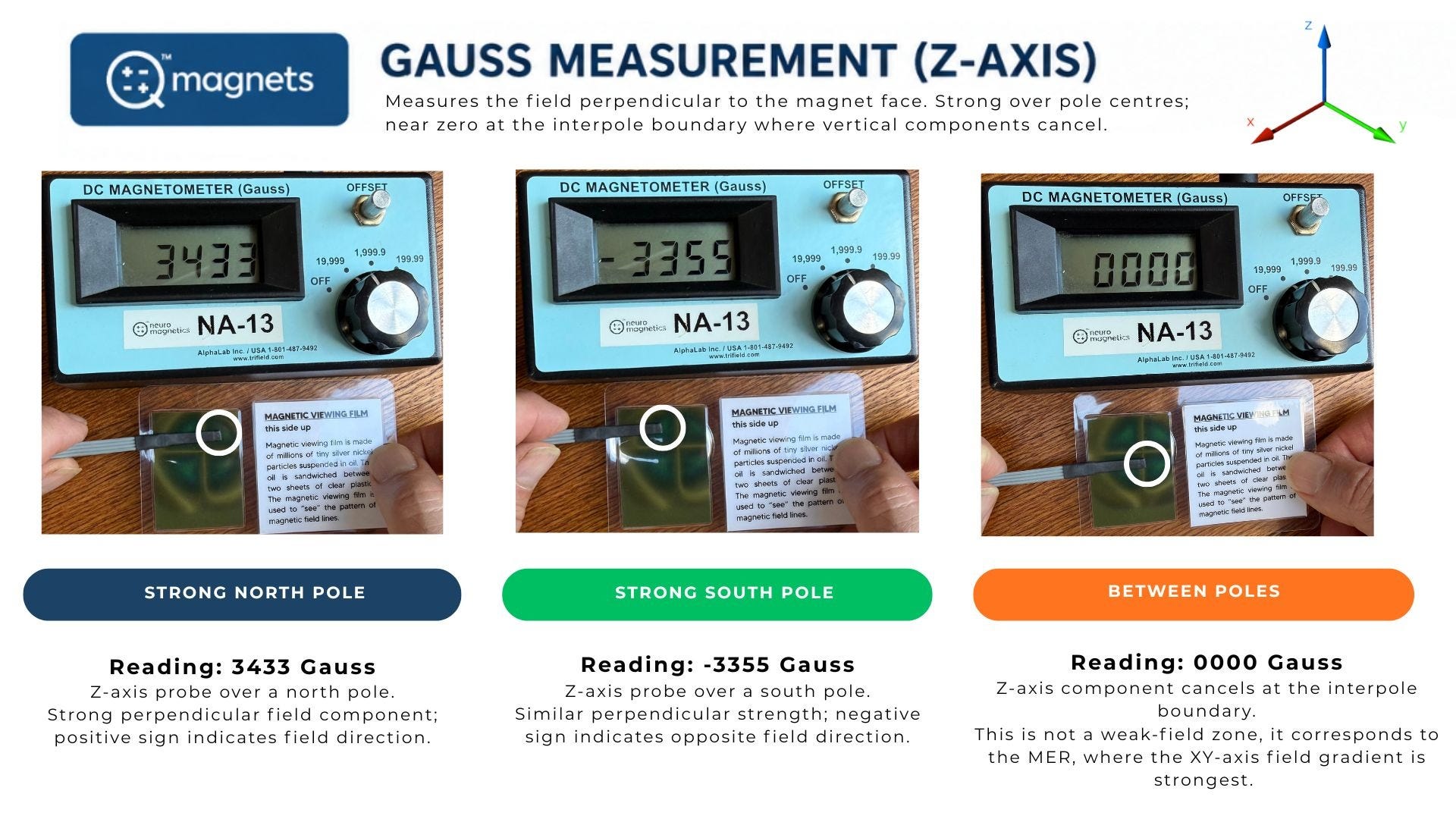
It may simply mean the instrument is measuring one axis of the field where the vertical components cancel. When measured across the surface, that same boundary can show a strong lateral field. This boundary region is important because it is where the field changes direction rapidly.
That rapid change is called a magnetic field gradient.
And this is one of the most important differences between ordinary bipolar magnets and precision multipolar medical magnets.
The question is not just:
“How many Gauss is it?”
A better question is:
“Where is the Gauss being measured, and what kind of field gradient does the magnet create?”
For Q Magnets, the variation in Gauss readings is not a flaw. It is part of the multipolar field design. The alternating pole structure creates localized gradients, and these gradients are central to why field geometry matters.
This is also why simply comparing magnets by their highest Gauss number can be misleading. A high surface Gauss reading does not tell you how the field behaves across the magnet, how quickly it falls with distance, or whether it creates the kind of localized gradient associated with multipolar medical magnet design.
So the takeaway is simple:
Gauss matters, but it is only part of the story.
When comparing magnets, especially therapeutic magnets, the more useful factors are:
how the Gauss was measured
whether the magnet is bipolar or multipolar
how the field changes across the surface
whether the magnet creates useful field gradients
how the magnet is positioned over the target tissue
For anyone who wants the deeper explanation, including Gauss vs Tesla, N45 magnet ratings, Z-axis and XY-axis measurements, field gradients, the Maximally Effective Region, and why “total Gauss” marketing can be misleading, we have written a full guide here:

Until next time, stay curious and stay well,
James Hermans
and the Q Magnets Team
Weekly Reframe
On fields, particles, and invisible forces:
“A complete field theory knows only fields and not the concepts of particle and motion.”
— Albert Einstein
Invisible does not mean inactive.
Einstein’s field-based view of physics reminds us that particles are not the whole story. Fields have structure, direction, and influence even when we cannot see them directly.
That is exactly why Gauss alone can be misleading. With Q Magnets, the important question is not just “how strong is the magnet?” but “how is the field shaped?”
Featured Article
Why magnet design matters? Learning from Cow Magnets

Magnetic Field Gradients

Magnetic Therapy