Why a simple question about magnets reveals a much bigger misunderstanding about frequency.
Over the years, I’ve been asked countless questions about Q Magnets and frequency.
What frequency do Q Magnets operate at?
Do they work at the same frequency as PEMF devices?
What about the Earth’s natural frequency, often referred to as the Schumann resonance?
Can magnets influence the body’s natural frequencies?
And if certain frequencies of sound or electromagnetic radiation can affect human physiology, shouldn’t magnetic therapy work in a similar way?
The questions come from different directions, but they have something in common.
They often assume that frequency means the same thing across very different physical phenomena.
It doesn’t.
And that’s what prompted me to write a new article: Do Q Magnets Have a Frequency?
The short answer is no
Q Magnets produce static magnetic fields.
A static magnetic field does not oscillate or pulse, so its frequency is 0 Hz.
That doesn’t mean the field is absent. It simply means the magnetic field is not repeatedly changing with time when measured at a fixed location relative to the stationary magnet.
For anyone familiar with the physics, that’s probably all the explanation you need.
But for those who aren’t, the distinction becomes quite interesting.
The same number doesn’t mean the same thing
Take 100 Hz.
A sound wave at 100 Hz involves air pressure oscillating 100 times per second. Our ears can detect that as a low-pitched sound.
An electrical stimulator delivering pulses at 100 Hz is doing something entirely different. Depending on the electrical parameters and where the electrodes are placed, those pulses may stimulate nerves or muscles.
A pulsed magnetic field operating at 100 Hz is different again. Its changing magnetic field may induce electric fields in conductive tissue.
All three can be described using the same unit—hertz—but the underlying physics is different.
The important question isn’t just “What frequency?” It’s “What is actually oscillating?”
That distinction becomes even more apparent when we consider light.
Ultraviolet B radiation within particular wavelengths can initiate vitamin D production in the skin. Other forms of ultraviolet radiation can damage biological molecules, while X-rays carry enough photon energy to ionise atoms and molecules.
Here, frequency and wavelength are fundamental to understanding the interaction.
But those photochemical processes tell us little about what a permanent magnet might do.
Frequency can change a physiological response dramatically
One reason frequency attracts so much attention is that, in the right circumstances, it really can make an enormous difference.
Consider electrical stimulation of a muscle.
Deliver individual pulses slowly and the muscle produces separate contractions.
Increase the pulse frequency and those contractions begin to overlap. At sufficiently high frequencies, they can merge into a sustained contraction.
The type of stimulus hasn’t changed. The timing has.
An even more striking example comes from deep brain stimulation research involving patients with Parkinson’s disease.
In one study, electrical stimulation at lower frequencies increased measured muscle rigidity, while stimulation at 130 Hz reduced it.
That is a genuine frequency-dependent physiological response.
But here’s the critical point: the finding applies to electrical stimulation of a particular neural target. It cannot automatically be transferred to sound, light, PEMF or static magnetic fields.
The type of stimulus, its strength, the biological target and the way energy is delivered all matter.
So where does that leave Q Magnets?
If frequency isn’t a meaningful operating specification for a static magnet, what should we be looking at?
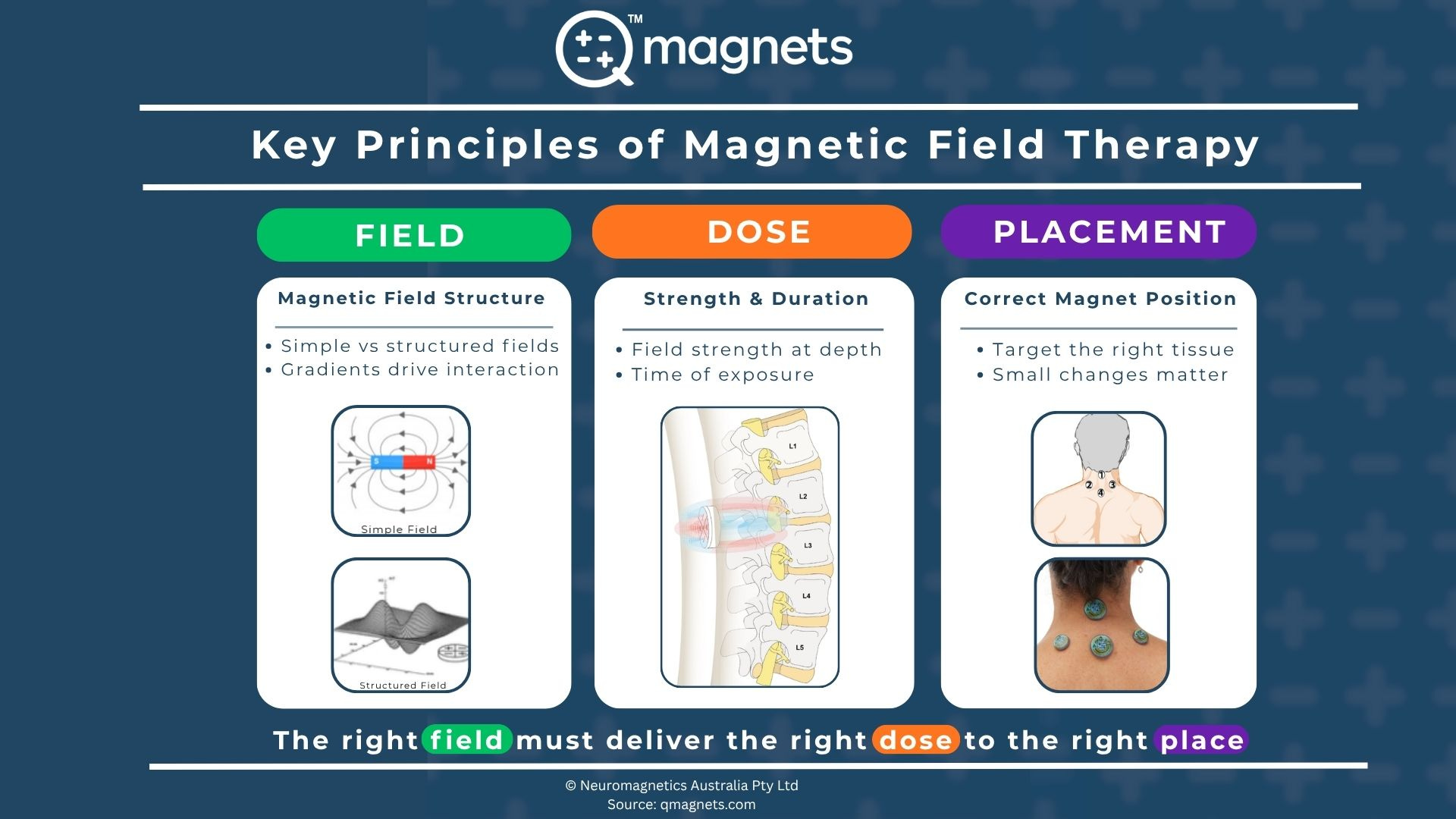
For Q Magnets, the more relevant physical characteristics are the magnetic field’s strength, spatial configuration and gradients, along with the exposure reaching the intended tissue and where the device is placed.
This is the reasoning behind our Field | Dose | Placement framework.
It describes the physical exposure more usefully than assigning an arbitrary frequency to a permanent magnet.
Of course, describing a magnetic field is not the same as proving a clinical benefit. Biological effects and therapeutic outcomes still need to be supported by appropriate evidence.
That distinction matters just as much as understanding frequency itself.
You don’t need a physics degree
I’ve written the new article for people who are curious about frequency but haven’t necessarily studied physics.
It starts with something as simple as clapping your hands, then explores sound, electricity, radio waves, infrared and ultraviolet light, Schumann resonances, and medical technologies such as PEMF, TMS and MRI.
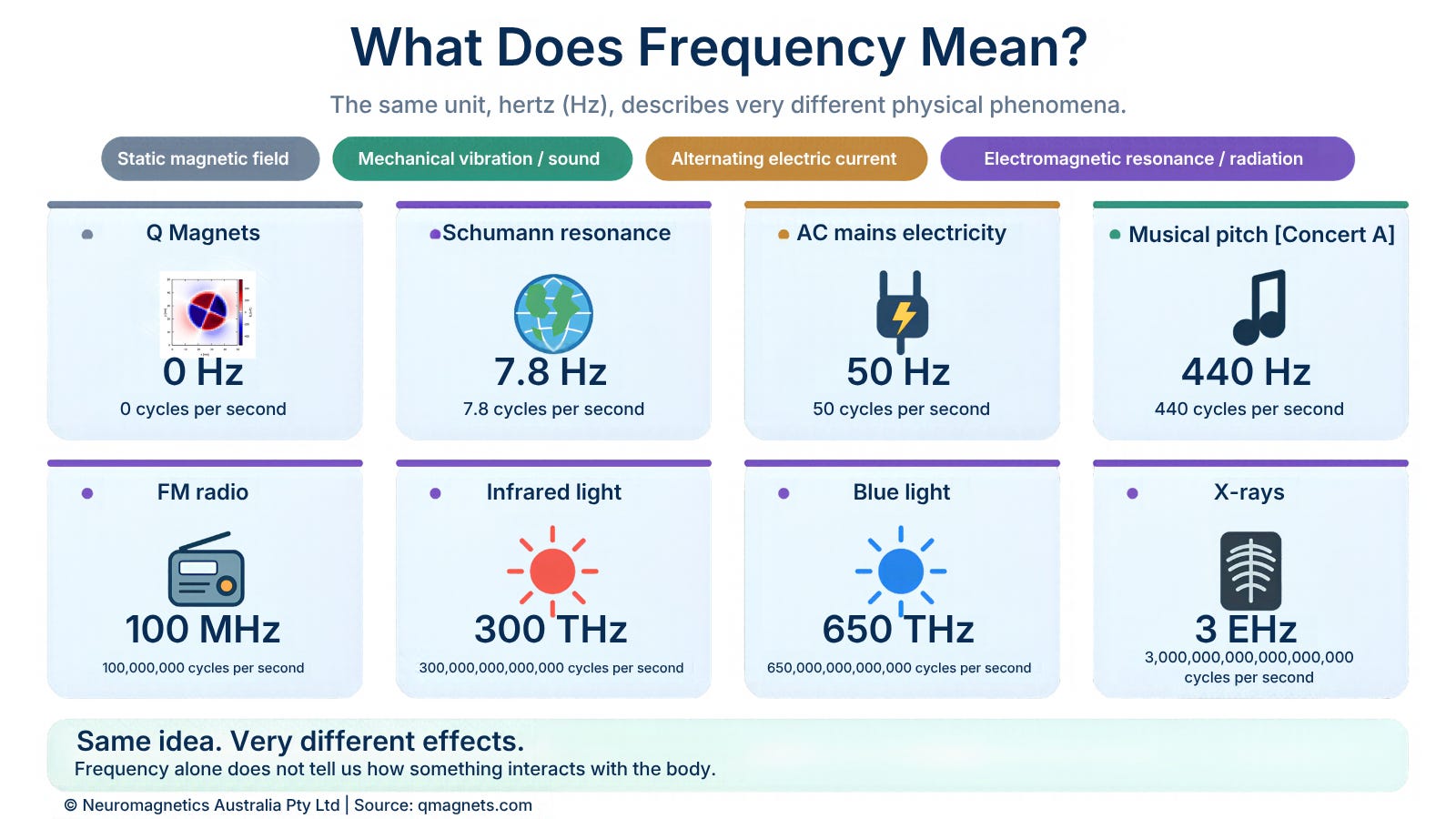
There’s also a visual comparison showing just how dramatically frequencies differ—from approximately 7.8 cycles per second for the fundamental Schumann resonance to trillions and even quintillions of cycles per second for forms of electromagnetic radiation.
If you already understand the physics, there’s no need to read a lengthy explanation of something you know.
But if you’ve ever wondered why some therapies are described by their operating frequencies while Q Magnets are not, I think you’ll find it useful.
Read: Do Q Magnets Have a Frequency?
The broader lesson is one worth remembering:
Frequency is a measurement, not a mechanism of action.
Before asking whether a particular frequency might be beneficial, we first need to understand what is oscillating, how it interacts with the body and what the evidence actually shows.
Until next time, stay curious and stay well,
James Hermans
and the Q Magnets Team
Weekly Reframe
It’s not just the frequency. It’s what you do with it.
A frequency of 100 Hz can describe sound, electrical pulses or a changing magnetic field. Same number. Very different physics.
Featured Article
Magnets vs Red Light, Infrared and TENS What Is Actually Different From a Physics Perspective?

Field, Dose and Placement in Magnetic Field Therapy
Magnetic Therapy