Greetings from Q Magnets!
As a keen birdwatcher, this is a topic close to my heart.
I have spent many hours counting shorebirds such as the Pacific Golden Plover, Eastern Curlew, Bar-tailed Godwit, Grey-tailed Tattler, Red Knot, Terek Sandpiper and the tiny Red-necked Stint.
Many of these birds migrate around 10,000 kilometres to reach Australian shores. Some cross vast stretches of open ocean, yet return to the same estuary, mudflat or harbour year after year.
How on Earth do they find their way?
The Sun, stars, landmarks and even smell may all contribute. But Earth’s magnetic field appears to provide another important part of the answer.
That is remarkable because Earth’s magnetic field is extremely weak.
So weak, in fact, that for many years it seemed impossible that the warm, noisy chemistry of a living body could detect it.
Yet the birds clearly can.
And the emerging explanation may have important implications for how we think about static magnetic fields and biology.
The Stars Are Still There During the Day
Think about the stars.
They do not disappear when the Sun rises. Their light is still reaching us, but the much brighter sunlight overwhelms their weak signal and makes them invisible.
Scientists once viewed Earth’s magnetic field in a similar way.
Inside a living body, molecules are constantly moving, vibrating and colliding. Compared with all this thermal activity, the magnetic influence of Earth’s field appears almost insignificant.
It should be lost in the noise.
But bird navigation tells us that biology has found a way to detect it.
A Weak Field Does Not Need to Power the Reaction
The leading explanation is known as the radical pair mechanism.
The name sounds complicated, but the central idea is surprisingly simple.
A magnetic field may not need to provide the energy that powers a chemical reaction. That energy may already have come from light, metabolism or another chemical process.
The magnetic field may only need to influence which direction the reaction takes.
Imagine a train approaching a railway junction.
The locomotive provides the enormous energy needed to move the train. But only a small movement of the railway points is needed to send it down a different track.
The small force does not power the train.
It changes its destination.
A weak magnetic field may sometimes do something similar within a chemical reaction.
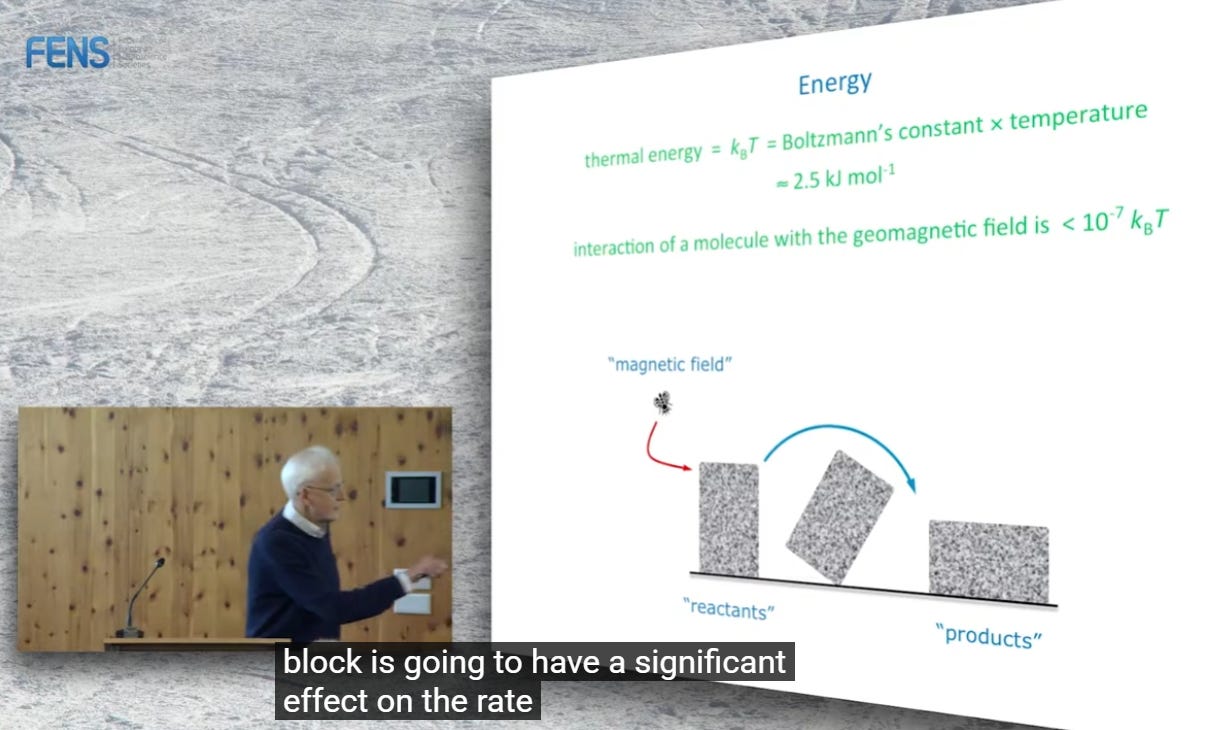
The tiny fly in Professor Peter Hore’s illustration represents the weak magnetic influence. It does not move the entire chemical reaction by force. It may simply help determine which product is formed.
This week’s MagnaBlog is a simplified summary of our in-depth article on bird magnetoreception and static field therapy.
How Might a Bird See a Magnetic Field?
The current leading theory involves a light-sensitive protein called cryptochrome, found in the bird’s eye.
When light activates cryptochrome, a brief chemical reaction occurs. Earth’s magnetic field may slightly influence the outcome of that reaction.
If these proteins are arranged throughout the retina, the bird may receive a pattern that changes according to the direction it is facing.
It may not experience magnetism as a compass needle pointing north.
Instead, it may see a faint pattern, shadow or change in contrast layered over its normal vision.
The complete mechanism has not yet been proven, but magnetically sensitive cryptochrome chemistry has been demonstrated in laboratory research involving migratory birds.
Watch Peter Hore Explain the Bird’s Magnetic Compass
What Does This Have to Do With Mitochondria?
Radical reactions are not limited to the bird’s eye.
They occur throughout biology, particularly wherever electrons are being transferred from one molecule to another.
That makes the mitochondria especially interesting.
Mitochondria are often called the powerhouses of our cells. They move electrons through a chain of reactions to help produce ATP, the chemical energy used by muscles, nerves and almost every repair process in the body.
During this activity, mitochondria also produce small amounts of reactive oxygen species.
These molecules are often associated with oxidative stress, but in controlled amounts they also act as important biological signals. They help regulate adaptation, inflammation, cell communication and responses to stress.
Some researchers have proposed that certain short-lived reactions involving these molecules could be magnetically sensitive.
Laboratory studies have also reported that relatively weak static magnetic fields can influence mitochondrial respiration and reactive oxygen species under particular conditions.
This does not prove that Q Magnets work by changing mitochondrial activity.
But it does show that mitochondria are one scientifically plausible place to investigate how static magnetic fields might interact with living systems.
The radical-pair mechanism is well developed as an explanation for bird magnetoreception. Similar reactions inside mitochondria remain an emerging hypothesis.
Biology May Respond Within a Window
One of the most important lessons from this research is that biological responses do not always increase as the field becomes stronger.
In some experiments, the response rises within a particular field range and then falls again.
This is known as a window of response.
It challenges the simplistic idea that:
stronger magnet = greater biological effect
Instead, the result may depend on:
the type and shape of the field
the duration of exposure
the depth and type of tissue
the exact placement
the condition of the tissue or nervous system
This fits closely with the Q Magnets framework of:
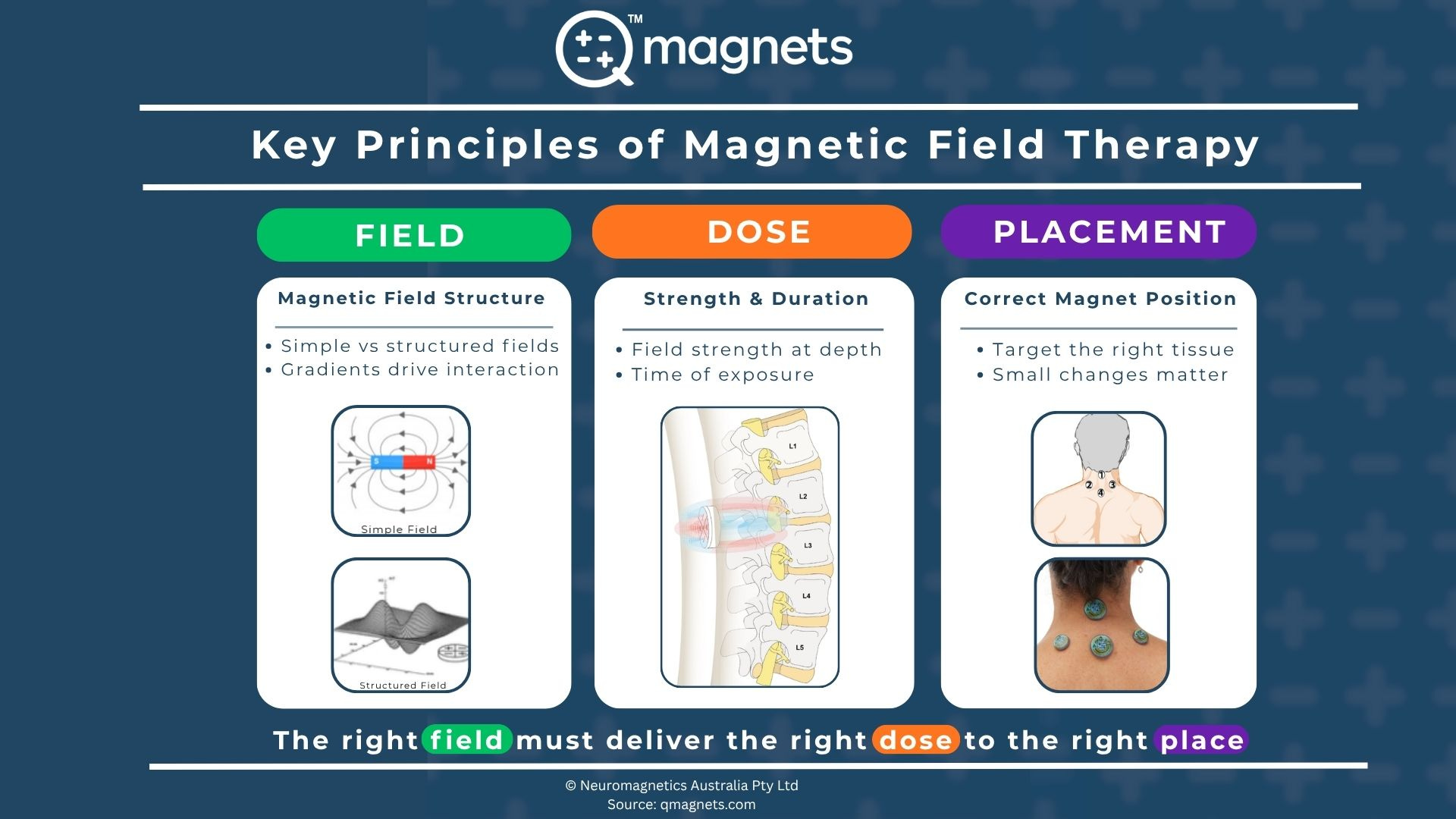
Field | Dose | Placement
Field
Not all magnetic fields are the same. Q Magnets use engineered multipolar arrangements that create localised fields and steep spatial gradients.
Dose
Dose includes more than magnetic strength. It also includes magnet size, exposure time, tissue depth and cumulative use.
Placement
The field must reach the relevant anatomical region. A well-designed magnet in the wrong place may provide little useful exposure.
This is why Q Magnets should not be compared with generic magnetic bracelets or flexible magnetic sheets simply because they all contain magnets.
The field environment is different.
What This Means for Q Magnets
We are not claiming that bird magnetoreception proves how Q Magnets work.
Nor should we claim that radical-pair chemistry or mitochondrial effects are established mechanisms of Q Magnets.
They are not yet proven.
But this research does weaken one of the oldest objections to static magnetic field therapy:
“The field is too weak to influence biology.”
Birds detect Earth’s field, which is dramatically weaker than the localised fields produced by Q Magnets.
The radical pair mechanism shows how a weak magnetic field may influence biology without overpowering thermal energy or supplying the energy for the reaction.
It may simply alter the probability of what happens next.
That does not provide the final answer.
But it tells us the question is no longer:
“Can a weak static magnetic field possibly matter?”
The more useful question is:
“Under what biological conditions might a particular field, dose and placement influence the system?”
Nature Has Already Shown Us It Is Possible
A Red-necked Stint weighs little more than a few coins.
Yet it can travel thousands of kilometres across a changing planet and find its way back to a familiar stretch of coast.
The magnetic signal helping guide it is extraordinarily weak.
But weak does not mean irrelevant.
Nature has already shown us that living systems can detect and use magnetic information in ways science is only beginning to understand.
There is still much we do not know about radical pairs, mitochondria, field gradients and static field therapy.
There may also be mechanisms we have barely considered and keep us curious.
Because sometimes the weakest signal can still help determine the direction.
Further Reading
Rodgers, C.T. “Magnetic Field Effects in Chemical Systems.” Pure and Applied Chemistry. 2009;81:19–43.
Xu, J., et al. “Magnetic Sensitivity of Cryptochrome 4 from a Migratory Songbird.” Nature. 2021;594:535–540.
Zadeh-Haghighi, H., and Simon, C. “Magnetic Field Effects in Biology from the Perspective of the Radical Pair Mechanism.” Journal of the Royal Society Interface. 2022;19:20220325.
Pooam, M., et al. “HEK293 Cell Response to Static Magnetic Fields via the Radical Pair Mechanism.” PLOS ONE. 2020;15:e0243038.
Luo, J. “Sensitivity Enhancement of Radical-Pair Magnetoreceptors as a Result of Spin Decoherence.” Journal of Chemical Physics. 2024;160:074306.
Until next time, stay curious and stay well,
James Hermans
and the Q Magnets Team
Weekly Reframe
A weak influence does not need to power a system if it can change which path the system takes.
Featured Article
How Birds Sense Earth’s Magnetic Field and What It May Teach Us About Static Magnetic Field Therapy

Field, Dose and Placement in Magnetic Field Therapy
Magnetic Therapy