Greetings from Q Magnets!
For months now, I’ve been seeing the same advertisement appear in the New York Times.
It’s for one of those futuristic LED face masks.
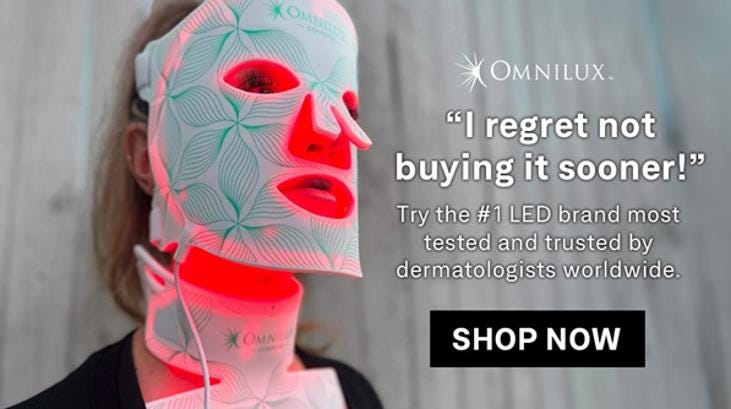
You know the type.
It promises healthier skin, fewer wrinkles and a more youthful appearance, provided you’re willing to sit there wearing it for twenty minutes every day.
Now, I'm certainly not suggesting it's a bad product. In fact, LED photobiomodulation is a valuable recovery technology and one that can sit very comfortably alongside static magnetic field therapy.
But every time I see the advertisement, I find myself thinking about something else.
I know more than one person who bought one with every intention of using it regularly.
They did...
For a few weeks.
Perhaps a month.
Then it quietly disappeared into the cupboard.
Not necessarily because it didn’t work.
Because life happened.
Work became busy.
Grandchildren arrived.
The garden needed attention.
The novelty wore off.
Like so many health products, it simply required one more thing to remember.
The Real Challenge Isn’t Always the Technology
One of the biggest challenges in healthcare isn’t always whether a treatment has the potential to help.
It’s whether people actually keep using it.
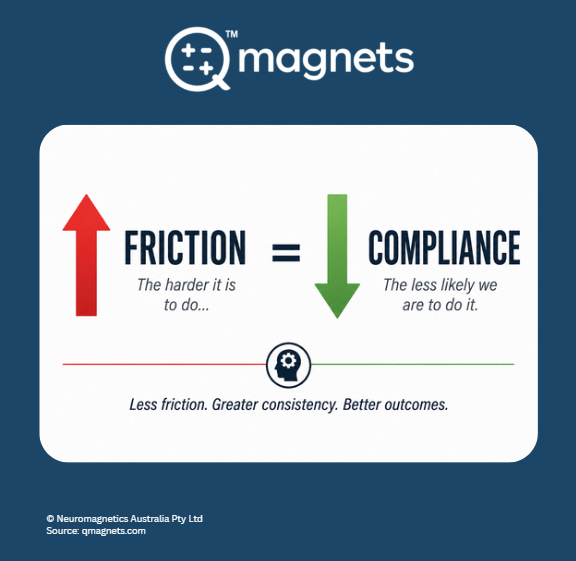
Behavioural scientists sometimes refer to this as friction.
Every health intervention has a certain amount of friction.
You have to remember it.
You have to make time for it.
You have to interrupt your day.
You have to stay motivated.
The more effort something requires, the more likely it is to slowly drift to the back of the cupboard.
That’s simply human nature.
We all have good intentions.
Life just gets busy.
Why Some Recovery Tools Fit Real Life Better
Over more than twenty years of working with Q Magnets, we’ve noticed something rather interesting.
People rarely tell us they stopped using them because they became disappointed.
More often, they stopped because they simply didn’t need them anymore.
The magnets went back into the medicine cabinet.
Not forgotten forever.
Just waiting.
Waiting for the next gardening marathon.
The next weekend of golf.
The heavy lift while helping a neighbour.
An old sports injury reminding you it still exists.
Or the occasional flare-up that catches you by surprise.
Then the cupboard opens again.
The magnets quietly return to work.
Perhaps that’s one of the advantages of a low-friction recovery tool.
It doesn’t demand your attention every day.
It’s simply there when life does.
What If You Didn’t Have to Remember at All?
If there’s one product that perfectly illustrates this idea, it’s probably the Q Blanket.
One of the biggest barriers to any recovery routine isn’t the treatment itself.
It’s remembering AND making the effort to do it.
The Q Blanket almost removes that barrier entirely.
You don’t need to schedule another session.
You don’t need to set a reminder.
You don’t need to charge batteries.
You don’t need to stop what you’re doing.
You simply go to bed.
For many people living with persistent pain, bedtime is when discomfort becomes most noticeable anyway. Rather than adding another task to an already busy day, the Q Blanket works with something you’re already going to do—sleep.
That’s about as low-friction as recovery gets.
Of course, the Q Blanket doesn’t replace targeted Q Magnets when precise placement over a particular nerve or painful area is required. They serve different purposes.
But for people looking for a simple way to support overnight comfort, it’s hard to imagine a routine that asks less of you.
Sometimes the easiest habit is the one that doesn’t feel like a habit at all.
“I Forgot I Was Supposed to Be in Pain”
Recently we received an email from Connie, a 69-year-old caregiver.
She had injured her own lower back while helping reposition her bed-bound partner.
Anyone who has cared for a loved one knows that when the caregiver is injured, it’s not just their own wellbeing that’s affected. Their ability to care for someone else is suddenly compromised as well.
Connie first tried the homeopathic creams she normally relied upon.
When they didn’t seem to help, she suddenly remembered her Q Magnets.
She applied two OF50-3 magnets along with two OF28-3 magnets over each kidney region.
Then she wrote something that genuinely made me smile.
“I soon forgot I was supposed to be in pain!”
What a wonderful sentence.
She wasn’t monitoring pain scores or analysing symptoms.
She simply became absorbed in getting on with life again.
Perhaps that’s what happens when discomfort no longer occupies the front of your mind.
Connie went on to write:
“Now I feel uplifted, positive and good about life. I feel defeated when I cannot help take care of her in the way she needs.”
That reminds us that recovery isn’t always about returning to sport or getting back to work.
Sometimes it’s about being able to care for the person who depends on you.
Sometimes Practitioners Forget Too
Interestingly, it isn’t only patients who forget.
Health professionals do too.
Recently, practitioner Lesley Wood shared that she had use Q Magnets years ago...
...then simply forgot about it.
Not because she had concluded it didn’t work.
Life moved on.
Other techniques filled her clinical toolbox.
Then she was treating a patient with persistent chronic back pain. Despite making good progress with manual therapy, the patient still had ongoing discomfort.
Suddenly she remembered the magnets.
She later wrote:
“I used magnets years ago and then forgot about them until recently.”
That probably resonates with many clinicians.
Over the course of a career, practitioners accumulate dozens of useful techniques.
Sometimes an old tool simply waits quietly until the right patient reminds you it’s there.
Then There’s Silvano

Perhaps no story illustrates this better than Silvano.
More than twenty years after surviving a life-changing helicopter accident...
He’s still using the very same magnets.
Not every day.
Not because he’s dependent on them.
Because they’re there when life reminds him he needs them.
In a world increasingly filled with disposable gadgets, rechargeable devices and monthly subscriptions, there’s something rather reassuring about having a trusted recovery tool waiting quietly in the cupboard.
Maybe We’ve Been Asking the Wrong Question
People often ask,
“Does this product work?”
That’s certainly an important question.
But perhaps an equally important one is:
“Will I actually use it?”
The most sophisticated technology in the world won’t help if it becomes another forgotten gadget sitting in a drawer.
The best recovery tools are often the ones that fit naturally into everyday life.
The ones that don’t ask for constant attention.
The ones that quietly support you when you need them.
Whether that’s a couple of Q Magnets ready for the next flare-up...
...or a Q Blanket that’s already waiting on your bed every night.
Perhaps that’s why so many emails we receive begin with the same words:
“I remembered my magnets...”
And every now and then, we’re lucky enough to receive one that says something even better:
“I forgot I was supposed to be in pain.”
That’s the kind of forgetting most of us would be happy to experience.
If your Q Magnets have been sitting quietly in the cupboard for a while, perhaps that’s not a sign they’ve been forgotten.
Perhaps it’s a sign they’ve already done their job.
And if life throws another long day in the garden, a sporting injury, an unexpected flare-up or simply reminds you that you’re not quite as young as you used to be, you’ll know exactly where to find them.
Because sometimes the best recovery tool isn’t the one with the most impressive technology.
It’s the one that fits so naturally into real life that, when you need it, using it is almost effortless.
Until next time, stay curious and stay well,
James Hermans
and the Q Magnets Team
Weekly Reframe
We often assume the best recovery tool is the one with the most impressive technology.
But technology isn’t usually what determines success.
Human behaviour does.
The treatments that become part of our lives are rarely the ones that demand the most attention.
They’re the ones that quietly fit around the life we’re already living.
Perhaps the best recovery tool isn’t the one that does the most...
It’s the one you’ll still be using six months from now.
Featured Article
Magnetic Mattress Pads helping provide support for those suffering pain

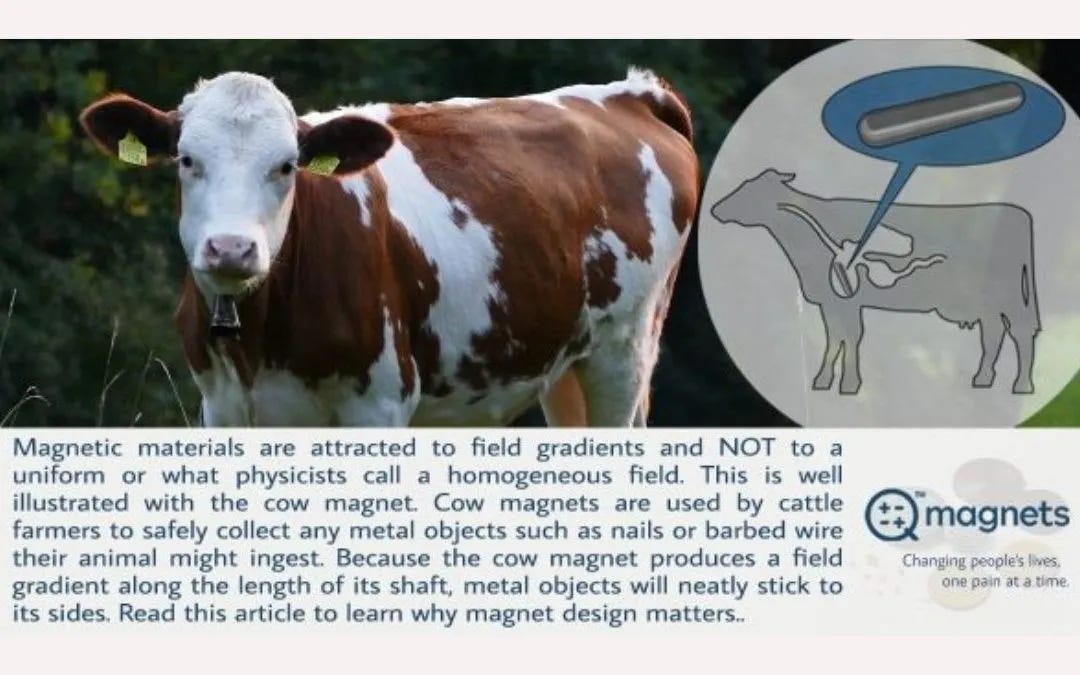
Why magnet design matters? Learning from Cow Magnets
Magnetic Therapy