Greetings from Q Magnets!
Every now and then, I find myself disappearing down a scientific rabbit hole.
One article leads to another. A podcast introduces an unfamiliar theory. Someone mentions a researcher whose work I haven’t read for years. Before long, I’m questioning things I’d previously taken for granted.
Recently, that rabbit hole has been the relationship between light, water, magnetism and human health.
There’s a growing conversation within biohacking and biophysics circles suggesting that our physical environment may influence health in ways we don’t yet fully understand.
Much of the conversation initially centred on natural sunlight, circadian rhythms, grounding and the biological importance of water.
But increasingly, I’m noticing another subject gaining attention.
The Earth’s magnetic field itself.
Some people are questioning whether living in regions with weaker geomagnetic fields might have implications for human health. Others are experimenting with magnetic devices during sleep or even relocating to places they believe offer a more favourable magnetic environment.
Some of the explanations are intriguing. Others stretch well beyond what current science has demonstrated.
But I don’t think that means we should stop asking questions.
In fact, this week’s exploration has brought together some rather interesting connections including a physician’s hypothesis from 1976, the spectacular Aurora Australis, research into sensory nerve activity and an unexpected visit from someone who lives practically around the corner from Q Magnets.
Would you move countries for a stronger magnetic field?
I recently listened to an interview with Nathan Siles on the Fitness Wisdom Podcast.
Nathan has an extraordinary personal history, including surviving serious childhood illness and later cancer. His experiences led him to investigate biophysics, particularly the relationship between light, water, temperature, magnetism and human physiology.
During the interview, Nathan explained that one reason he moved from Australia to Mexico was his belief that the local magnetic environment would be more favourable to his health.
He described improvements in his sleep and certain health markers following the move.
Of course, relocating to another country changes far more than magnetic field exposure. Sunlight, climate, lifestyle, diet, activity, sleep patterns and numerous other factors may change simultaneously.
His experience is therefore a personal observation, not evidence that differences in geomagnetic field strength caused those improvements.
Nevertheless, I found his reasoning fascinating.
Something else caught my attention during the interview.
Nathan mentioned that he had previously used Q Magnets specifically our quadrapolar and octapolar magnets during sleep, recovery and for pain.
It was interesting to hear Q Magnets discussed in a conversation primarily concerned with optimising health rather than treating a specific pain condition.
And it made me wonder whether we’ve been looking at our technology through a relatively narrow lens.
Magnetic field deficiency: an idea from 50 years ago
These questions aren’t entirely new.
In 1976, Japanese physician Dr Kyoichi Nakagawa published a paper proposing what he called Magnetic Field Deficiency Syndrome.
Nakagawa was interested in the gradual changes occurring in the Earth’s magnetic field and the possibility that modern living environments might alter our exposure to natural magnetic fields.
He also considered how steel-framed buildings, transportation and other structures containing magnetic materials could distort the local geomagnetic environment.
Drawing on clinical observations involving permanent magnets, Nakagawa hypothesised that insufficient magnetic exposure might contribute to symptoms such as fatigue, muscular discomfort, headaches and sleep disturbances.
It was an ambitious proposition.
However, the existence of such a syndrome has never been convincingly established through rigorous clinical research.
Nor does a reported response to magnetic treatment establish that a magnetic deficiency caused the original symptoms.
Still, nearly 50 years later, people are once again discussing remarkably similar questions.
Has our magnetic environment changed, and could those changes matter biologically?
That question leads us to something we know considerably more about: the Earth’s magnetic field itself.
The Earth’s magnetic field isn’t as simple as we imagine
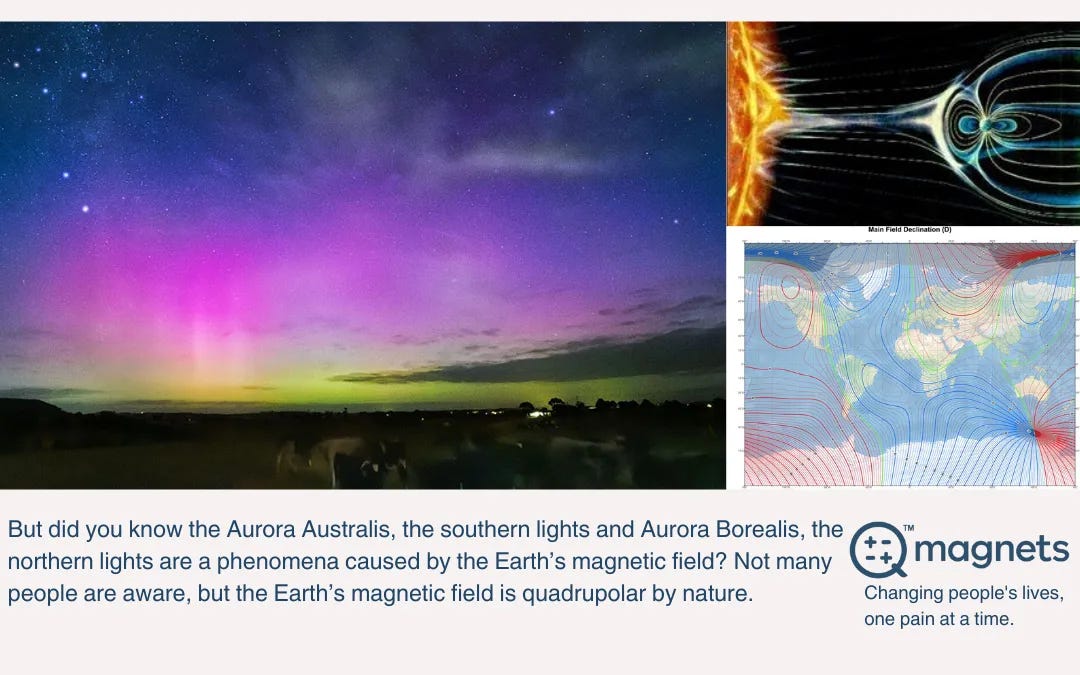
A couple of years ago, following a spectacular display of the Aurora Australis, I wrote an article about the Earth’s magnetic field.
Like many people, I had grown up picturing Earth as a gigantic bar magnet, with magnetic field lines extending between the north and south magnetic poles.
And that’s a reasonable starting point.
But the actual field is much more complicated.
Although the Earth’s magnetic field is predominantly dipolar, it also contains quadrupolar and higher-order multipolar components.
These contribute to the variations in magnetic field strength and direction observed around the planet.
The Earth’s field is also constantly changing, although usually over timescales much longer than those of everyday human activities.
NOAA and the British Geological Survey model these changes through the World Magnetic Model, which is used in navigation systems around the world.
The model describes the field using mathematical components that account for its complex spatial distribution.
So the Earth’s magnetic field isn’t simply one uniform field surrounding us everywhere.
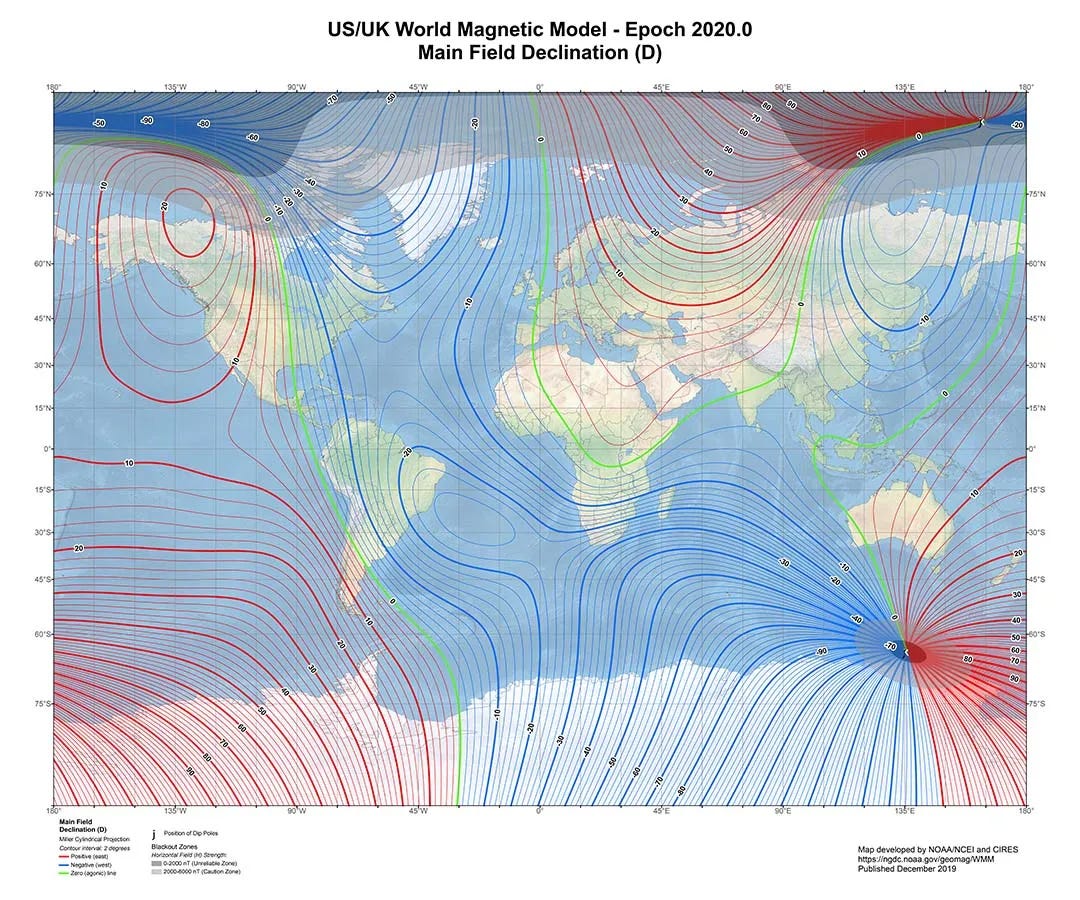
It has structure
And that raises an interesting parallel with the technology behind Q Magnets.
Our quadrapolar and other multipolar magnets also have deliberately engineered magnetic field structures, using alternating north and south poles to produce localised magnetic field gradients.
Of course, the Earth’s enormous, predominantly dipolar field and the highly localised field of a Q Magnet operate on completely different spatial scales.
The fact that the Earth has quadrupolar components doesn’t mean a Q Magnet reproduces the natural geomagnetic environment or its biological effects.
Nevertheless, it raises a question worth exploring.
When investigating magnetic fields and biological systems, should we pay more attention to field structure rather than simply field strength?
You can explore the original article here:
Aurora Australis and the Earth’s Magnetic Field
What about the South Atlantic Anomaly?
Another subject frequently raised in these discussions is the South Atlantic Anomaly.
This is a large region extending across parts of South America and the South Atlantic Ocean where the Earth’s magnetic field is unusually weak.
It’s a real phenomenon, measured and monitored by scientific organisations including NASA and the European Space Agency.
The weaker magnetic field allows energetic particles in near-Earth space to approach closer to the planet, creating particular concerns for satellites and spacecraft electronics.
But that doesn’t establish that people living beneath the anomaly experience magnetic field deficiency or poorer health.
At ground level, the atmosphere provides substantial protection from energetic particle radiation.
And there’s currently no convincing clinical evidence that the SAA causes the health problems sometimes attributed to it in online discussions.
The difference between a measurable physical phenomenon and a demonstrated biological consequence is important.
It also reminds me of another subject that frequently appears in biohacking conversations: the Schumann resonances.
These are naturally occurring electromagnetic resonances associated with lightning activity in the cavity between the Earth’s surface and the ionosphere.
Their existence is well established.
But claims that particular Schumann frequencies automatically synchronise the brain or optimise human physiology require separate experimental evidence.
Perhaps the same reasoning should apply to magnetic field geometry.
Just because a particular characteristic exists in nature doesn’t mean we’ve established what it does to the human body.
Nevertheless, understanding the physics is a sensible place to begin.
Light, water and magnetism: the new biophysics conversation
Neurosurgeon Dr Jack Kruse has become one of the prominent voices encouraging people to think about light, water and magnetism as interconnected influences on human physiology.
In a recent podcast with John Kemp, Kruse explored a wide range of ideas involving circadian biology, mitochondrial electron transport, oxygen chemistry, the Earth’s changing magnetic field and the physical properties of water.
His broader argument is that nutrition, exercise and conventional biochemistry don’t tell the whole story.
We also need to understand the physical environment in which biological processes occur.
There is certainly value in that general perspective.
Light regulates circadian rhythms. Water is essential to cellular chemistry. Electrical signalling underpins the activity of nerves and muscles. Some organisms can detect the Earth’s magnetic field and use it for navigation.
But these established observations don’t automatically validate Kruse’s proposed connections between weakening geomagnetic fields, mitochondrial dysfunction and human disease.
Those are much larger claims requiring direct experimental support.
I find some of the questions fascinating, even when I’m unconvinced by the explanations.
And that’s why I think this interview is worth sharing.
Watch: Dr Jack Kruse Light, Water and Magnetism for Optimal Health and Performance
It’s a wide-ranging discussion containing a mixture of established science, interpretation and speculation.
I wouldn’t endorse every conclusion, but it provides a useful introduction to why magnetism is receiving renewed attention within parts of the biohacking community.
John Kemp has also compiled a starting point for further Jack Kruse interviews, for anyone interested in following this particular rabbit hole.
Mae-Wan Ho and the idea of biological coherence
Another researcher whose work has intrigued me over the years is the late Dr Mae-Wan Ho.
In her book The Rainbow and the Worm: The Physics of Organisms, Ho explored the idea that living organisms are highly organised physical systems rather than collections of largely independent biochemical reactions.
In Chapter 13, How Coherent Is the Organism? Sensitivity to Weak Electromagnetic Fields, she considered research suggesting that some biological processes may respond to relatively weak electromagnetic influences.
She also explored the importance of organisation, coordination and the physiological state of an organism when interpreting biological responses.
Her broader concept of biological coherence was concerned with how living systems maintain coordinated activity across different scales.
Some of Ho’s proposed mechanisms and interpretations remain controversial, and her conclusions shouldn’t be treated as established simply because they are presented within a scientific framework.
Nevertheless, I find her work to be very credible.
Could the organisation of a physical field influence biological responses in ways that aren’t explained by field strength alone?
It’s a question that leads directly towards the research behind multipolar magnetic fields.
What happens when we change the structure of a magnetic field?
Most discussions about magnetic therapy focus on magnetic strength, often expressed in gauss or tesla.
But field strength is only part of the picture.
Magnetic fields also have direction, spatial distribution and gradients the rate at which the field changes from one location to another.
A conventional permanent magnet presenting one magnetic pole towards the skin produces a different local field distribution from an engineered multipolar magnetic arrangement.
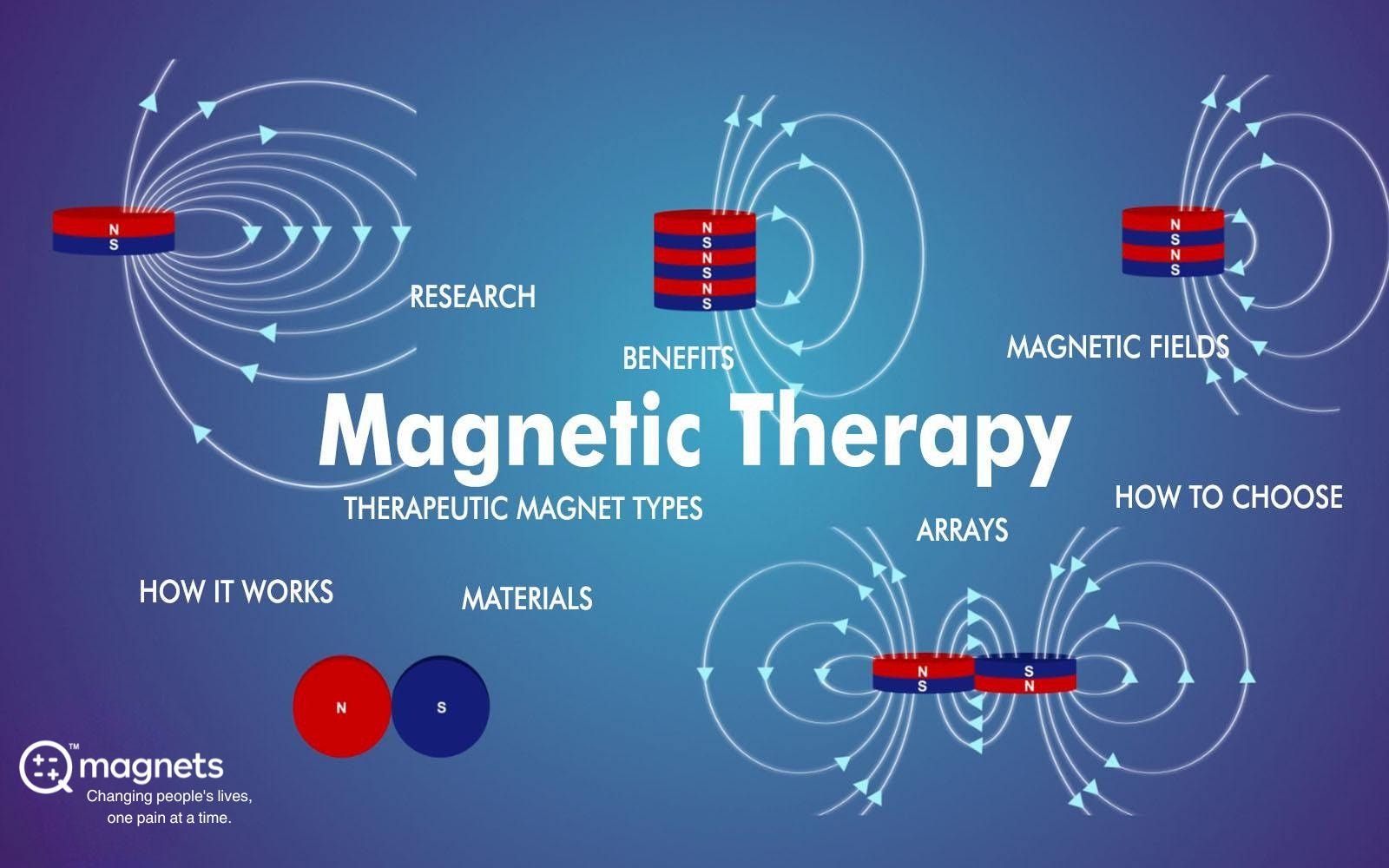
Q Magnets incorporate quadrapolar, hexapolar, octapolar and alternating concentric-pole configurations.
Rather than presenting one dominant pole across the entire application surface, these arrangements have alternating north and south magnetic poles.
This creates localised spatial variation in the magnetic field, including relatively steep field gradients.
It doesn’t mean north and south poles somehow deliver opposite healing effects that balance one another.
It may establish that multipolar magnets produce superior therapeutic effects.
What it does mean, is that the physical exposure produced by a multipolar magnet differs from that of a conventional single-pole-facing arrangement.
And there is some interesting experimental research exploring what that might mean biologically.
Holcomb, McLean and Cavopol: where the research becomes interesting
During the 1990s, researchers including Robert Holcomb, Michael McLean, Andrew Wamil and Anthony Cavopol investigated how specially configured static magnetic fields affected sensory neurons.
Their laboratory experiments found that certain static magnetic field configurations could suppress action potential firing in cultured sensory neurons.
The effect was reversible under the experimental conditions.
Importantly, the researchers also investigated the spatial characteristics of the magnetic fields, including the role of magnetic field gradients.
This was a very different approach from simply asking whether a magnet was strong enough.
The work suggested that magnetic field configuration might be an important variable when investigating interactions with excitable tissue.
For me, that has always been one of the more compelling directions in magnetic therapy research.
It connects the engineering of a magnetic device with a measurable electrophysiological response.
More recently, a 2023 paper in Medical Acupuncture, Acupuncture and Static Multipolar Magnets: An Emerging Attraction?, explored clinical applications of multipolar magnets and the need for further investigation.
These findings are interesting, but the distinction between experimental levels is essential.
A result obtained in cultured neurons doesn’t establish that the same exposure will improve sleep, enhance recovery, optimise mitochondrial activity or correct a supposed geomagnetic deficiency in humans.
Those applications need to be investigated in their own right.
Still, the research gives us a much more concrete scientific question than the vague idea that magnets somehow restore the body’s energy.
And it brings us back to Q Magnets.
Have we been looking at Q Magnets too narrowly?
For most of our history, we’ve concentrated on the therapeutic application of Q Magnets, particularly their use for the temporary relief of minor aches and pains.
That remains their established medical-device purpose.
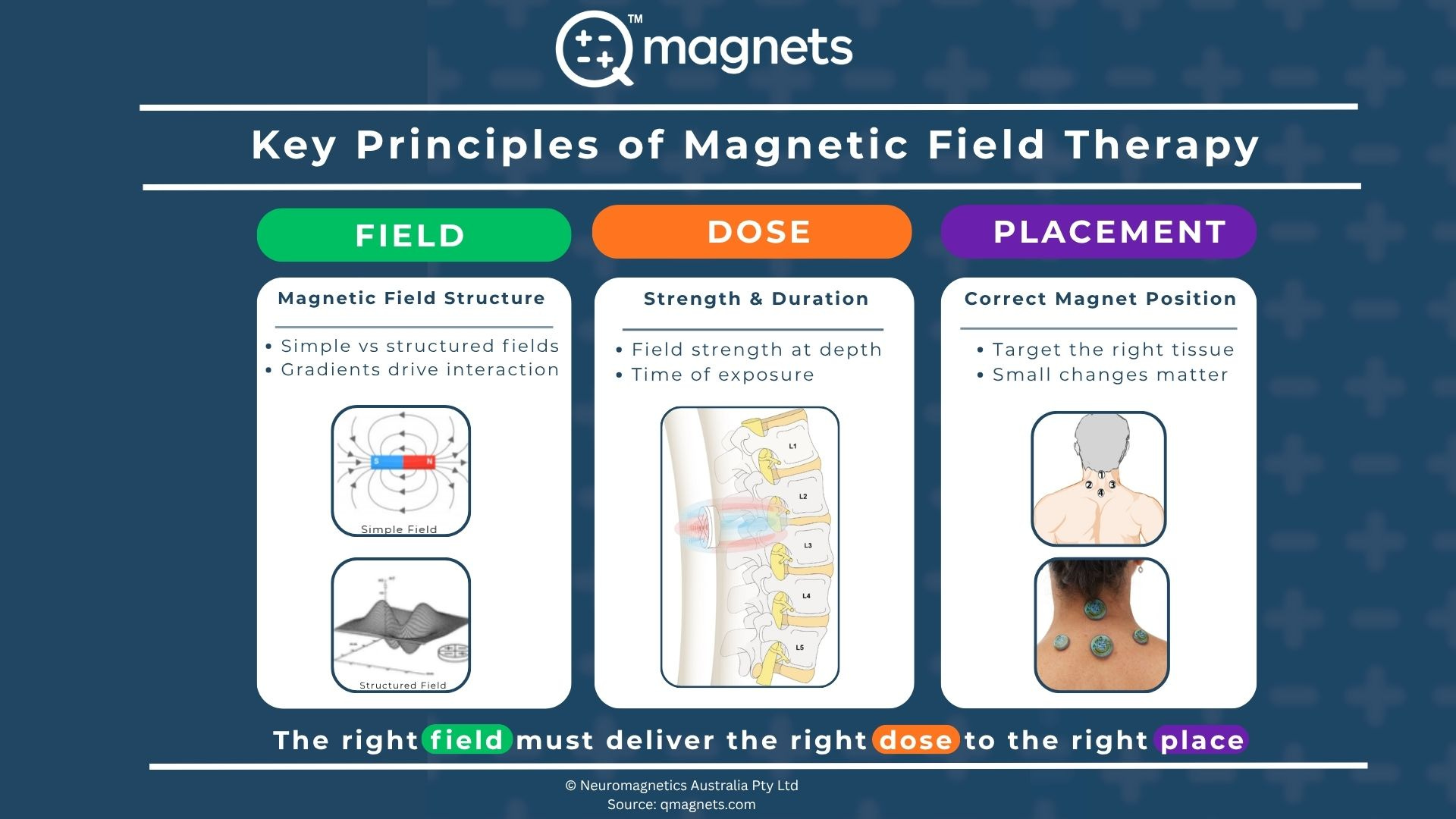
Our Field | Dose | Placement framework reflects the importance of magnetic field characteristics, exposure and accurate positioning over relevant anatomical structures.
But lately I’ve been wondering whether there might be broader questions worth investigating.
For example, what happens when someone spends several hours sleeping in a localised multipolar magnetic field environment?
Could there be measurable changes in sleep physiology or autonomic nervous system activity?
Would any response differ from that produced by a conventional magnetic configuration?
And could the surrounding environmental conditions, including ambient geomagnetic field strength, influence those responses?
I don’t have convincing answers.
However, over the years, some practitioners have considered Q Blankets through a broader wellbeing perspective.
Dr Robyn Cosford, for example, has described recommending the Q Blanket to patients for general nervous system support and has suggested that its field distribution may influence tolerance to environmental stressors.
That’s a practitioner observation and interpretation, not clinical proof of these broader benefits.
But it illustrates how some users and practitioners have been considering applications beyond localised pain relief.
And something happened this week that made this discussion especially relevant.
An unexpected visitor and a rather encouraging phone call
Earlier this week, a gentleman named Andrew came to visit us at Q Magnets.
Andrew isn’t a health professional. He’s simply someone who takes an active interest in his health and enjoys experimenting with different ways of improving his wellbeing.
He had been following the work of Jack Kruse and researching magnetism, light, water and the physical environment.
During that research, he came across our website.
When he discovered that Q Magnets was located not far from where he lived, he decided to drop in.
We had an enjoyable conversation about magnetism, biophysics and some of the ideas circulating within this growing community.
Andrew subsequently purchased a Q Blanket and a Pillow Topper, and I gave him a set of individual Q Magnets to experiment with as well.
Today, we spoke on the phone, and he shared something I hadn’t expected.
Back in 2020, Andrew had experienced an ear infection. Although most of the infection had cleared up, he continued to experience discomfort whenever he tried to sleep on his left side.
For approximately five years, that had prevented him from sleeping comfortably in that position.
After beginning to use his Q Blanket and Pillow Topper, however, he noticed a change.
For two consecutive nights, Andrew slept through the night and was even able to spend time sleeping on his left side something he hadn’t been able to do comfortably for years.
Naturally, he was delighted.
Now, two nights is a very short observation period.
We can’t establish whether the magnetic products caused the improvement, whether the experience will continue or whether other factors contributed.
But what we do know is that at no time, within the past five years has Andrew been able to sleep on his left side without pain and discomfort. Then suddenly after using the Q Blanket and Pillow Topper, he can!
Andrew was happy for me to share his story, and I found it encouraging.
What struck me most was how he first discovered Q Magnets.
He wasn’t initially searching for a treatment for his longstanding ear-related discomfort.
He was exploring magnetism as part of a broader interest in optimising his health.
Yet one of the first things he noticed was something very practical: greater sleeping comfort and the ability to rest in a position he had avoided for years.
Sometimes people come to Q Magnets with one set of expectations and notice something quite different.
And sometimes those personal observations raise questions worth exploring further.
Not as proof of a theory, but as a reason to keep investigating.
An open mind still needs a critical mind
Following this particular rabbit hole has reminded me of something important.
There’s a difference between dismissing an unfamiliar idea because it sounds unconventional and accepting it because it offers an appealing explanation.
Both can prevent us from learning.
I’m interested in what Nakagawa was trying to understand in 1976.
I’m interested in the Earth’s changing magnetic field and its complex multipolar structure.
I’m interested in Mae-Wan Ho’s thinking about biological coherence and electromagnetic sensitivity.
I’m interested in the laboratory experiments suggesting that certain structured static magnetic fields can influence neuronal activity.
And I’m interested in why people such as Jack Kruse and Nathan Siles are encouraging others to reconsider their magnetic environments.
But interest isn’t endorsement.
Some ideas are supported by established physics. Others have experimental biological evidence. Some are hypotheses awaiting proper tests, and others may ultimately prove incorrect.
For me, the most promising direction isn’t to assume that Q Magnets compensate for a weakening geomagnetic field.
It’s to investigate whether engineered multipolar static magnetic fields produce measurable biological responses beyond the applications we’ve traditionally studied.
That question can be approached through physics, physiology and properly controlled experiments.
And it’s one I intend to keep exploring.
Have you experimented with Q Magnets for general wellbeing?
Andrew’s experience has made me particularly interested in hearing from other readers who have explored Q Magnets beyond their usual application for pain relief.
Perhaps you’ve incorporated a Q Blanket or Pillow Topper into your sleep routine.
Perhaps you’ve experimented with Q Magnets for recovery, comfort or general wellbeing.
Or perhaps, like Andrew, your interest began with the broader relationship between magnetism and human physiology.
Have you noticed any unexpected changes positive, negative or no difference at all?
I’d love to hear what prompted you to experiment, what you’ve observed and what questions you think deserve further investigation.
Personal experiences aren’t scientific proof, but they can sometimes help us identify questions worth studying more carefully.
And perhaps that’s the most important lesson from this week’s rabbit hole.
There may be much more to discover about the relationship between magnetic fields and living systems.
We just need to remain curious enough to investigate and critical enough to distinguish what we know from what we hope might be true.
Until next time, stay curious and stay well,
James Hermans
and the Q Magnets Team
References and further exploration
1. Nakagawa, K. (1976). Magnetic Field Deficiency Syndrome and Magnetic Treatment. Japan Medical Journal, No. 2745.
2. Ho, M.-W. (2012). The Rainbow and the Worm: The Physics of Organisms, 3rd edition. World Scientific. Chapter 13.
3. McLean, M.J., Holcomb, R.R., Wamil, A.W., Pickett, J.D. & Cavopol, A.V. (1995). Blockade of sensory neuron action potentials by a static magnetic field in the 10 mT range. Bioelectromagnetics, 16(1), 20–32.
4. Cavopol, A.V., Wamil, A.W., Holcomb, R.R. & McLean, M.J. (1995). Measurement and analysis of static magnetic fields that block action potentials in cultured neurons. Bioelectromagnetics, 16(3), 197–206.
5. Roth, B.J. (2023). Biomagnetism: The First Sixty Years. Sensors, 23(9), 4218.
6. Pock, A.R., Niemtzow, R.C., Niemtzow, S.Z. & Koda, E.K. (2023). Acupuncture and Static Multipolar Magnets: An Emerging Attraction?. Medical Acupuncture, 35(3), 127–134.
7. NASA. Earth’s Magnetosphere: Protecting Our Planet from Harmful Space Energy.
8. Dr Jack Kruse — Light, Water and Magnetism. Interview with John Kemp.
9. Nathan Siles — EZ Water, Magnetism and Melanin. Fitness Wisdom Podcast, October 2026.
Weekly Reframe
Curiosity Killed the Cat. But It Might Just Advance the Science.
Featured Article
Aurora Australis and the Earth’s Magnetic Field
Field, Dose and Placement in Magnetic Field Therapy
Magnetic Therapy