Greetings from Q Magnets,
Last week’s MagnaBlog featured Beverley, a customer who has been using Q Magnets for over 16 years and enthusiastically sharing them with family and friends.
It prompted an interesting response from one reader:
“If they are using them for 16 years isn’t it obvious they are not healing. They should only need to use them for a few days.”
It’s a reasonable question, and one worth exploring.
Because it highlights an important distinction between pain relief, healing and why someone might continue using a product long after they first purchased it.
Another customer question I received recently provides a useful opportunity to take that discussion a little further.
Pain relief isn’t necessarily the same as healing
When we injure a muscle, ligament or other soft tissue, healing may take days, weeks or considerably longer, depending on the injury.
Pain often diminishes as recovery progresses, although a reduction in pain doesn’t necessarily mean the underlying tissue has completely healed.
Similarly, an improvement in symptoms while using Q Magnets doesn’t by itself demonstrate that the magnets have accelerated tissue repair.
And not every episode of pain comes from a new injury.
Some people experience recurring discomfort or stiffness. Others live with persistent pain, which can involve changes in how the nervous system processes and responds to pain signals.
Our bodies also change over time. We experience different physical demands, new injuries and sometimes new health conditions.
So, when someone tells me they’ve been using Q Magnets for 16 years, that doesn’t necessarily mean they’ve been treating the same injury continuously.
They may have experienced relief from one problem years ago and simply continued keeping their magnets available for other occasions when discomfort arises.
After all, a reusable device doesn’t become redundant simply because it has been owned for many years.
Of course, individual responses vary, and not everyone finds Q Magnets helpful. It’s important to distinguish a customer’s reported experience from evidence of a treatment’s effectiveness.
Which brings me to another interesting question.
Individual Q Magnets or a Q Blanket — which is better?
Recently, a customer contacted me after receiving her Q Magnets.
She wrote:
“The magnets arrived and they work very well for me. The stiffness of my neck and back are relieved quickly.”
She then asked a very practical question.
Would buying a Q Blanket save her time before going to sleep, rather than having to position her individual magnets each evening?
I thought it was an excellent question because, although both products use Q Magnets, they offer quite different ways of applying magnetic fields.
And understanding that distinction can help people decide which product best suits their needs.
Individual Q Magnets: precision and targeted placement
One of the distinguishing characteristics of Q Magnets is their multipolar magnetic field configuration.
Rather than using a simple bipolar arrangement, Q Magnets incorporate alternating magnetic poles to produce localised magnetic field gradients.
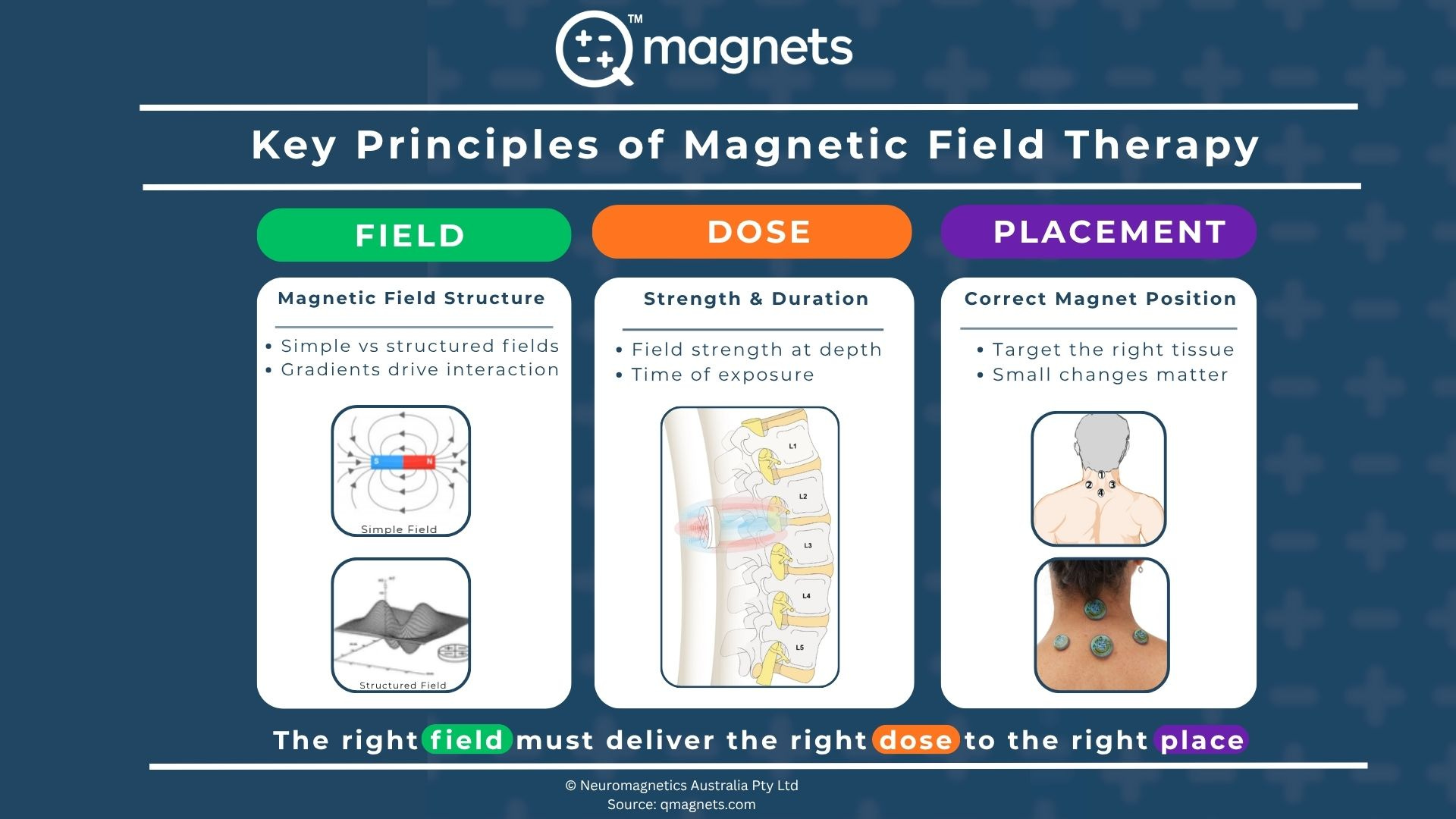
When discussing how to apply individual Q Magnets, we use a framework called Field | Dose | Placement.
Field refers to the magnetic field configuration and its spatial gradients.
Dose considers factors such as magnet size, strength, distance from the intended tissue and duration of exposure.
Placement concerns positioning the magnet over the intended anatomical region.
The practical advantage of individual Q Magnets is flexibility.
If someone wants to apply a magnet to a particular area, such as the neck, shoulder, knee or lower back, they can select an appropriate magnet and position it individually.
Placement can also be adjusted when the location of discomfort changes.
However, there’s a practical disadvantage.
For someone applying several magnets every evening, choosing locations and securing each magnet can take time.
And this was exactly the issue our customer was trying to solve.
Q Blankets: broader coverage with less preparation
A Q Blanket approaches magnetic field exposure differently.
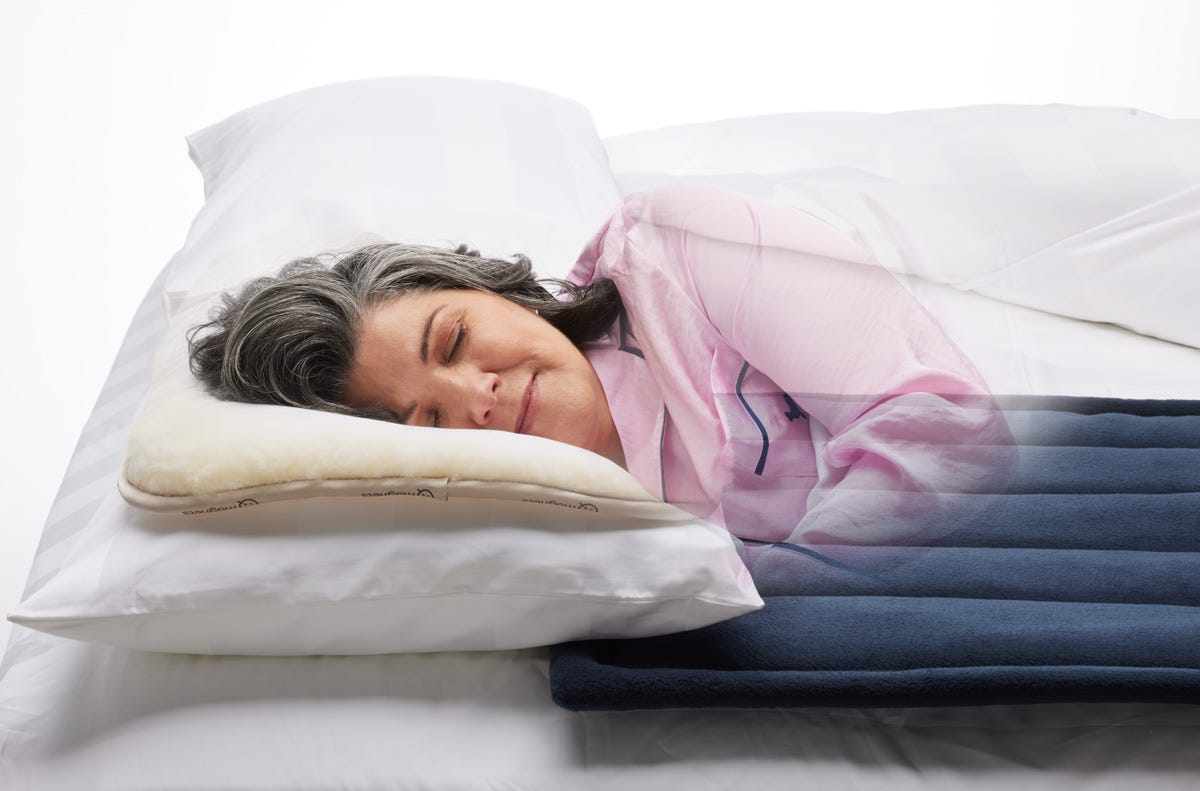
Rather than requiring someone to position individual magnets each time, Q Blankets contain multiple Q Magnets arranged in a matrix within a comfortable polar-fleece blanket.
Depending on the model and the manufacturer’s instructions, the blanket can be placed on a mattress or draped over the body while resting.
This creates a broader distribution of magnetic fields across the areas covered by the blanket.
And for someone who regularly uses several individual magnets, that may offer an appealing level of convenience.
There are several different Q Blanket sizes.
The Q13 is intended for smaller areas of the body, while the Q28 and Q35 offer larger coverage. The Q20 is designed primarily for use on a practitioner’s treatment couch.

The most appropriate model depends on how and where someone intends to use it.
But there’s an important trade-off.
A blanket cannot position every magnet over a specific painful location or anatomical point with the same precision as a carefully applied individual Q Magnet.
And although a customer may respond positively to individual magnets, that doesn’t guarantee they will experience the same result from a Q Blanket.
Individual Q Magnets offer precision. Q Blankets offer broader coverage and convenience. Neither approach guarantees the same response for everyone.
My suggestion was that the two approaches could be complementary.
Individual Q Magnets remain available when targeted placement is preferred, while the Q Blanket offers an alternative for those who value ease of application while resting.
It’s also important to follow the manufacturer’s instructions and precautions, particularly regarding pacemakers, magnetically programmable medical devices and pregnancy.
What does the research say about magnetic mattress pads?
There is some interesting research involving magnetic mattress pads, although the overall evidence remains limited.
A small randomised, double-blind pilot study published by Colbert and colleagues in 1999 investigated magnetic mattress pads in people with fibromyalgia.
Twenty-five participants completed the study, and the researchers reported improvements in several measures, including pain and sleep.
You can read the original Colbert study here.
Those findings were encouraging, but they need to be understood alongside other research.
A larger randomised trial published in 2001 investigated different static magnetic mattress pads over six months. Although some outcomes improved, most comparisons did not show statistically significant advantages over the control groups.
Read the 2001 clinical trial here.
Importantly, these studies investigated particular magnetic mattress pad designs, not Q Blankets themselves.
Different field configurations, magnet arrangements and exposure conditions make direct comparisons difficult.
So, while magnetic mattress pads remain an interesting area of research, we should not assume that broader magnetic field exposure necessarily results in better pain relief, improved sleep or faster healing.
For readers who would like to explore the subject further, we’ve previously discussed this research in our article:
Magnetic Mattress Pads and Chronic Pain — What Does the Research Say?
The science is worth following, but the practical difference between individual magnets and blankets is already clear from their design.
One allows targeted placement. The other makes broader coverage more convenient.
Black Friday is approaching — including Q Blankets
And the timing of this customer question couldn’t be better.
Our annual Q Magnets Black Friday promotion is approaching, with Black Friday falling on Friday, 27 November 2026.
This year’s promotion will include Q Blankets, alongside other Q Magnets products.
If you’ve been thinking about purchasing a Q Magnets Set, or even one of the Q Blankets, this may be a useful opportunity to explore the available options.
Whether you’re choosing something for yourself or considering a gift for a family member, I’d encourage you to think first about how the product will actually be used.
Do you prefer being able to position individual magnets precisely?
Or would the convenience and broader coverage of a Q Blanket better suit your routine?
We’ll share the Black Friday offers and purchasing details shortly, so keep an eye on your inbox.
Explore Q Blankets and the Q Magnets range
A final thought
The question that started this week’s discussion was whether someone should still need Q Magnets after 16 years.
But perhaps that’s not quite the right way to look at it.
Pain relief and healing are not the same thing. And having a reusable option available for occasional discomfort doesn’t necessarily mean someone has been treating one problem for years.
Our needs change as we move through life.
Sometimes we want targeted application to a particular area.
Other times, convenience becomes a greater priority.
What matters is understanding what a product is designed to do, recognising the limitations of the evidence and deciding whether it offers something useful for our individual circumstances.
And whether your experience has been positive, mixed or disappointing, we welcome your honest feedback.
You can share your experience through our Q Magnets Feedback Program.
The real question isn’t how many years someone has owned their Q Magnets.
It’s whether they continue to find them useful when they need them.
Until next week, stay curious and stay well.
James Hermans
Q Magnets
P.S. Our annual Black Friday promotion is approaching, including offers on Q Blankets. Keep an eye on your inbox for details, or explore the Q Magnets range here.
Weekly Reframe
“There’s a right tool for every job.” Individual Q Magnets offer targeted application, while Q Blankets provide broader coverage and convenience. And using Q Magnets for 16 years doesn’t mean treating the same pain for 16 years. Sometimes it’s simply about having the right tool when you need it.
Featured Article
Magnets vs Red Light, Infrared and TENS What Is Actually Different From a Physics Perspective?

Field, Dose and Placement in Magnetic Field Therapy
Magnetic Therapy