

Greetings from Q Magnets!
A number of years ago, I received an email from a Canadian plastic surgeon who was also a passionate marathon runner.
His name was Mark Thibert, and he had a problem.
During training, he had suffered a tibial stress fracture. With an upcoming marathon on his calendar, he was understandably concerned that his running plans might be over.
A medical colleague suggested he investigate magnetic therapy.
Mark found Q Magnets, ordered some and subsequently wrote to tell me about his experience.
He reported a substantial reduction in discomfort after applying the magnets. He also rested during his recovery and eventually returned to marathon participation.
You can read his original story here.
Naturally, I was delighted to hear that he was doing well.
But the story also raises an interesting scientific question.
Were the magnets influencing his pain, the underlying healing process, or perhaps something else entirely?
Those are three very different possibilities.
And interestingly, researchers in Italy had been investigating a related question using quadrupolar permanent magnets.
In 2007, Costantino and colleagues published a paper in Acta Biomedica examining the use of permanent magnets in patients with hand and wrist fractures.
What caught my attention was the type of magnet they used.
These were not conventional PEMF machines, which generate time-varying electromagnetic fields using electrically powered coils.
The researchers used small neodymium magnets arranged in a quadrupolar configuration, with alternating north and south poles.
They positioned the magnets inside plaster casts as part of conventional fracture management.
The paper reported approximately 40 patients with fractures involving the wrist, scaphoid, metacarpals and fingers.
The researchers then compared the immobilisation periods with conventional treatment durations described in orthopaedic literature.
Their reported finding?
Immobilisation periods were approximately 35% shorter than the historical reference periods.
That certainly sounds interesting.
But before anyone concludes that permanent magnets make broken bones heal 35% faster, there is an important qualification.
The study did not include a concurrent randomised control group. It compared patients receiving magnets with historical treatment expectations.
There was also no sham-magnet comparison, and the researchers did not establish a standardised, blinded measurement of fracture union.
So the study does not prove that the magnets caused the shorter immobilisation periods.
Nevertheless, it is an interesting preliminary clinical investigation involving quadrupolar permanent magnets, and one that I believe deserves more attention and better-controlled follow-up research.
Read the original Costantino paper.
This is where the story becomes particularly relevant to our work at Q Magnets.
Much of the research on magnetic stimulation and fracture healing involves PEMF.
PEMF devices produce magnetic fields that change with time, and certain devices have been investigated for particular bone-healing indications.
Q Magnets are different.
They are permanent magnets with engineered multipolar configurations designed to produce localised static magnetic field gradients.
They do not require batteries or electricity.
That distinction matters because research involving one magnetic exposure cannot automatically be applied to another.
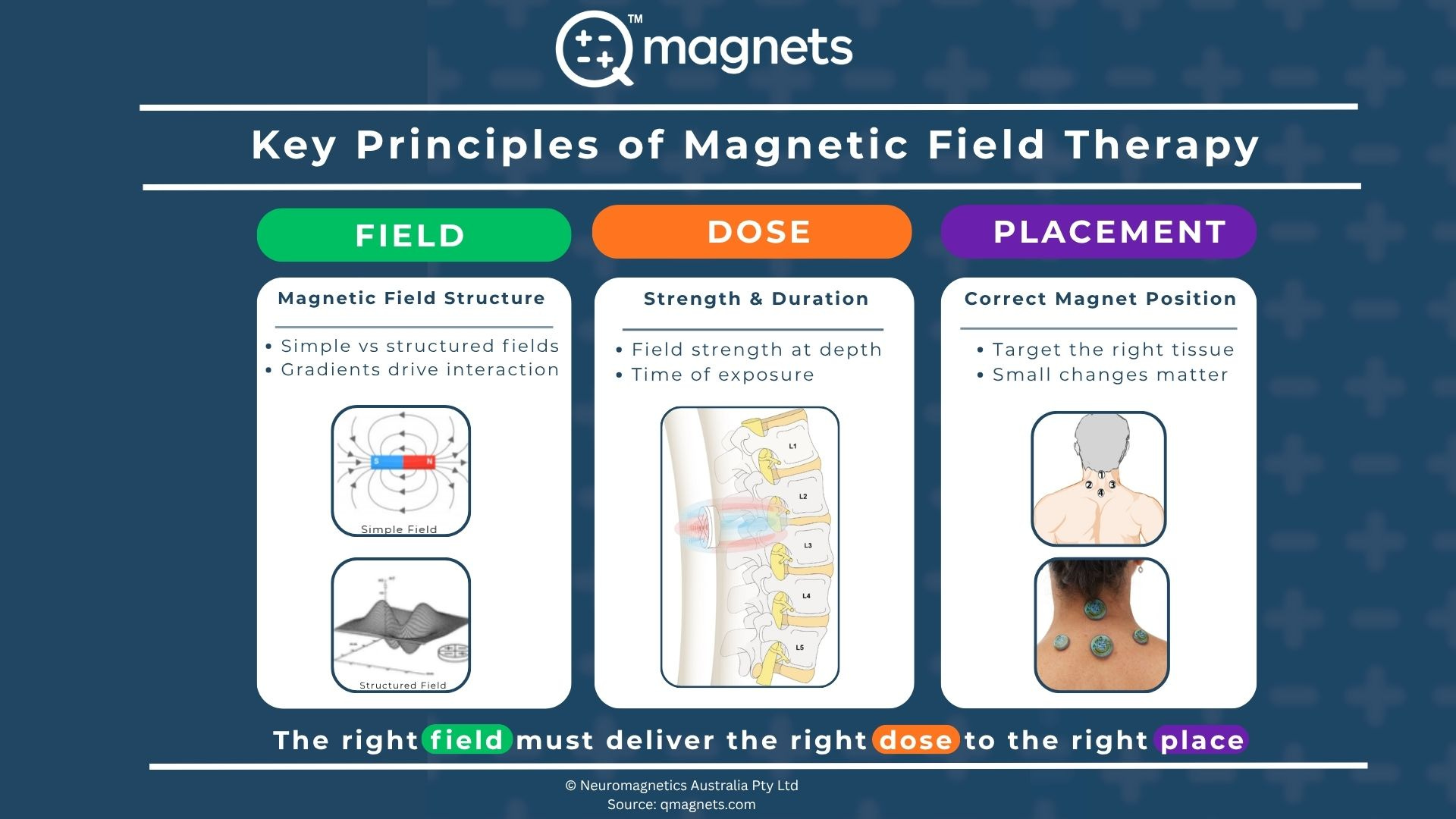
It also brings us back to our familiar Field | Dose | Placement framework.
The field configuration, the magnetic exposure experienced by the tissue, and the anatomical location all matter when trying to understand what an experiment actually tested.
Costantino’s researchers placed their magnets within plaster casts near the fractures.
That is a very different exposure arrangement from applying a magnet externally to relieve local discomfort.
And while the study is interesting from a physics and clinical-research perspective, it does not establish an effective magnetic dose for bone healing.
Over the years, we have also received feedback from customers who used Q Magnets during recovery from fractures.
Mark’s marathon story is one example.
Another came from Wilma Beltrame, who described using Q Magnets during rehabilitation following a tibial plateau fracture.
We also received a practitioner account from Megan McMahon involving a patient with a broken toe.
The patient’s reported pain score fell from approximately 5/10 to 1/10 over seven days, and the patient returned to work.
Then there were two accounts involving broken ribs.
Sharlene described finding greater comfort after a fall that resulted in four fractured ribs.
And George Graham reported a substantial reduction in discomfort, improved sleep and a return to work after sustaining two broken ribs.
These are five different experiences, involving different injuries and circumstances.
What interests me is that several of the stories have something in common.
The customers were describing changes in pain, comfort, sleep or their ability to resume everyday activities.
Those are meaningful experiences.
But none of these accounts establishes that Q Magnets accelerated bone healing.
That distinction matters.
Imagine someone with a fractured rib.
Breathing deeply, coughing, turning over in bed and getting out of a chair can all be uncomfortable.
If that person experiences less pain, they may sleep better and find ordinary activities easier.
That is a meaningful improvement in comfort.
But it does not tell us whether the fractured rib has united any faster.
The same principle applies to a runner with a tibial stress fracture.
A reduction in discomfort may be welcome, but it must never be mistaken for evidence that the bone is ready to tolerate running again.
Bone repair is a biological process involving inflammation, callus formation, mineralisation and remodelling.
Pain, meanwhile, is produced by the nervous system in response to a much broader range of influences.
The two processes are related, but they are not interchangeable.
A person can feel better before the underlying injury has fully healed.
This is why appropriate medical assessment, immobilisation where required, rehabilitation and professional guidance remain essential.
The scientifically responsible answer is that we do not yet know whether the kinds of permanent static magnetic fields investigated by Costantino can reliably accelerate fracture healing in humans.
There are interesting laboratory investigations into electromagnetic fields and bone-cell behaviour.
There is also a much larger research literature involving PEMF.
But these different technologies and their outcomes must not be combined as though they represent one uniform treatment.
And the preliminary Costantino study, while noteworthy, needs replication using stronger clinical methods.
Q Magnets themselves are intended for temporary, localised relief of minor aches and pains, not for treating fractures or accelerating bone union.
That doesn’t make the broader research question any less interesting.
Quite the opposite.
I think it makes the question more worthwhile, because it encourages us to distinguish what people experience from what we can objectively demonstrate.
We’ve prepared a more comprehensive educational article examining the Costantino study, how fractures normally heal, the difference between static magnets and PEMF, and what our customer experiences can—and cannot—tell us.
Can Static Magnetic Fields Influence Fracture Healing? What the Research Shows
For anyone interested in magnetic field research, I think this is a fascinating subject.
Not because we can claim to have all the answers.
But because an interesting clinical observation, some memorable personal experiences and a better understanding of magnetic field physics leave us with a question worth investigating.
And sometimes, that’s where the most worthwhile science begins.
Until next time, stay curious and stay well,
James Hermans
and the Q Magnets Team
Weekly Reframe
Static magnets may influence tissue repair, but faster fracture healing requires further investigation.
Featured Article
Magnets vs Red Light, Infrared and TENS What Is Actually Different From a Physics Perspective?

Field, Dose and Placement in Magnetic Field Therapy
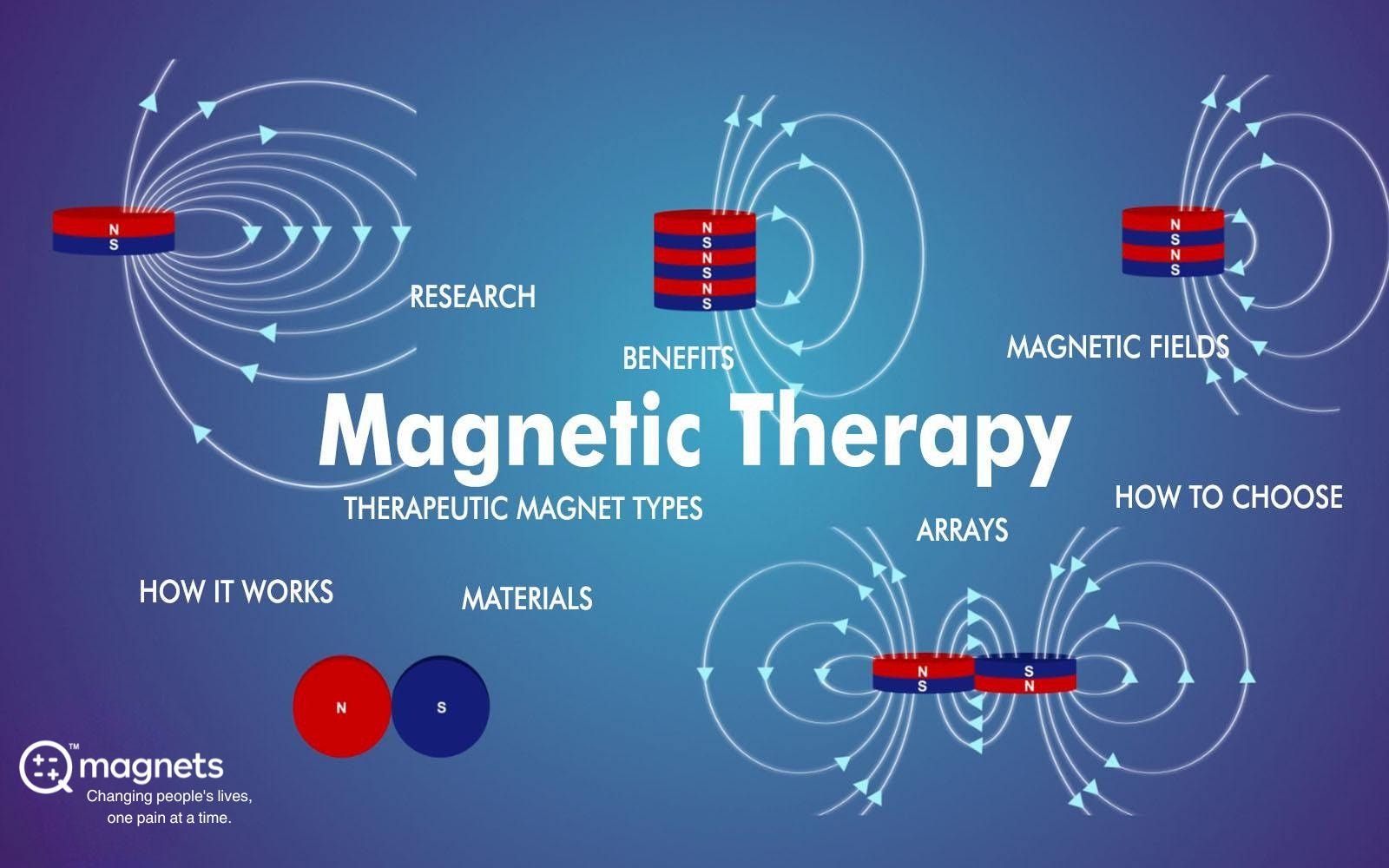
Magnetic Therapy
I have been routinely using RQ magnets over plaster/splints in fractures since I first had access to them many years ago, in conjunction with specific nutrients and homeopathics. Uniformly, the patients report rapid pain releif and shorter healing times. An absolute go to for my practice.